To price snow removal, cost one push in a light, an average and a heavy winter, then choose per-push, seasonal or capped seasonal pricing by deciding who carries the weather risk. Here is why that matters, and how to do it.
Say a homeowner signs up for snow removal at $45 a push. In their head, $45 is the price of a driveway cleared, and it is the same $45 in every storm. For you, that $45 is a different amount of profit in every winter, because most of what a snow side costs you is spent before the first flake falls.
That is the whole problem with pricing snow removal: the plow, the insurance and the season’s upkeep are fixed, but the number of pushes they get spread across is set by the weather. Get that division wrong and a contract that looked profitable in October loses money by February, or, just as often, a light winter leaves a per-push route with far less income against the same full year of costs.
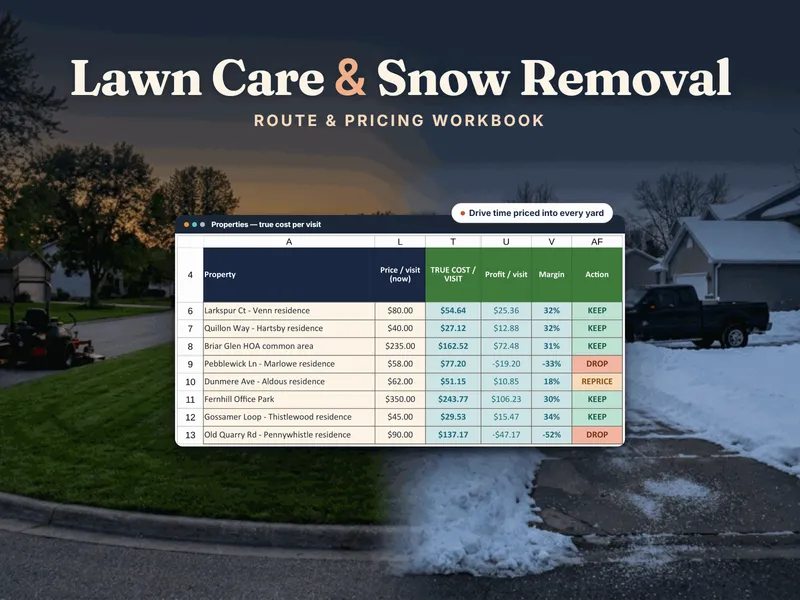
The Lawn-Care & Snow-Removal Seasonal Route & Pricing Workbook does this division for every snow account at once, in a light, an average and a heavy winter. But the method matters more than the tool, so here is the whole thing worked through by hand.
What a snow push actually costs you
A push is one plowing visit to one account, and its true cost has two parts: the variable cost of the minutes you spend on it, and a share of the fixed costs of being in the snow business at all. Most operators only price the first part.
The variable part is the easy one. It is your labor and the truck’s running cost for the time the push takes, including the drive from the account before it. A 10-minute driveway with an 8-minute drive is an 18-minute push. If you price lawn visits this way already, it is the same method as pricing a lawn mowing job by its cost per visit. Snow just has a second layer on top.
The fixed part is everything the snow side costs you whether or not it snows:
- The plow’s depreciation. A blade that cost $7,200 and lasts six seasons costs $1,200 a season standing in the yard.
- Plow upkeep. Cutting edges, hydraulic hoses, lights and the pre-season service.
- Snow-only insurance. Any coverage or policy endorsement you carry only because you plow.
- The cost of selling the route. Door hangers, ads, the phone line that rings at 4 a.m.
| Cost | Amount | Type |
|---|---|---|
| Plow depreciation | $1,200 per season | Fixed |
| Plow upkeep | $400 per season | Fixed |
| Snow-only insurance | $600 per season | Fixed |
| Marketing and phone | $200 per season | Fixed |
| Total fixed snow costs | $2,400 per season | Fixed |
| Labor | $28 per hour | Variable |
| Truck running cost, blade down | $22 per hour | Variable |
| Time per push, drive included | 20 minutes | Variable |
On those numbers, the variable cost of one push is $50 an hour times a third of an hour: $16.67. A truck’s cost per mile is a useful reference point for the running-cost line. The IRS business standard mileage rate is 72.5 cents a mile for the first half of 2026 and 76 cents from July 1 (opens in new tab). But a plow truck spends a storm crawling and reversing, not cruising, so cost it per hour.
The fixed $2,400 still has to be recovered, and that is where the weather comes in.
Why the cost of a push depends on the winter
The fixed cost per push is the season’s fixed costs divided by every push the route does that winter, so the fewer storms there are, the more each push costs you. Same plow, same insurance, same driveway. A different winter means a different cost.
Take the 25-account route above and three winters: a light one with 6 pushes per account, an average one with 12, and a heavy one with 20.
| Winter | Pushes per account | Total pushes | Fixed cost per push | Variable cost per push | True cost per push |
|---|---|---|---|---|---|
| Light | 6 | 150 | $16.00 | $16.67 | $32.67 |
| Average | 12 | 300 | $8.00 | $16.67 | $24.67 |
| Heavy | 20 | 500 | $4.80 | $16.67 | $21.47 |
A $45 push has a $12.33 margin in a light winter and a $23.53 margin in a heavy one. Nothing about the driveway changed. The fixed costs are the same $2,400 either way, and the per-push customer only pays toward them when it snows.
That is the trap of per-push pricing with no floor: in a light winter you carry the whole cost of being ready and earn the least on every push. Seasonal pricing moves that risk the other way, and that is the real choice between the pricing models.
The five ways to price snow removal
Every snow pricing model is an answer to one question: who carries the weather risk, you or the customer? There are five common structures, and they differ almost entirely on that.
| Model | How it bills | Light winter hurts | Heavy winter hurts | Best for |
|---|---|---|---|---|
| Per push | A fixed price each time you plow above the trigger depth | You | The customer | Customers who want to pay only when it snows |
| Per push by depth band | A per-push price that steps up for deeper snow | You | The customer, more fairly | Areas with big storms as well as small ones |
| Seasonal | One price for the whole winter, paid up front or monthly | The customer | You | Steady income and simple billing |
| Seasonal with a cap | One price covering up to a set number of pushes, per push after that | The customer | Shared | Residential routes wanting steady income with a limit on heavy winters |
| Per hour | Time on site, billed by the hour | You | The customer | Commercial lots with unpredictable scope |
Two terms in that table do a lot of work:
- Trigger depth is the snowfall at which a contract says you will come out, usually written in inches. Below it, there is no visit and no charge on a per-push contract. It sets how many pushes a winter produces, so a 1-inch trigger and a 3-inch trigger are not the same contract at the same price.
- A cap is the number of pushes a seasonal price covers. Past it, the customer pays per push. It is the single clause that stops a heavy winter from turning a seasonal contract into a loss.
For most small residential routes, the better fit is seasonal with a cap, or per push with a minimum (a small seasonal retainer that covers your fixed costs, plus a per-push price that covers the variable ones), which is a variant of per push. Both are ways of splitting the weather risk instead of handing all of it to one side.
Per push vs seasonal: the break-even push count
The break-even push count is the number of pushes at which a seasonal price and a per-push price earn exactly the same, and it is found by dividing the seasonal price by the per-push price. Below that count, seasonal pays you more. Above it, per push pays you more.
Say the route offers $45 a push or, as an illustrative seasonal price, $480 for the season. The break-even is $480 ÷ $45 = 10.7 pushes. Run both prices through the three winters, for one account carrying its $96 share of the fixed costs ($2,400 ÷ 25):
| Winter | Pushes | Per-push revenue | Seasonal revenue | Cost (fixed share + pushes) | Per-push profit | Seasonal profit |
|---|---|---|---|---|---|---|
| Light | 6 | $270 | $480 | $196 | $74 | $284 |
| Average | 12 | $540 | $480 | $296 | $244 | $184 |
| Heavy | 20 | $900 | $480 | $429 | $471 | $51 |
Neither price is “better”. Seasonal earns more in a light winter, per push earns more in an average or heavy one, and the gap between them swings from $210 one way to $420 the other.
There is a second number that matters more: the push count where the seasonal price stops covering your cost. That is the seasonal price minus the account’s fixed share, divided by the variable cost of a push: ($480 − $96) ÷ $16.67 = 23 pushes. A winter with more than 23 pushes makes that seasonal account lose money outright. Your cap belongs comfortably below it. In this example, a cap at 15 pushes and $45 a push after that keeps the heaviest winter profitable.
If your area’s typical winter sits well below the break-even count, an uncapped seasonal price is mostly upside for you and a poor deal for the customer, and a customer comparing prices may notice. If it sits well above, an uncapped seasonal price earns less than per push would, and any winter past the count where it stops covering cost loses money outright.
How to price snow removal for your own route
To price snow removal, cost one push in a light, an average and a heavy winter for your area, set both prices against those costs, then test them before you sign anything. In order:
- Add up the season’s fixed snow costs: the plow’s yearly depreciation, its upkeep, any insurance you carry only for snow, and the marketing and phone costs of the snow side.
- Put a cost on one hour of plowing: your labor, burdened with payroll tax and workers’ comp if you have them, plus what the truck costs to run per hour with the blade down. If you have never built a burdened hourly rate, what an hour of a service call actually costs you walks through the layers.
- Time a push for each account, including the drive from the account before it in the order you actually run the route. Tight routes are where snow money is made. The idea is the same one behind route density for mowing, and it matters more in a storm, when every account wants clearing before the same 7 a.m.
- Count the pushes in a light, an average and a heavy winter for your area at your trigger depth. Do not guess this from memory of last year. NOAA’s free NOWData climate tool (opens in new tab) has past winters’ snowfall for weather stations near you. For each of the last ten winters, count the days whose snowfall reached your trigger depth, treating each as roughly one push, then pick a low, a middle and a high winter.
- Cost a push in each winter: the variable cost of the push plus the fixed costs divided by every push the whole route will do that winter (accounts times pushes per account).
- Set the per-push price and the seasonal price: the per-push price above the true cost of a push in a light winter, and the seasonal price no higher than the per-push price times your average-winter push count. Then find the break-even push count and the count where the seasonal price stops covering cost.
- Cap the seasonal contract between the break-even count and the count where it stops covering cost, and write the terms down: the trigger depth, the cap, the rate for pushes past the cap, and what salt costs.
Steps 5 and 6 are where a pencil gets tedious: they have to be redone for every account, and redone again every time a price or a winter changes. That is the job the Lawn & Snow Job Pricing Calculator does for a single account, free. The full workbook does it for every account on the route at once, and flags any signed seasonal contract that loses money in an average or heavy winter.
Pricing heavy snow, salt and the extras
Anything that changes how long a push takes, or what it uses up, should change the price. These are the usual places a flat per-push price quietly leaks money.
- Deep snow. A push through 10 inches takes longer and is harder on the truck than a push through 3. On per-push contracts, price by depth band, with a step up for each band rather than a separate charge per inch. For example, the base price up to 6 inches, plus half again for 6 to 12, and per hour above that.
- Salt and ice melt. Price it per application, separately from the push: the bags or pounds of material at what you paid for them, plus the minutes it takes to spread, plus a margin.
- Return trips. A storm that drops snow for 18 hours may need a second push before it ends. Say in the contract whether that counts as one event or two.
- Hand work. Walkways, steps and the mailbox apron are shovel or blower time, not truck time. Price them as their own line.
- Windrows and end-of-driveway plow-ins. If you clear the berm the city plow leaves, that is another visit, and the contract should say so.
The general rule: the per-push price covers one clearing of the agreed area at the agreed depth. Everything else is a line item.
Common questions about pricing snow removal
Should I charge per push or per season for snow removal?
Seasonal pricing protects you in a light winter and exposes you in a heavy one; per-push pricing does the reverse. Work out the push count where the two earn the same, compare it with your area’s typical winter, and cap any seasonal contract above that count but below the count where the seasonal price stops covering your cost.
What is a trigger depth in snow removal?
A trigger depth is the snowfall at which a contract says you will come out, usually written in inches. Below it, there is no visit and no charge on a per-push contract. It has to be in writing, because it decides how many pushes a winter produces.
How do I price salting or ice melt?
Price it per application, separately from the push: the bags or pounds of material at what you paid for them, plus the minutes it takes to spread, plus a margin. Never fold it into the push price, because some storms need salt and no plowing, and some need plowing and no salt.
Should I charge more for heavy snow?
Yes, on a per-push contract. A push through 10 inches takes longer and is harder on the truck than a push through 3, so price by depth band, with a step up for each band rather than a separate charge per inch.
The takeaway: price the winter, not the driveway
A snow price is not a price for a driveway. It is a price for a season of being ready, divided across however many storms the season brings. Cost the push in three winters, find the break-even count, cap the seasonal contract below the point where it loses money, and put the trigger depth in writing.
Do that once for the whole route and October’s contract signing stops being a bet. The Lawn-Care & Snow-Removal Seasonal Route & Pricing Workbook runs the per-push and seasonal price for every snow account through a light, an average and a heavy winter, alongside your mowing season, in a file you buy once and keep.