What a budget narrative is actually for
Most people write a budget narrative as prose restating the spreadsheet. That adds nothing: the reviewer can read the spreadsheet.
The narrative’s real function is to pre-answer questions. A reviewer moving through twenty applications is looking for a reason to stop, and an unexplained number is one. A narrative that shows how each figure was arrived at removes that reason line by line — and a reviewer who has no questions about your budget is a reviewer who has stopped looking.
Everything below follows from that one idea.
Step 1 — Work from the final budget, in its order
Write from the finished spreadsheet, not a draft, and keep your paragraphs in the same order as its lines. A reviewer holds the two side by side; a narrative in a different order reads as a narrative for a different budget.
Step 2 — Total and request, in the first two sentences
The total cost of the fifth afternoon for the twelve months from September is $47,200. We are requesting $35,000 from the Alderbrook Fund, which is 74 percent of the total.
Give the share. Do not make the reader compute it — they will, and they will notice you did not.
Step 3 — Show the arithmetic on every line
This is the single highest-return habit in the whole document. It costs about eight words a line.
| Weak | Strong |
|---|---|
| $4,189 for meals | 1,088 meals at $3.85 — 34 Fridays at an average of 32 young people |
| $2,380 for materials | $70 per Friday session across 34 weeks |
| $5,236 for tutors | 238 hours at $22 — two tutors for 3.5 hours on each of 34 Fridays |
Then say where the unit rate came from: a written quote, last year’s actual from your own records, or a published rate. “Our actual per-meal cost for the year ended June 30, from the kitchen log” is a sentence nobody follows up on.
Step 4 — Justify staff time in hours
Personnel is usually the largest ask and always the most queried. The fix is to break the week into what the hours do:
The post is 20 hours a week: five hours on Friday running the session, six hours across the week preparing studio projects and buying materials, four hours on family contact and enrollment, three hours entering attendance and administering the termly survey, and two hours of supervision and the Monday staff meeting.
Once hours are attached to tasks, a salary line stops being an overhead question and becomes a delivery question — which is the one you want to be answering. Place the salary against something: a compensation survey range, or the rate at which you last filled the post.
If the role is a new hire, name where and when it will be advertised, the target start date, and what you will do if you cannot fill it. Every funder has watched a grant sit unspent for five months while a small organization tried to recruit; the applicant who names the fallback in advance is the one who picks up the phone in month three rather than month nine.
Step 5 — Explain indirect costs; do not apologize for them
Never call it “overhead” and never write that it is kept to an absolute minimum — that invites the reader to cut it. Describe what the line actually pays for:
Indirect costs — 20 percent of direct costs — $7,867. This covers the share of rent, utilities, liability coverage, bookkeeping, the annual audit, and the Executive Director’s time that this project consumes and that cannot honestly be charged to a single program. In concrete terms it is the Friday share of a $19,500 lease, an $8,400 audit, and a $6,100 insurance program.
Then say where the rate comes from — a negotiated federal rate agreement, an audited allocation, or a board-approved policy — and make the basis reconcile with your financial statements. If the funder caps indirect below your rate, budget to their cap and say plainly that the remaining shared cost is met from unrestricted funds. Showing the gap is better than burying the same dollars inside program lines where nobody can see them.
Step 6 — Other sources: committed, pending, or to be raised
Use those three words, consistently, with the date each was confirmed and by whom.
$7,200 is committed from Copperline Bank’s community giving program, confirmed in writing on April 18. $5,000 is to be raised through our spring appeal, which has raised between $4,600 and $7,900 in each of the last four years; we have budgeted at $5,000 rather than at the average of $6,025.
Be careful with in-kind. Valuing volunteer hours at a national hourly rate can add several thousand dollars to a page and quietly cost you credibility with any reviewer who has seen the trick. Report the hours; value them only if the funder’s guidelines tell you to and give you the rate.
Step 7 — Say what you would do with a partial grant
Name the specific reduced version and the line you would cut first. And remember the arithmetic almost everyone gets wrong: cutting direct cost also cuts the indirect that rides on it.
If your indirect is 20 percent of direct and you need to close a $7,000 gap, you do not cut $7,000 of direct — $5,950 of direct cuts takes another $1,190 of indirect with it, which is $7,140. Getting this wrong is how an organization accepts a reduced award and then quietly under-delivers, because the budget it wrote never actually balanced.
Step 8 — Say what happens after the grant
Separate the one-time costs from the ones that recur, state the continuing annual figure as a single number, and say where it would come from with the track record behind each source.
“We anticipate diversifying our funding base to ensure long-term sustainability” is a sentence every reviewer has read several hundred times and believes none of. “The continuing annual cost is $46,450; we have $24,000 to $26,000 of it identified from sources with a track record, and about $21,000 that would have to be raised” is the only version of this answer that has ever been credible.
The checklist
- Same order as the spreadsheet, written from the final version
- Total, request, and the share, in the first two sentences
- Rate × quantity on every line, with the source of the rate
- Hours per week, broken into tasks, for every funded person
- Indirect described as the audit and the insurance it pays for, with its basis
- Every other source marked committed, pending, or to be raised, with dates
- The partial-grant version, costed, with indirect adjusted
- The continuing annual cost as one number, and the honest gap
Where to get the blocks
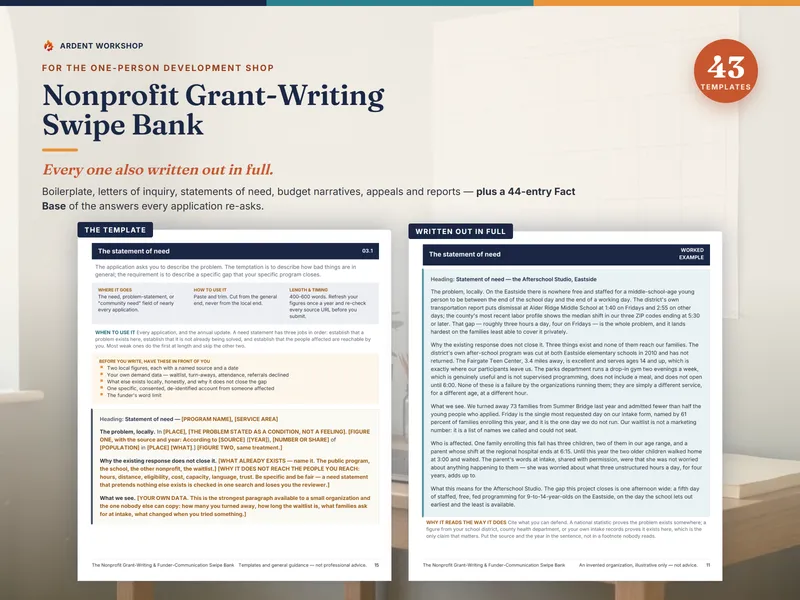
The free Organization Boilerplate Builder covers the organization-background half of an application — ungated, no email. The full Nonprofit Grant-Writing & Funder-Communication Swipe Bank carries the budget narrative itself, the personnel justification, the indirect-cost explanation, the match and in-kind statement and the sustainability answer — each as a fill-in template and written out in full for one invented nonprofit whose figures reconcile across the whole book.
See also what a statement of need is, what a letter of inquiry is, and grant templates vs hiring a grant writer.