The three jobs it has to do, in order
- Establish that the problem exists here. Not that it exists nationally — that it exists in your service area, with a figure and a source.
- Establish that it is not already being solved. Name what already exists — the public program, the school, the other nonprofit — and say plainly why it does not reach the people you reach: hours, distance, eligibility, cost, capacity, language, trust.
- Establish that the people affected are reachable by you. Your own intake data, your waitlist, the families who walk in the door.
Most weak statements of need do the first at length and skip the other two entirely. Reviewer feedback along the lines of “the need is not well established” almost always means one of exactly those two gaps — and the second one first.
Local evidence beats national evidence
A national statistic proves the problem exists somewhere. A figure from your school district, your county health department, or your own intake records proves it exists here — which is the only place the grant can be spent. Put the source and the year inside the sentence rather than in a footnote nobody reads.
If you have to choose, your own data beats everybody else's, because it is the one thing no other applicant can copy: how many you turned away, how long the waitlist is, what families ask for at intake, what changed when you tried something.
How long, and where it goes
Typically 400 to 600 words, in the field labeled “need,” “problem statement,” or “community need.” When a character limit forces a cut, cut from the general end and keep the local end — the reverse of what most people do under pressure.
Using a person's story
One short, specific account of someone affected is worth more than a paragraph of adjectives — used with written consent, and de-identified unless the person has agreed to be named. Describe what they were trying to do and what stopped them, rather than making them pitiable. Show the person the paragraph before it goes out; beyond the ethics, the writing is nearly always better when the writer knows the subject will read it.
The test it has to pass
A reviewer should be able to state the gap back in one sentence — and it should be the same sentence your program description answers. If the need statement and the program do not name the same gap, the application is scored as unfocused no matter how true both halves are.
Where statements of need go wrong
- National statistics with no local figure. The reviewer has read the national study.
- Pretending nothing else exists. It is checked in one search, and it costs you the reader.
- A need broader than the project. If the need is “childhood poverty” and the project is a Friday afternoon, the gap between them is where the application loses its score.
- No demand evidence. A waitlist, a turn-away count, or an intake pattern is the strongest evidence a small organization owns, and it is the one most often left out.
Related templates and concepts
The need statement is one of nine sections a grant year asks you to write. The free Organization Boilerplate Builder covers the organization-background blocks, ungated; the full Nonprofit Grant-Writing & Funder-Communication Swipe Bank adds the statement of need, the program description, the logic model and 40 others, each also written out in full. See also what a letter of inquiry is, how to write a budget narrative, and the templates for nonprofits hub.
Templates that implement this
A statement of need, already written
2 templates
The Swipe Bank includes a fill-in statement of need in the five movements reviewers score, and the same passage written out in full for an invented nonprofit, so you can see how much evidence is enough.
- $19.95 Mix
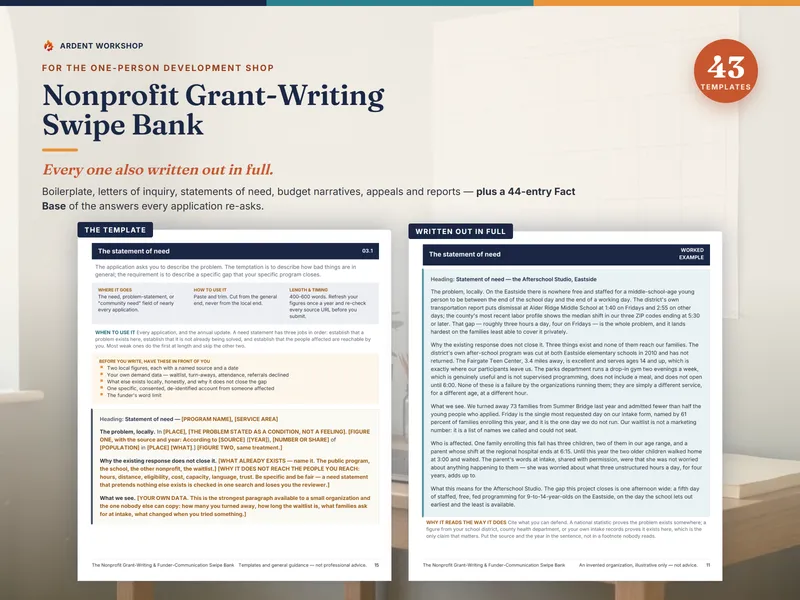
Nonprofit Grant-Writing & Funder-Communication Swipe Bank — 43 Fill-In Templates, Each Also Written Out in Full
43 nonprofit grant-writing templates — boilerplate, LOIs, statements of need, budget narratives, appeals and reports — each also written out in full.
Operator OSView details - $38.95 Spreadsheet
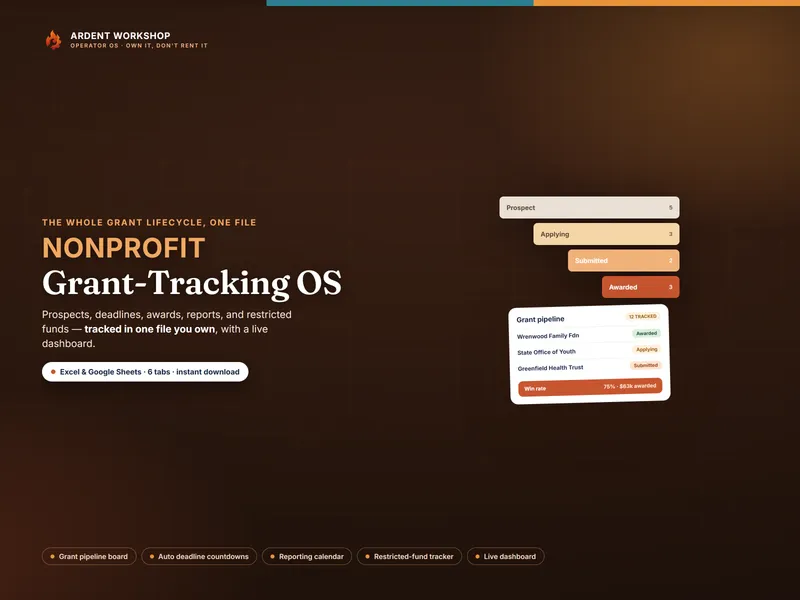
Nonprofit Grant-Tracking OS — Grant Pipeline, Deadline & Reporting Tracker for Excel & Google Sheets
A nonprofit grant tracker for Excel & Google Sheets — manage your grant pipeline, deadlines, reports, and restricted funds in one owned file.
Operator OSView details