Analysis or assessment — the same thing
"Training-needs analysis" (often written without the hyphen, "training needs analysis") and "training needs assessment" describe the same exercise; the letters TNA stand for either. Both mean: work out the gap between the skills your people need and the skills they have, then decide what training closes it. Some frameworks split it into organizational, task, and individual levels — but for most teams the practical unit is one person and one skill.
The three questions a TNA answers
- What should people be able to do? The required level for each skill the role depends on — the standard, not the ceiling.
- What can they do now? An honest, evidence-backed rating of current skill, person by person.
- What's the gap worth closing first? Not every gap is equal — the ones on critical skills, or shared across the team, are the ones training budget should protect.
The 0–4 scale
A TNA needs a rating scale everyone applies the same way. A common, generic one runs 0 to 4:
- 0 — None. No capability yet, or not assessed.
- 1 — Aware. Knows the basics but needs step-by-step guidance.
- 2 — Working. Handles the routine cases with occasional support.
- 3 — Proficient. Does the whole task independently, to standard — the target for most roles.
- 4 — Expert. Mastery: handles the hardest cases and can train others.
The gap is simply required level − current level, counted in steps. A person rated 1 on a skill the role needs at 3 has a two-step gap; someone already at or above the required level has no gap at all.
Priority = gap × weight
Ranking gaps by size alone sends your budget to whichever skill happens to have the most beginners — not the skill whose absence hurts most. The fix is to weight each gap by how critical the skill is (a common scheme: High = 3, Medium = 2, Low = 1) and rank on gap × weight. A one-step gap on a critical, high-risk skill then outranks a two-step gap on a nice-to-have. That single priority score is what turns a gap list into an order of work.
How to run a training-needs analysis
- List the skills and set required levels. Group them, mark how critical each is, and set the level the role actually needs.
- Rate the team. Score each person on each skill against evidence — an observation, a passed check, a completed record — not a gut feeling.
- Read the gaps. A skills-matrix heat map makes them obvious: a column of low scores is a team-wide gap; a row of low scores is a person who needs development.
- Rank by priority. Sort by gap × weight and the training that protects the most sits at the top.
- Build a costed plan. Turn the top gaps into actions — method, cost, owner, target date — and total the budget.
- Review on a rhythm. Re-rate after training and a closed gap drops off while a new one may surface. Quarterly suits most teams.
TNA vs a skills matrix vs an LMS
These get confused. A skills matrix is the record of who can do what — the raw data a TNA reads from. A training-needs analysis is the step that ranks and costs the gaps in that matrix — a skills gap analysis applied to training. An LMS (learning management system) is a different thing again: it delivers and tracks courses — who completed what. A TNA tells you what training to buy; an LMS reporting module tells you what training was taken. See TNA template vs LMS reporting for when you need which.
Common mistakes
- Rounding people up. Calling someone Proficient because they're nearly there hides the very gap the TNA exists to find. When in doubt, rate the lower level.
- Ranking by gap size, not weight. A big gap on a low-stakes skill can wait; a small gap on a critical one usually can't.
- Treating it as a one-off. A TNA is only true on the day it was done — the value is in re-running it as people qualify and roles change.
- Rating without evidence. A score you can't point to is a guess, and a TNA built on guesses budgets for the wrong training.
Related templates and concepts
A training-needs analysis reads best straight off a skills matrix and is a form of structured gap analysis applied to people. To try the method on one team for free, the free TNA starter is an ungated taste of the 0–4 gap heat map; the full Training-Needs Analysis Workbook ranks every gap by priority and turns it into a costed plan. See the templates for HR & team leads hub for the rest of the toolset.
Templates that implement this
Templates that run a training-needs analysis
2 templates
Rate the team on a 0–4 scale, set the required level, and the gaps rank themselves by priority — then turn the top ones into a costed training plan with a budget rollup.
- $24.95 Spreadsheet
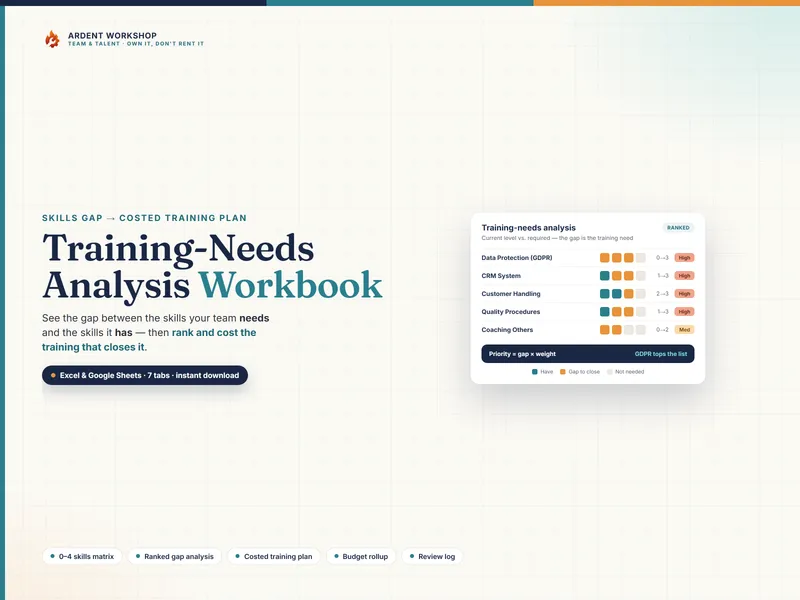
Training-Needs Analysis (TNA) Workbook — Skills Gap Analysis & Costed Training Plan (Excel + Google Sheets)
A training-needs analysis workbook for Excel & Google Sheets — rate skills 0–4, rank the gaps by priority, and turn them into a costed training plan.
Team & TalentView details - $24.95 Spreadsheet
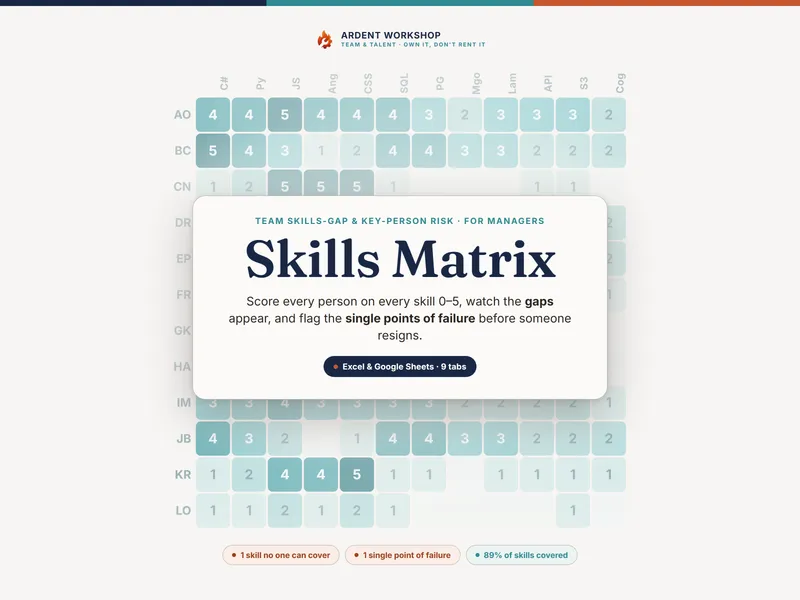
Skills Matrix Template - Team Skills Gap Analysis & Key-Person Risk (Excel & Google Sheets)
A 9-tab skills matrix for Excel & Google Sheets: score your team 0-5, find the skills gaps, and flag single points of failure before someone resigns.
Team & TalentView details