The four columns of a gap analysis
Every working gap analysis you've ever seen, no matter the industry, is a four-column table. The wording shifts but the columns don't.
- Current state. What is actually true today — measured where possible, described concretely where not.
- Future state. What "good" looks like. Specific enough that you'd know if you hit it.
- Gap. The delta between the two. Quantified if you can.
- Action(s) to close. What you'll do, who owns it, and by when.
Add columns for priority, status, and owner and you have a working document. Stop after column three and you have a complaint.
What gap analysis is actually for
Most strategy documents describe the future state in glossy terms and leave the gap as an exercise to the reader. Gap analysis makes the gap explicit — and the awkward part is that quantifying the gap usually surfaces uncomfortable truths. You said the team needs to be "more customer-obsessed." How many customer conversations did they have this quarter? You said you need "better tooling." Better than what, measured how?
Once the gap is concrete, the action is almost obvious. Most of the work of gap analysis is in the first two columns, not the fourth.
When to run one
- After a strategy review (SWOT, OKRs, annual planning) — translate the ambition into closable gaps.
- Before launching a process change, certification, or compliance push.
- During a job search or career change — current skills vs. target role.
- For onboarding into a new role — what does the role need, what do you currently bring?
- For audit prep (ISO, SOC 2, HIPAA) where the "future state" is defined by the standard.
How to run a gap analysis in an hour
- Pick the dimension of comparison. Skills, process maturity, system capability, customer experience — one analysis per dimension.
- Write the future state first. If you can't articulate it, the analysis can't proceed.
- Then write the current state — measured, not estimated, wherever data exists.
- Subtract. The gap column should be specific: "team logs 200 conversations/quarter; target is 1,000" beats "not enough conversations."
- Rank gaps by priority. Closing all of them is not a plan; closing the top three is.
- Assign each closing action an owner and a target date. Without these two, the analysis is a journal entry.
Common mistakes
- Vague current state. "We're not great at X" is not a measurement. Quantify even if approximately.
- Aspirational future state. If "future" describes the best company in the industry, the gap is too large to plan against. Set the target for the next horizon, not the final one.
- No prioritization. A list of 40 gaps with the same priority is a list of zero gaps.
- Actions without owners. The most common reason gap analyses never close their gaps.
- Single-use document. Update it quarterly. The gaps that close should disappear; new ones will surface.
Related templates and concepts
Gap analysis is the natural follow-on to a SWOT analysis — every weakness becomes a gap. Pair it with a risk register for the gaps that could derail the project, and a RACI matrix for the people who will close them. See the templates for project managers hub or the templates for job seekers hub (gap analysis is a common career-change tool).
Templates that implement this
Templates that run a gap analysis
2 templates
Current state, future state, the gap, the priority, the action, the owner — laid out in a sortable grid with automatic charts.
- $3.95 Excel
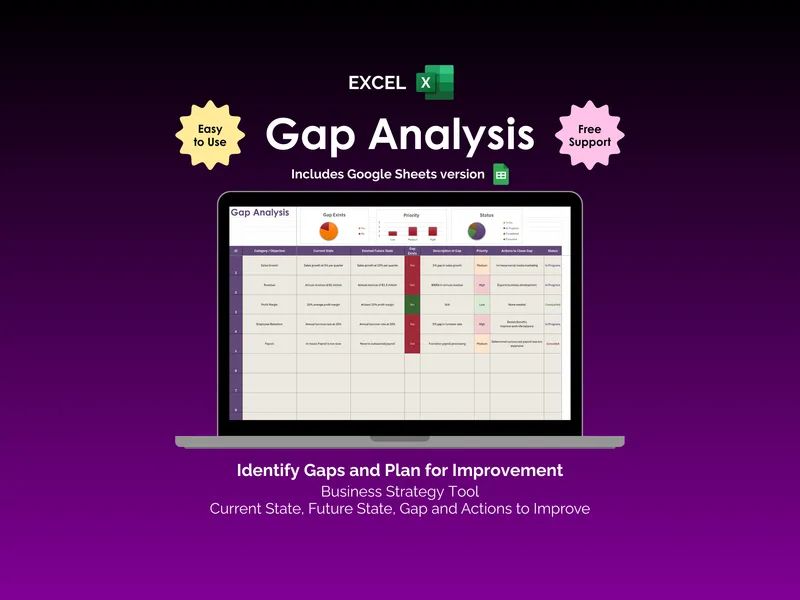
Gap Analysis - Excel
Most strategy decks describe goals. They skip the gap. This excel gap analysis template forces the conversation: current state, future state, gap, and the actions to close it.
Project ManagementView details - $3.95 Sheets
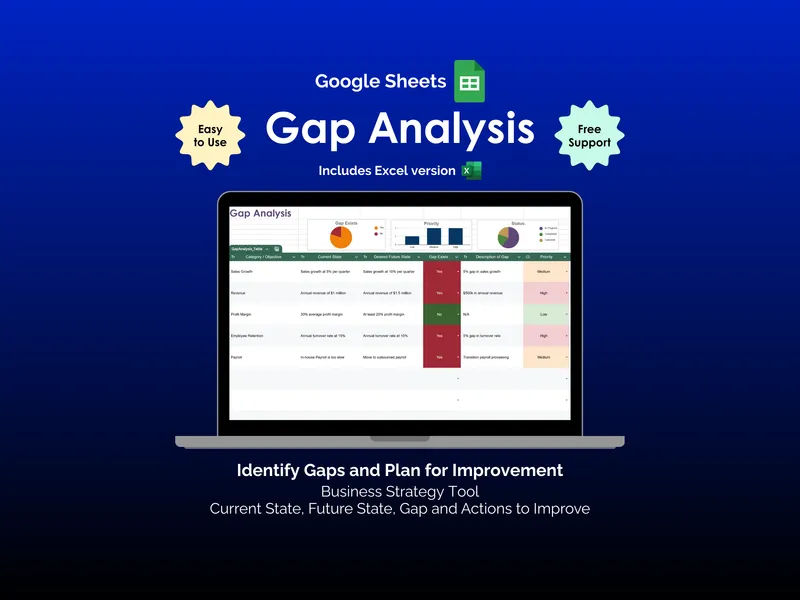
Gap Analysis - Google Sheets
Your last strategy review listed goals. Did it tell you what to fix first? This google sheets gap analysis template ranks every gap by priority and status with live charts.
Project ManagementView details