You are standing in a house you no longer live in. The furniture is gone, the echo is unfamiliar, and somewhere in your pocket is a set of keys you have to make a decision about. The job is 900 miles away, the lease on the new place starts in three weeks, and everyone you have talked to has a confident opinion about whether you should sell your house or rent it out.
They cannot all be right, because they are all answering a different question than the one in front of you.
Short answer: sell if the tax-free gain you are sitting on is large and the rent does not clearly cover the house; rent it out if the loan is cheap, the rent covers the full stack with margin, and you can be a landlord on purpose rather than by accident. Four numbers settle it — the rent shortfall, the net sale proceeds, the capital-gains clock, and depreciation recapture — and one of those four is a deadline. The rest of this post is why, worked through one household’s figures.
That household is a composite scenario — not a real household, but assembled from the version of this decision people describe over and over. (If you have not bought yet and are wondering whether to get in at all, the framework for whether you should buy a house in 2026 is the post you want instead.)
The reflexive answer: “let the tenant pay the mortgage”
The first instinct is usually to keep the house. The logic is clean and it feels like free money: someone else covers the payment, you keep the asset, the asset goes up, and in thirty years you own a house outright that you barely paid for.
The instinct is not stupid. It is just incomplete. “Rent it out” is not a way to keep the house passively — it is a decision to start a small business whose only product is a house you are emotionally attached to and no longer live near. Every number below exists because that business has costs the reflexive answer leaves out.
Here is the house our composite household — call them the Whitlocks, and remember they are illustrative — is deciding about. Every figure is invented for the example:
| The house | Figure |
|---|---|
| Current market value | $420,000 |
| Mortgage balance | $265,000 |
| Mortgage rate | 3.4% fixed |
| Principal and interest payment | $1,331 a month |
| Property tax | $4,800 a year ($400 a month) |
| Adjusted basis (purchase price plus improvements) | $305,000 |
| Comparable market rent | $2,300 a month |
Rent of $2,300 against a payment of $1,331. That looks like $969 a month of profit, and that number is the reason so many people become landlords by accident.
What a $2,300 rent check actually leaves you
The $969 gap between the $2,300 rent and the $1,331 mortgage payment is not profit. It is the number before the house is fully paid for.
A rent check has to cover more than the mortgage. It has to cover the taxes, an insurance policy that is no longer a homeowner’s policy, the person managing the property if you are not local, and three reserves that feel optional right up until the month they are not: routine maintenance, vacancy, and capital replacement. The figures below are illustrative for one specific house, not benchmarks — the reserve percentages in particular are planning assumptions you should replace with quotes and your own history.
| Where the rent goes | Per month |
|---|---|
| Mortgage principal and interest | $1,331 |
| Property tax ($4,800 a year) | $400 |
| Landlord insurance | $175 |
| Property management (9% of rent) | $207 |
| Maintenance reserve (8%) | $184 |
| Vacancy reserve (7%) | $161 |
| Capital reserve — roof, HVAC, water heater (5%) | $115 |
| Total out | $2,573 |
| Rent check in | $2,300 |
| Shortfall against the rent check | $273 short a month |
The seven cost lines split into two kinds. The first three — mortgage, property tax, and insurance — are fixed obligations that arrive whether or not a tenant does. The last four — management, maintenance, vacancy, and capital reserve — are operating costs and reserves that scale with the rent, and they are the ones people quietly delete to make the answer come out the way they want.
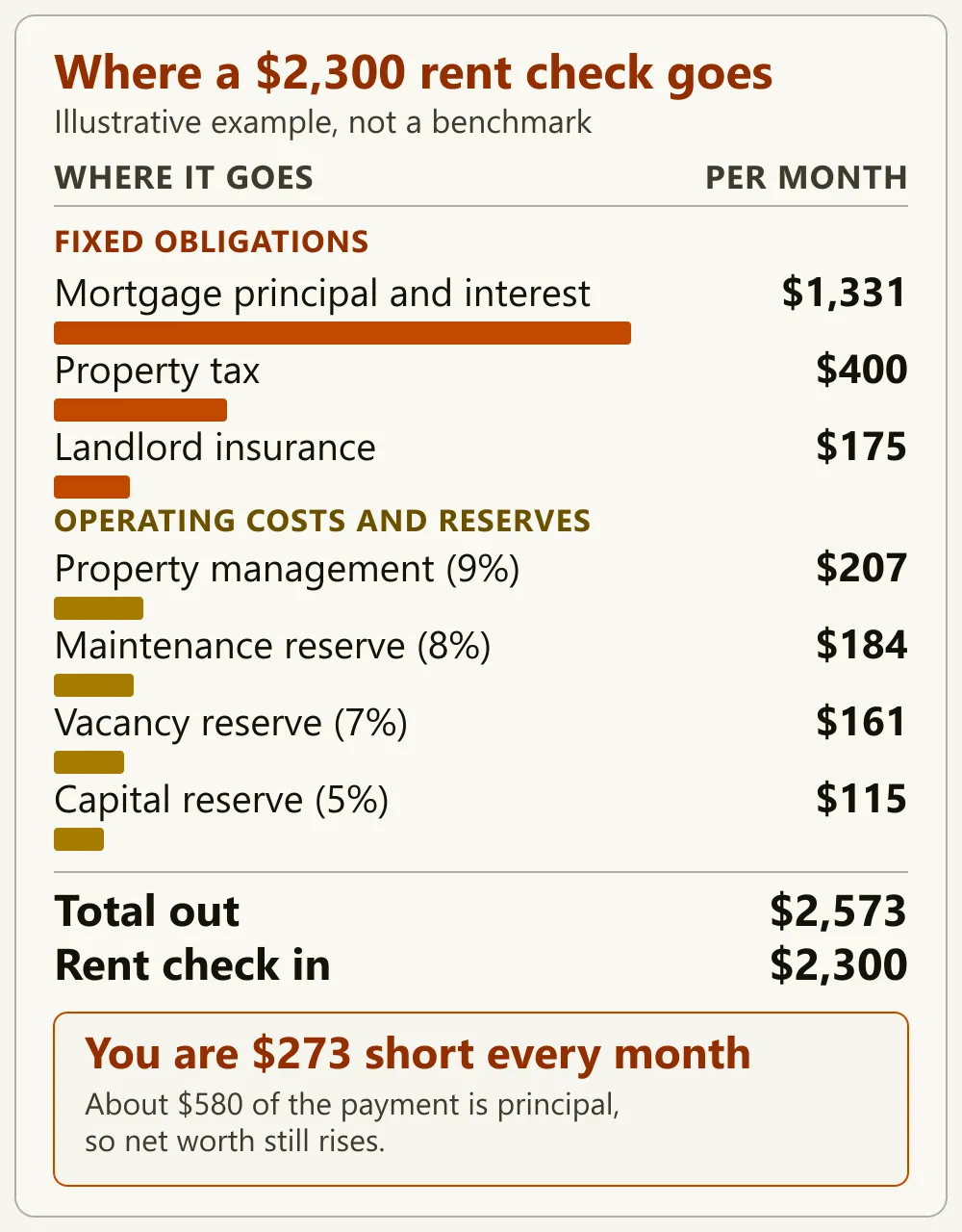
Number one of the four: the rent shortfall. The house that looked like it made $969 a month costs $273 a month to keep. Not because anything went wrong — this is the version where the tenant pays on time every month and nothing breaks.
Three of those lines are worth naming, because they are the ones that get deleted first:
- The insurance line changes. A house you rent out is generally not covered by the policy that covered the house you lived in. You have to tell your insurer what the house is now doing, and a landlord policy typically prices differently than a homeowner’s policy. Read your form or call your carrier before the first tenant moves in — skipping that call is how people discover at claim time that they are uninsured.
- The reserves are not savings, they are deferrals. A water heater you replace once a decade is a few thousand dollars you pay in one lump — call it $30 to $40 a month while you wait. Not funding the reserve does not make the roof cheaper; it just means the roof arrives as a crisis instead of a line item. If you have never priced this out for your own house, the seasonal home maintenance schedule most new owners learn the hard way is a useful reality check on the real cadence.
- Management is 9% here, and it is not optional at 900 miles. Self-managing from another state means you are the one taking the 11 p.m. call about a burst pipe and finding a plumber in a city you no longer live in. You can absolutely save the $207. You are paying it in a different currency.
One input deserves its own note, because the whole framework pivots on it: get your own rent number rather than borrowing this one. Three current listings of comparable size and condition within a mile or so will bracket it, and a local property manager will often run a rent analysis free in exchange for the chance to pitch you.
The line nobody counts: what you build even when cash flow is negative
Now the honest counterweight, because a $273 monthly shortfall on this $420,000 house is not the whole story.
Of the $1,331 payment, about $751 is interest ($265,000 at 3.4%, one month’s worth) and about $580 is principal. The principal is not an expense — it is you buying the house from the bank in installments, funded largely by the tenant. So the monthly position is:
- $273 short in cash out of pocket
- +$580 in mortgage balance destroyed
- = +$307 a month of net worth, before any appreciation, and before taxes
This is the single most misunderstood thing about renting out a former home: it can be cash-flow negative and wealth-positive at the same time. That is a real answer, not a rationalization. It is also a real risk, because you cannot pay a plumber in equity. A house that builds $580 a month of net worth while draining $273 a month of cash requires you to have the cash.
What selling actually nets after commissions and closing costs
The sell side has its own gap between the headline number and the wire transfer. The house is worth $420,000. That is not what the Whitlocks would receive.
| Selling the house | Amount |
|---|---|
| Sale price | $420,000 |
| Agent commissions (5.5%) | −$23,100 |
| Other seller closing costs (~1.5%) | −$6,300 |
| Pre-sale repairs, paint, cleaning | −$6,000 |
| Mortgage payoff | −$265,000 |
| Net cash at closing | $119,600 |
Number two of the four: net sale proceeds — $119,600. The commission rate there is an assumption, not a standard. There is no legally standard rate: the joint Federal Trade Commission and Justice Department report on competition in the real estate brokerage industry (opens in new tab) (April 2007) noted evidence that some consumers “are not necessarily aware that commission rates are negotiable,” and documented fee-for-service brokers who let sellers buy less than the full bundle of services, along with state restrictions on rebates. More recently, since the National Association of Realtors settlement practice changes (opens in new tab) took effect on August 17, 2024, written buyer agreements must carry “a conspicuous statement that broker fees and commissions are fully negotiable and not set by law.” Treat 5.5% as this example’s assumption and get your own quotes.
These are the seller’s costs, which are a different bundle from the buyer’s side of the closing table — for that half, see what closing costs actually cover. All in, including the $6,000 of pre-sale work, this example’s cost of selling is about 8.4% of the sale price.
So the choice, so far, is between $119,600 in cash now and $307 a month of mostly-illiquid net worth that costs $273 a month in cash to hold. Reasonable people land in different places on that, which is why the argument never resolves on those numbers alone.
It resolves on the next one.
Does renting it out cost you the capital-gains exclusion?
Not immediately, but it starts a clock most people never notice. Renting the house out does not disqualify you on its own — you lose the exclusion when you no longer have 24 months of residence inside the 5 years ending on the sale date. If you lived there two years right up to the day you left, that leaves roughly three years of renting before it expires.
Here is the rule underneath that. When you sell a home you have lived in, federal law lets you exclude a large chunk of the gain from your income entirely. Per IRS Publication 523 on selling your home (opens in new tab), you can exclude up to $250,000 of gain — $500,000 for a married couple filing jointly, which is what the Whitlocks are assumed to be — if you meet both an ownership test and a residence test. The residence test is the one with teeth: you must have owned and used the home as your residence for at least 24 months out of the 5 years ending on the date of sale (IRS Topic 701 (opens in new tab) covers the same rules in brief).
That is better news than most people assume. The statute’s “nonqualified use” rules specifically carve out any portion of the 5-year period after the last date the property was your principal residence (opens in new tab), so moving out and renting does not itself poison the exclusion. What gets you is simply running out of the 24 months.
Number three of the four: the clock. Here is what that deadline is worth. The gain is about $85,600: the $420,000 sale price, less roughly $29,400 of selling costs — the commissions and closing costs from the table above, since the $6,000 of pre-sale repairs generally is not a selling expense (opens in new tab) — less the $305,000 basis.
| When they sell | Federal tax on the $85,600 gain |
|---|---|
| Now, or any time inside the 24-of-60-month window | $0 (covered by the $500,000 exclusion) |
| After renting for four years | ~$12,840 — the whole gain at the 15% long-term rate |
That 15% is itself an assumption: long-term capital gains are taxed at 0%, 15%, or 20% depending on taxable income (IRS Topic 409 (opens in new tab)), and state tax and the 3.8% net investment income tax (opens in new tab) may apply on top. Neither row includes depreciation recapture, which is the next section and applies either way.
Nothing about the house changed between those two rows. They just crossed a date. A capital-gains exclusion is a use-it-or-lose-it asset with an expiration date, and it is almost always the largest single number in the sell-or-rent decision.
Depreciation is not optional, and it comes back at sale
Number four of the four: recapture. This one applies even if you sell well inside the window, and it is one of the most commonly missed items when a former home becomes a rental.
Once the house is a rental, you depreciate it. IRS Publication 527 on residential rental property (opens in new tab) puts residential rental property on a 27.5-year straight-line schedule. Land is not depreciable, so only the building counts: if about $65,000 of the $305,000 basis is land, the building portion is $240,000, which is about $8,727 a year of depreciation deductions. Publication 527 splits the two on their relative fair market values, and the land-to-building ratio on your county tax assessment is the usual practical proxy for that — and on conversion you use the lesser of adjusted basis or fair market value that day.
Those deductions are genuinely useful while you hold the house, because they shelter rental income. They are a deferral, not a gift. Publication 523 (opens in new tab) is explicit that you cannot exclude “the portion of gain equal to any section 1250(b)(3) depreciation adjustments allowed or allowable after May 6, 1997, which must be recaptured…”. That recaptured amount is unrecaptured section 1250 gain, taxed at a maximum rate of 25% (IRS Topic 409 (opens in new tab)).
Three consequences worth internalizing:
- Three years of renting creates roughly $26,000 of depreciation here, and up to about $6,500 of tax at sale — owed even though the exclusion covered the rest of the gain.
- Four years stacks the two penalties. Selling in year four costs roughly $12,840 on the gain plus about $8,700 of recapture — call it $21,600 of federal tax on a house that would have sold tax-free three years earlier.
- The words are “allowed or allowable.” Not claiming depreciation on your return does not avoid the recapture. You can end up paying tax on a deduction you never took.
How much does one vacant month actually cost?
One vacant month costs more than one month of rent, because the bills do not pause when the tenant leaves. The mortgage, the taxes, and the insurance keep running; you just stop being paid for them. On this $420,000 example house that is about $1,906 of carrying cost ($1,331 + $400 + $175) in a month with $0 coming in, plus turnover — cleaning, paint, a listing, and the days the house sits empty while someone decides. For this example, budget roughly one month’s rent for a full turn, and replace that with your own quotes.
That is not a rare event. National vacancy rates for rental housing were 7.3% in the first quarter of 2026, per the Census Bureau’s quarterly residential vacancies and homeownership release (opens in new tab). That figure measures the share of rental units standing vacant and available at a point in time, not any single landlord’s rent loss — but a reserve in that neighborhood is a reasonable planning proxy rather than pessimism.
The practical version: a single-property landlord has no diversification. A twenty-unit owner with one empty unit has a 5% revenue dip. You have a 100% revenue dip. Every reserve in the rent-check table above exists to make one bad month survivable instead of decisive.
Where this composite household lands
Run all four for this hypothetical $420,000 house with $265,000 owed at 3.4% — the shortfall, the net proceeds, the clock, and recapture — and the answer is not either of the two instincts.
Selling now is clean and pays $119,600 tax-free. But the loan is at 3.4%, and a rate like that may well not come back within their holding horizon, so handing it back to the bank reads as a real loss. Renting indefinitely means a $273 monthly hole and, if they sell in year four, roughly $21,600 of federal tax that year three would not have cost.
Which points at the middle path: rent it out, with a hard deadline. Three years of tenancy, a decision date on the calendar 30 months out, and a listing appointment before the 24-of-60-month window closes. Over three years the illustrative math is roughly a $9,800 cash drain, about $22,000 of principal paid down by someone else, and about $6,500 of recapture tax at the end — call it about $5,700 ahead of selling today, on paper, with the $500,000 exclusion still intact on the way out.
Be honest about how thin that margin is, because it cuts both ways. It counts nothing for appreciation, which helps the renting case — but it also gives the selling case no credit for what $119,600 would earn sitting somewhere else for three years, and at even a few percent a year that alone erases the gap. A $5,700 edge on a $420,000 asset is not a verdict, it is a coin flip with a deadline attached. Which is exactly why the decision should turn on the things that are not close: whether your exclusion is about to expire, and whether the rent covers the house.
That is not a triumphant answer. It is an honest one, and the shape of it is what matters: an open-ended emotional decision becomes a dated financial one.
Should you sell your house or rent it out?
Sell if the tax-free gain you are sitting on is large and the rent does not clearly cover the house; rent it out if the loan is cheap, the rent covers the house with a real margin, and you can be a landlord on purpose rather than by accident. Concretely:
Lean toward selling when:
- Your gain is close to or above the $250,000 / $500,000 exclusion, and you currently qualify. This is the strongest sell signal there is, and it expires.
- The rent does not cover the full stack — payment, taxes, insurance, management, and all three reserves — with margin left over.
- You need the equity for the next house, or a negative month would genuinely hurt.
- You would be self-managing from far away, reluctantly.
- Your local rules make small-scale landlording expensive or slow: licensing, inspections, rent regulation, and eviction timelines vary enormously by state and city, and they are a real cost line, not a formality. Look up your state’s landlord-tenant statute and your city’s rental-licensing page before you price this.
Lean toward renting it out when:
- Your mortgage rate is well below current rates. A cheap fixed loan on an appreciating asset is genuinely hard to replace, and it is the single best argument for holding.
- The rent covers the full stack with margin, not just the mortgage.
- You have cash reserves to absorb four to six months of carrying costs without stress.
- You may move back, or the market has a specific reason to move in your favor that you can name in one sentence.
- You are willing to run it as a business: a real lease, a real reserve account, and real books.
And one honest note on the tempting third option: turning it into a short-term rental changes the business rather than removing the problem. Higher gross, far higher variance, real labor per stay, and a different regulatory picture. If you are seriously considering it, price it per stay before you commit — that is what the Short-Term Rental Owner P&L and Turnover Workbook exists to do — and do not assume the nightly rate times thirty is revenue.
How to score the sell-or-rent decision with weighted factors
The reason the sell-or-rent decision drags on for months is that people keep re-litigating it in conversation, where whoever spoke most recently wins. Write it down once instead. Every factor that matters, weighted by how much it matters to you, scored for both options.
- Tax-free gain at stake — how much of the exclusion you would forfeit, when, and the depreciation recapture owed on top.
- Rate advantage — your rate versus today’s, expressed as dollars per month.
- Full-stack cash flow — rent minus every line in the rent-check table, not rent minus mortgage.
- Cash resilience — months of carrying cost you could absorb with the house empty.
- Distance and management — who takes the 11 p.m. call.
- Need for the equity — what the $119,600 would otherwise do.
- Regulatory friction — licensing, inspections, and eviction timeline where the house sits.
- Reversibility — how expensive it is to change your mind in each direction.
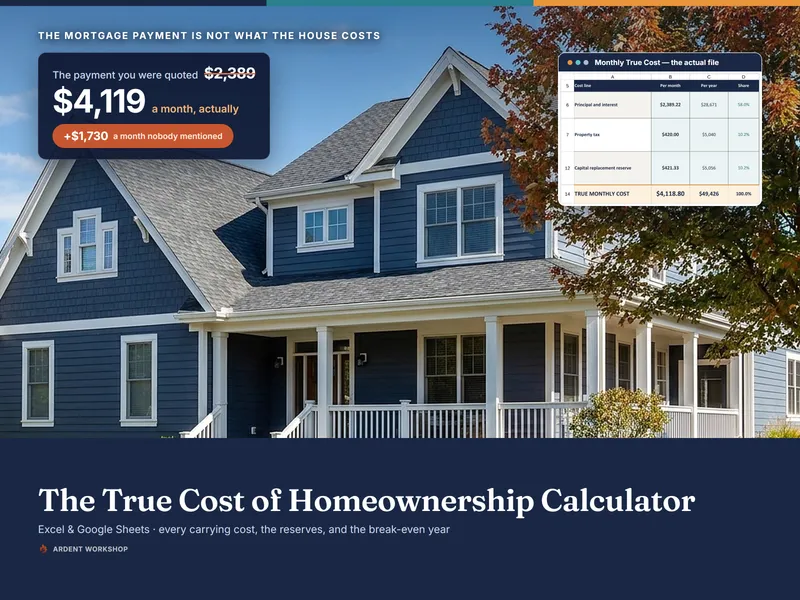
Four of those — tax-free gain, rate advantage, full-stack cash flow, and cash resilience — are pure arithmetic and belong in a model you can re-run when a number changes. The True Cost of Homeownership Calculator prices the carrying-cost side — every line that never appears in a listing. The Decision Helper handles the weighted scoring, so the answer comes from your weights rather than from whoever you spoke to last.
The traps that turn accidental landlords into sellers anyway
If you choose to rent, these are the failure modes that show up in year one:
- Renting to a friend at a discount. The discount is the smallest cost. The unenforceable lease is the expensive part.
- No written lease, or a template you did not read. Landlord-tenant law is state and local, and the generic form you downloaded may contain clauses that are unenforceable where your house is.
- Not telling your lender. Primary-residence financing frequently carries occupancy requirements. Read your note and any occupancy rider before you advertise the house for rent; your loan documents govern, not general advice.
- Commingling the money. Rent into your personal checking account means you will never know what the house actually earned, and your tax return becomes an archaeology project.
- No reserve account. The reserves in the rent-check table only work if the money physically leaves the operating account. A reserve you did not move is a reserve you already spent.
- Treating the security deposit as income. It is generally the tenant’s money held in trust, with state rules about where it sits and how fast you return it.
Every one of those is a bookkeeping problem before it is a legal or financial one, which is the good news: it is fixable with a system, and the system is small.
Own the Schedule E file, not just the house
Whether you sell this house or rent it out, the thing that makes the decision survivable is having the numbers in something you own, not scattered across a lender portal, a property manager’s dashboard, and a text thread.
If you rent it out, you now run a business with a tax return attached, and Schedule E does not care how you felt about the house. Rent received, expenses by category, deposits held, lease dates, repairs versus improvements — that last distinction matters, because per Publication 527 (opens in new tab) a repair is deductible now while an improvement is capitalized and depreciated over years. The Small-Landlord (1-4 Unit) Income & Expense Workbook was built for exactly this scale of landlord: one to four units, kept in a file you own, with the Schedule-E numbers falling out at the end of the year instead of being reconstructed in April.
That is the whole difference between a landlord and an accidental landlord. Not the size of the portfolio — the existence of the file.
You are still standing in an empty house holding a set of keys. But now the question is not “sell or rent?” It is “which of the four numbers decides it for me, and when does my exclusion expire?” That question has an answer.
Sources
- IRS Publication 523, Selling Your Home (opens in new tab) — the $250,000 / $500,000 exclusion, the ownership and residence tests, and the rule that depreciation allowed or allowable after May 6, 1997 must be recaptured
- IRS Topic no. 701, Sale of your home (opens in new tab) — the 24-months-of-5-years residence requirement in brief
- 26 U.S. Code § 121 (opens in new tab) — the nonqualified-use rules and the exception for periods after the home was last your principal residence
- IRS Publication 527, Residential Rental Property (opens in new tab) — the 27.5-year straight-line depreciation schedule, the land-versus-building split, and the repair-versus-improvement distinction
- IRS Topic no. 409, Capital gains and losses (opens in new tab) — the 0% / 15% / 20% long-term capital gains rates and the maximum 25% rate on unrecaptured section 1250 gain
- IRS Topic no. 559, Net investment income tax (opens in new tab) — the additional 3.8% tax on net investment income
- U.S. Census Bureau, Quarterly Residential Vacancies and Homeownership, First Quarter 2026 (opens in new tab) — the 7.3% national rental vacancy rate
- Federal Trade Commission and U.S. Department of Justice, Competition in the Real Estate Brokerage Industry (April 2007) (opens in new tab) — evidence that some consumers are unaware commission rates are negotiable, fee-for-service brokerage models, and state restrictions on rebates
- National Association of Realtors, what the settlement means for home buyers and sellers (opens in new tab) — the August 17, 2024 practice changes and the written-agreement disclosure that broker fees are fully negotiable and not set by law
Disclaimer: This post is for informational and educational purposes only and does not constitute financial, tax, legal, or real estate advice. Every figure above is an illustrative worked example for one hypothetical house, and the rules that decide your outcome — the capital-gains exclusion, your capital-gains bracket, depreciation recapture, your loan’s occupancy terms, and landlord-tenant and rental-licensing law — depend on your specific facts and change by state and city. Consult a licensed CPA or tax professional, attorney, and your lender and insurer before making decisions based on this content.