How much does a car depreciate each year?
The common shortcut is to treat depreciation as a flat annual percentage — "cars lose about 15% a year," say — and apply it evenly across every year of ownership. Real depreciation doesn't work that way. It is steepest in the first year and flattens out as the car ages, which is why a barely-used car sells for so much less than the same car new while a six-year-old car and a seven-year-old car are priced close together. A car does not lose the same dollar amount, or even the same percentage of its current value, in year six that it lost in year one.
The scale is easy to underrate. In iSeeCars' analysis of more than 950,000 five-year-old vehicles (March 2026), the average vehicle had kept 58.2% of its value after five years. On a car bought for $35,000 — a round figure used here purely to show the arithmetic — that is roughly $14,600 gone in five years, about $240 a month, before a gallon of fuel or a single insurance premium. That is why depreciation is usually the largest line in what a car costs to own, and the only one that never appears on a statement.
A flat annual rate applied across the whole ownership period overstates what a car loses in its later years and understates what it loses in its first. That gap matters most for the two decisions a depreciation number is actually used for: whether to buy new or used, and how long to keep a car once you own it. If you want the number for a specific car before reading any further, the free True Monthly Cost of a Car Estimator works it out in a single tab with no signup.
Why a flat depreciation rate breaks the arithmetic
There's a second problem with a flat rate, and it shows up depending on which number the rate is applied to:
- Applied to the car's current value each year (compounding), the value can shrink forever but mathematically can never hit zero — a car "worth" $30,000 losing 15% a year is worth about $25,500 after year one, about $21,675 after year two, and so on, always leaving something on the table. That understates how little an old car is really worth.
- Applied to the original purchase price each year (straight-line, as with a flat dollar amount), the same 15%-of-$30,000 figure — $4,500 — subtracts every year regardless of what's left. Run that to year seven and the "value" goes negative, which no car ever does. It can never fall below zero, but a straight-line flat rate doesn't know that.
A real resale curve avoids both errors because it isn't a rate applied to a formula — it's an observed relationship between a car's age and what it actually sells for, which naturally slows its own descent and never crosses zero.
Which cars hold their value best?
Depreciation isn't one curve for every car, either. Body style and powertrain change how much value a vehicle keeps, and the spread between classes is wide. These are the five-year retention figures measured in iSeeCars' analysis of more than 950,000 five-year-old vehicles (March 2026):
| Vehicle class | Value kept after five years |
|---|---|
| Pickup truck | 65.8% |
| Hybrid | 64.6% |
| All vehicles (average) | 58.2% |
| SUV / crossover | 55.1% |
| Electric | 42.8% |
Pickup trucks and hybrids hold value meaningfully better than the average vehicle; SUVs sit a little below it, and electric cars have fallen fastest of any class by a wide margin. A model that assumes every vehicle depreciates at the same rate is quietly wrong for a large share of the vehicles it's asked to price, in both directions.
Does buying used avoid depreciation?
Not all of it, but the worst of it. Because the steepest drop happens in year one, the biggest single way to avoid it is to not be the owner in year one. Buy a car that's already three years old and the first owner has already absorbed the steepest part of the curve; what's left to you is the flatter, slower-moving tail.
The catch is that you can't just apply a fresh depreciation curve to a used car's purchase price — that price already reflects three years of decline. To read the car's remaining curve correctly, you first have to work backward to its implied as-new price, then apply the curve from the car's actual age forward. Skip that step and a used-car depreciation estimate will be too optimistic, because it's re-depreciating a price that's already depreciated.
How does mileage affect a car's depreciation?
A resale figure describes a typical car for its age — neither a hard-driven one nor a barely-driven one — so every curve carries an implied baseline mileage, whatever the model that built it chose to use. Drive well above that baseline and a car arrives at resale with more wear than a typical car its age, which pulls its value below the curve. Drive well below it and the opposite happens: a lightly-driven car for its age tends to hold value above the curve. Annual mileage isn't a separate cost from depreciation — it's an input that shifts where you land on the curve, so a depreciation estimate is only as good as the mileage figure you feed it.
Is this the same as depreciation for taxes?
No. You may also hear "depreciation" used in a business or tax context — tax rules let a business write off the cost of an asset over a set schedule of years, following conventions that have nothing to do with what the asset is actually worth on the used market that year. That's a real and useful idea, but it's a separate one from what this page describes. This page is about market-value depreciation — what a car would actually sell for — which is the number that matters for a household deciding what a car costs to own. Nothing here is tax guidance; check anything you intend to deduct with a tax professional.
How do you calculate car depreciation?
The calculation itself is simple once you have a real resale figure to work with: take what you paid, subtract the car's expected resale value at the end of however long you plan to keep it, and divide the result by the number of months you'll hold it. That's your monthly depreciation cost — the number nobody bills you for, spread out so you can see it. The work is in the resale figure, not the division.
Start free
The True Monthly Cost of a Car Estimator runs that math for one car in a single tab. No email, no signup — you download the file and it's yours.
Then price the decision properly
The Car Total Cost of Ownership Calculator goes further: it reads each car's resale off a per-year curve for five vehicle classes instead of one flat rate, works back to what a used car cost new so the depreciation the first owner already absorbed is priced properly, amortizes a lease as a lease — money factor, residual, acquisition and disposition fees, mileage overage — and solves for the annual mileage and the holding length at which the cheapest car actually changes. It's a one-time file you own and reuse for every car you ever price, not a subscription and not a lead-capture form.
Where depreciation sits among the eight costs of a car
Depreciation is usually the largest single line in what a car truly costs to own each month, but it's only one of eight. The other seven are financing (or, if you paid cash, the return that money is no longer earning), fuel or charging, insurance, registration and taxes, servicing and repairs, tires, and everything else the car quietly asks for. Add all eight together and you have the car's total cost of ownership.
See that total assembled line by line, for a car and for a house, in what is total cost of ownership, and how the monthly figure converts into a rate per mile in what cost per mile means for a household car. For why the two ways of pricing a car disagree so often, see cost per mile vs sticker price.
Templates that implement this
Tools that put a real number on it
3 templates
The cost engine that reads each car's resale off a real curve rather than a flat guess, plus the two weighted scorers for ranking cars on everything cost can't measure.
- $12.95 Spreadsheet

Car Total Cost of Ownership Calculator — Cost Per Month and Per Mile, Depreciation Curve & Lease vs Finance vs Cash (Excel & Google Sheets)
Work out what a car really costs — per month and per mile — for three cars at once, and find the mileage where the cheapest one changes.
Big DecisionsView details - $2.95 Excel
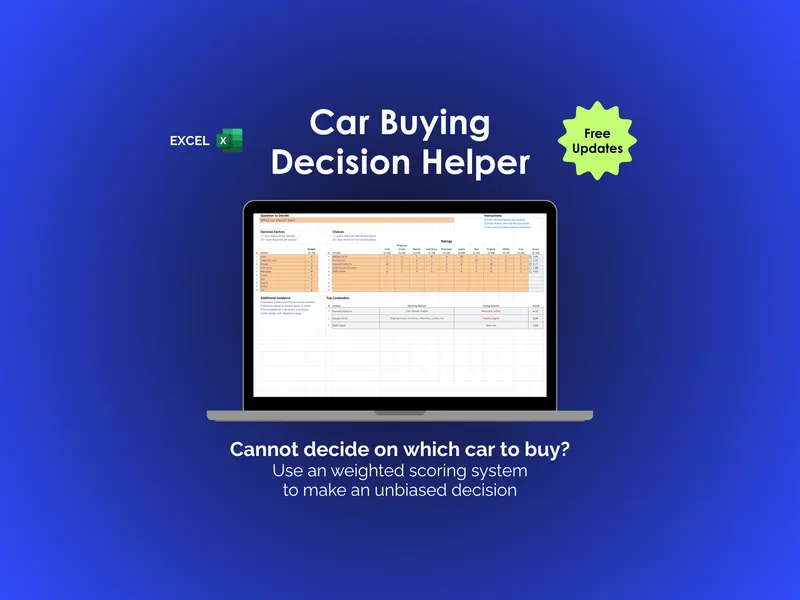
Car Buying Decision Helper - Excel
There are two kinds of car shoppers: the ones who score every option, and the ones who guess. This Excel car buying decision helper turns gut feel into weighted math.
Big DecisionsView details - $4.95 Excel
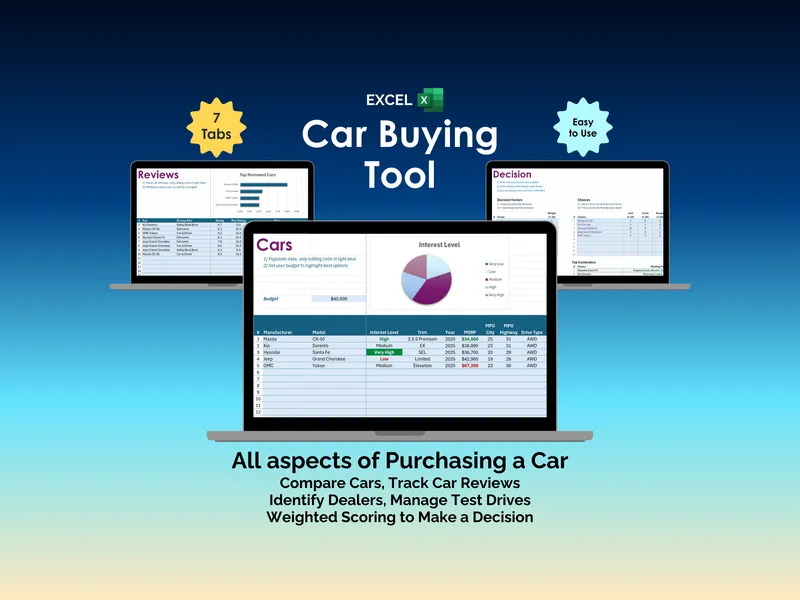
Car Buying Tool - Excel
Six tabs open across two browsers and a notes app. The excel car buying tool pulls every listing, dealer, review, and test drive into one weighted score.
Big DecisionsView details