A car lot sells you one number twice: once on the windshield, and once again, restated, on the finance desk as a monthly payment. Neither one is what the car costs you. The sticker price is what you hand over on day one. Cost per mile is what the car actually takes from you, divided by the miles you drive it. They are measuring different things, and a car that wins on one routinely loses on the other.
Two definitions, side by side
- Sticker price is the price tag on the windshield — the manufacturer's suggested retail price, or the number a dealer or private seller is asking. It is a single, one-time figure: what it costs to acquire the car, before financing, before you've driven a mile.
- Cost per mile is every dollar the car takes from you over the years you keep it — depreciation, financing, fuel or charging, insurance, registration and taxes, servicing, and tires — divided by the miles you actually drive it in that time. It is a rate, not a price tag, and it is the number that predicts what owning the car will actually cost you.
Why sticker price is a poor comparator
The windshield number is real and it matters — but as a way of ranking two cars against each other, it leaves out most of what determines which one is actually cheaper to own. What it doesn't capture:
- Depreciation. For most owners this is typically the largest single cost of the car, and it is never invoiced — it shows up as the gap between what you paid and what the car is worth when you sell or trade it in. Two cars with the same sticker price can lose value at very different rates, and the sticker gives you no signal either way: in iSeeCars' analysis of more than 950,000 five-year-old vehicles (March 2026), the average vehicle kept 58.2% of its value over five years, while pickup trucks kept 65.8% and electric cars 42.8%. See what depreciation is for how it's measured.
- Financing, or the opportunity cost of the cash. Finance the purchase and you pay interest on top of the price; pay cash and that cash stops earning a return elsewhere. Either way, the sticker price is not what the purchase costs — it's the principal the rest of the cost gets built on top of.
- Fuel or charging. Two cars at the same price can differ by thousands of dollars over a holding period, purely on how many miles a gallon or a kilowatt-hour buys.
- Insurance. Premiums are shaped by the car's repair cost, theft rate, and safety record as much as by what it cost to buy — so a cheaper car can easily be the more expensive one to insure.
- Registration and taxes. Recurring, and in some states tied to the car's value or weight class, so they don't track the sticker in any simple way either.
- Servicing that escalates with age. A car's maintenance bill is rarely flat — it tends to climb as warranty coverage ends and wear items come due, and which car climbs faster is invisible on the lot.
- Tires. A recurring cost sized to the car's weight and performance envelope, easy to forget and easy to underbudget.
The monthly payment isn't the cost either
It's tempting to think the payment fixes what the sticker price misses, since it at least includes financing. It doesn't, for two different reasons depending on whether you're buying or leasing.
On a purchase loan, most of the payment is you buying the car — principal — with interest layered on top. The payment can look small because the term is long, but stretching the term doesn't shrink what the car costs you; it just spreads the same total over more months and usually adds interest in the process. A small payment on a seven-year loan can sit on top of a much larger true monthly cost once depreciation, fuel, insurance, and servicing are added back in.
On a lease, the payment is a different animal entirely. It is built from the vehicle's projected depreciation over the lease term, plus a rent charge on the money tied up — set by the lease's money factor — plus, typically, an acquisition fee at signing and a disposition fee at turn-in, and it comes with a mileage cap that gets expensive fast if you go over it. A lease can be the cheaper way to drive a given car for a given number of years, but that has to be computed against the cost of buying the same car and keeping it the same length of time — not assumed from the size of the payment.
Fixed and variable per-mile costs — and why the ranking can flip
Cost per mile is not one lump number; it is two, added together, and they behave in opposite directions:
- Fixed per-mile costs — depreciation, insurance, registration — are set by time, not by miles driven. Drive the car further in the same holding period and these costs get divided across more miles, so the per-mile figure falls.
- Variable per-mile costs — fuel, tires, and the mileage-driven share of servicing — scale with the miles themselves, so they stay roughly flat per mile no matter how much or how little you drive.
This split is exactly why two cars can trade places depending on who's asking. A car with high fixed costs and low running costs is the better buy for a high-mileage driver, because the fixed costs get diluted across more miles; the same car can lose to a cheaper-to-buy, thirstier alternative once the annual mileage drops low enough that the fixed costs barely get diluted at all. Holding length matters the same way, because depreciation is steepest in a car's first few years — a short hold concentrates the worst of it into your average, and a long hold spreads it thin. There is no single mileage or holding length at which "cost per mile" stops depending on the driver; it has to be computed for yours.
Sticker price vs cost per mile, side by side
| What matters | Sticker price | Cost per mile |
|---|---|---|
| What it answers | What you'll hand over to acquire the car | What the car actually costs you, per mile driven, over the time you keep it |
| What it hides | Depreciation, financing, fuel, insurance, registration, servicing, tires — every cost that arrives after the sale | Nothing structural, but it depends on assumptions — resale value, annual mileage, holding length — that have to be estimated |
| Timing | A single figure, due once | A rate that accrues over the whole time you own the car |
| Sensitive to | Negotiation, trim level, incentives | Resale value, fuel economy, insurance class, annual mileage, holding length |
| When it's the right number | Checking against a budget ceiling, a financing pre-approval, or the cash you need for a down payment | Comparing two cars, deciding how long to keep one, or deciding whether to buy or lease |
Where sticker price is genuinely the right number
None of this makes sticker price a bad number — it's a poor comparator between two cars, but it's still the correct answer to several real questions. If your bank account only stretches to a certain figure, that figure is your ceiling and the sticker price is exactly what has to fit under it. If a lender's pre-approval caps what they'll finance, that cap is also a sticker-price question. And if you need to put a specific amount of cash down at signing, the deposit you have to find is set by the sticker, not by the cost per mile. Sticker price gates whether a purchase can happen at all; cost per mile tells you what it will cost you once it does.
A worked example: the cheaper car loses on cost per mile
The figures below are a clearly-labeled illustrative example — invented round numbers meant to show the arithmetic, not a claim about any real make or model. Two buyers each keep their car five years and drive 12,000 miles a year, 60,000 miles total. To keep the two columns comparable, both are assumed to be cash purchases, so no financing line appears — which also means neither column is charged for the return that cash is no longer earning, an omission that flatters the pricier car slightly. Registration and taxes are left out on the assumption they fall the same way on both cars. A real comparison would carry all three.
| Cost line (per year unless noted) | Car A — the lower sticker | Car B — the higher sticker |
|---|---|---|
| Sticker price (one-time) | $24,000 | $28,000 |
| Depreciation | $3,120 a year — keeps 35% after five years, losing $15,600 | $2,520 a year — keeps 55% after five years, losing $12,600 |
| Fuel (at $3.50 a gallon) | 24 mpg — about $1,750 | 34 mpg — about $1,240 |
| Insurance | $1,400 | $1,100 |
| Servicing | $900 on average, weighted toward the later years | $650 on average |
| Tires | $200 on average | $180 on average |
| Total a year | About $7,370 | About $5,690 |
| Total over five years | $36,850 | $28,450 |
| Cost per mile across 60,000 miles | Roughly $0.61 | Roughly $0.47 |
Car A costs $4,000 less to buy. Car B costs about $8,400 less to own across the five years these figures assume — and that $8,400 is already net of the higher price, because the extra $4,000 is carried inside Car B's own depreciation line. Car B wins on value retention, fuel, insurance and servicing by more than enough to cover what it cost extra on day one. Rank these two cars by sticker price and Car A wins by $4,000. Rank them by cost per mile, on this holding length and this mileage, and Car B wins. Change the mileage or the years held and the fixed-cost side of each car's number moves, which is exactly why this has to be computed on your own numbers rather than borrowed from an example.
Get the number for your own cars
Start free
The True Monthly Cost of a Car Estimator turns one car's price, financing, and running costs into a monthly figure on a single tab. No email, no signup — you download the file and it's yours.
Then run the real comparison
The Car Total Cost of Ownership Calculator prices up to three cars at once against a per-year resale curve for five vehicle classes, amortizes a lease properly against a purchase over the same holding period, and solves for the annual mileage and the holding length at which the cheaper car actually changes — instead of you reworking the arithmetic by hand every time one of those numbers moves. It's a one-time file you own, not a subscription and not a dealer's lead-capture calculator.
Cost is only half the choice
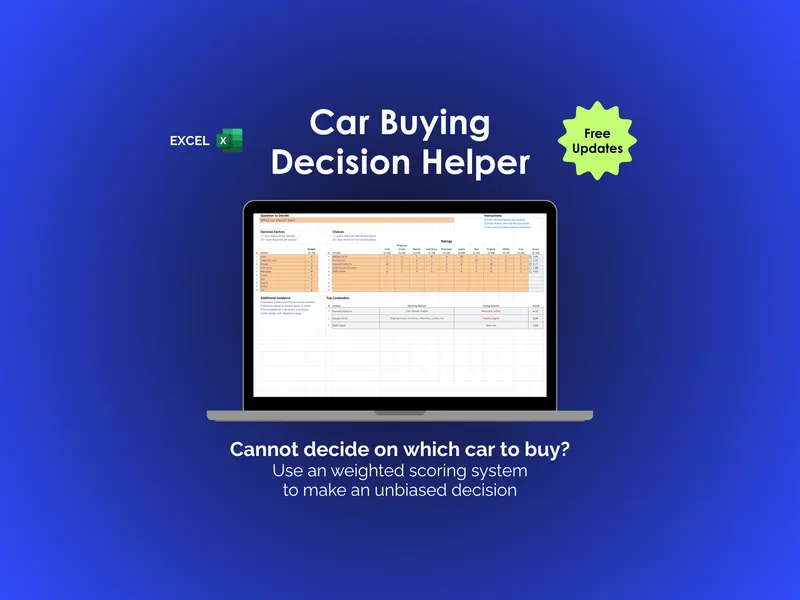
When two cars are close on the numbers and the decision turns on the things money doesn't measure, the Car Buying Decision Helper is the weighted scorer that ranks them on the factors you care about.
For the broader idea both numbers sit inside, see what total cost of ownership is and what cost per mile means more generally.
Not financial advice
This page compares two ways of pricing the same purchase. It is not financial or tax advice, and the dollar figures in the worked example above are an invented illustration, not a claim about any real vehicle's depreciation, fuel economy, or running costs. Run your own numbers before you decide, and confirm financing and insurance figures with your own lender and insurer.
Frequently asked questions
- Isn't the monthly payment already the cost of the car?
- No — a loan payment is mostly you buying the car, not you running it. It covers principal and interest and stops there, so it says nothing about fuel, insurance, registration, servicing, or tires, and nothing about what the car will be worth when you're done with it. Two cars can carry an identical monthly payment and cost very different amounts per mile, because the payment only ever measures how the purchase was financed.
- Why does a cheaper car sometimes cost more per mile?
- Because sticker price and cost per mile are ranking cars on different things. A low sticker price can hide fast depreciation, thirsty fuel economy, or a parts-and-labor bill that climbs faster than a rival's. When those costs are large enough, they outweigh the head start the lower price gave you, and the car that cost less to buy ends up costing more to own.
- Does leasing get around the depreciation problem?
- No, it prices it differently. A lease payment is built from the vehicle's expected depreciation over the lease term plus a rent charge on the money tied up (set by the money factor), and it usually adds an acquisition fee up front and a disposition fee at the end. You are still paying for depreciation — the lessor has just estimated it in advance and billed it to you as rent, with a mileage cap and a wear standard attached. It can still be cheaper per mile than buying the same car, but that has to be computed, not assumed.
- What annual mileage and holding length should I use to compare two cars?
- Your own. Cost per mile is not a fixed property of a car — it depends on how many miles you'll actually put on it and how long you'll keep it, because fixed costs like depreciation and insurance get divided by fewer or more miles depending on the answer. Use your realistic annual mileage and the number of years you actually tend to keep a car, not a nationwide average, and recompute if either one changes.
- When is sticker price still the right number to use?
- When the question is whether you can do the deal at all, not what the deal will cost you over time. A budget ceiling, a financing pre-approval, or the cash you need for a down payment are all sticker-price questions — they gate the purchase. Cost per mile answers a different question, the one that matters once the purchase clears the gate: what will this car actually take from you while you own it.