Who owes the nanny tax?
IRS Publication 926 says that if you hire someone to care for your children in your home and you can control not only what work is done but how it is done, you are generally treated as a household employer. The person is then your employee, not an independent contractor, even if you call them a babysitter or pay them in cash. The page on what a household employer is goes through that test in more detail. Pub 926 also lists exceptions, for example certain family members and some employees under 18, so read it before assuming the tax applies or does not.
What are the 2026 nanny tax thresholds?
Two thresholds matter, and they are measured differently. Both come from Publication 926.
- Social Security and Medicare: for 2026 you generally must withhold and pay these taxes if you pay a household employee $3,000 or more in 2026 in cash wages. The figure was $2,800 for 2025. It is measured over the whole year.
- Federal unemployment (FUTA): generally owed if you paid cash wages of $1,000 or more in any calendar quarter of 2025 or 2026. It is measured quarter by quarter, so a family can cross it in a single busy quarter.
The thresholds change by year and Pub 926 carries the exceptions, so confirm the current figures there. IRS Topic 756 is a shorter summary. Your state may have its own unemployment tax and its own rules.
What does the nanny tax cover?
- Social Security and Medicare taxes on cash wages, once the annual threshold is met.
- FUTA, the federal unemployment tax, once the quarterly threshold is met.
- Schedule H, the form household employers use to report these taxes. Pub 926 and Topic 756 explain how it connects to your income tax return.
- A W-2 given to the employee for the year.
Who runs the calculation (you, a payroll service or a preparer) is a separate choice. The comparison of a spreadsheet and a nanny payroll service covers that trade-off.
What records do you keep for the nanny tax?
Whoever files will ask for the same things, so keep them as you go:
- Cash wages by pay date, so the annual total and each quarter's total can be added up instead of guessed.
- Hours worked each week, including guaranteed hours the family paid even when it canceled, and overtime for live-out employees. Under federal law, live-out domestic workers are generally owed 1.5 times their regular rate for hours over 40 in a workweek (DOL Fact Sheet 79B), and state law can require more.
- Reimbursements and mileage kept separate from wages, with dates and receipts.
- Start and end dates and the work agreement.
- Form I-9, kept 3 years after hire or 1 year after employment ends, whichever is later, per USCIS.
- Employment tax records, kept at least 4 years after the due date of the return or the date the tax was paid, whichever is later (Pub 926). For 2026 records, that means at least through 2031, and later if a tax was paid late.
Do not keep Social Security numbers in a spreadsheet. Sharing a workbook shares every tab, so give the caregiver the printed binder pages, not the file. Keep the I-9 and anything showing a Social Security number in a locked or encrypted place few people can open, and shred or delete them once their keep-until year has passed. The tutorial on organizing records when you employ a nanny walks through the folder and the weekly habit.
How a records kit fits in
The usual path is a blank spreadsheet, then a structured kit you own, then a payroll service if you want one to run payroll and file for a monthly fee. The Nanny Binder & Household-Employer Records Kit is the middle step. It turns each employee's logged days into weekly pay with guaranteed hours and overtime, rolls the year into quarterly cash-wage totals flagged against the thresholds you enter, and builds a year-end packet whose keep-until years follow the Pub 926 and I-9 rules. It does not run payroll, file anything or compute tax. It keeps the records a payroll service or preparer asks for. The household employers page shows how it is laid out.
If you only need the caregiver side to start, the free Nanny Daily Log & Emergency Info Sheet is a printable two-pager, and what to put in a nanny binder covers the rest. For other kinds of in-home care, see resources for caregivers, and for who can act on a child's behalf, what a caregiver authorization is.
Templates that implement this
Keep the records the nanny tax depends on
2 templates
The nanny tax runs on cash wages, dates and how long you keep the paper. These keep those in one place.
- $21.95 Spreadsheet
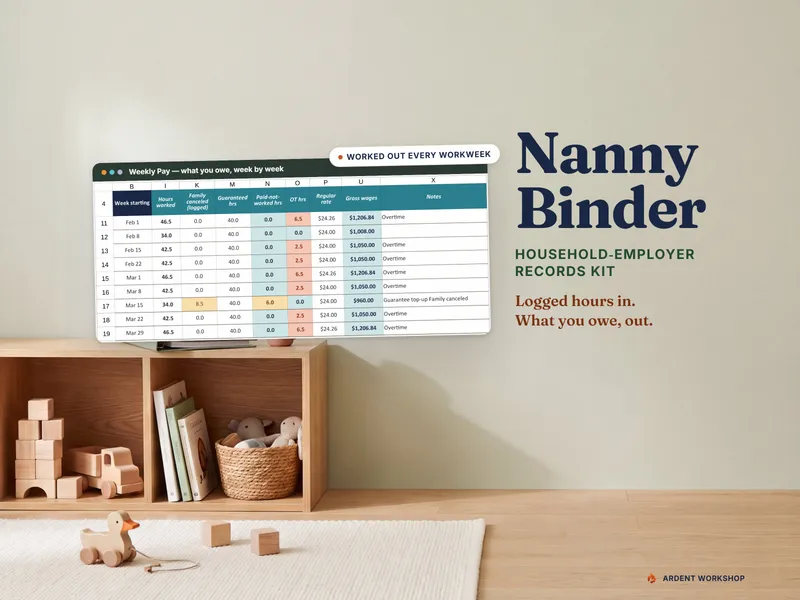
Nanny Binder & Household-Employer Records Kit — Nanny Timesheet, Guaranteed Hours, Overtime, PTO & Year-End Records (Excel + Google Sheets)
A nanny binder for Excel & Google Sheets that works out the wages you owe each week — guaranteed hours, overtime, PTO — and keeps the year's pay records.
Life AdminView details - $24.95 Spreadsheet

Caregiver / Aging-Parent Care Binder — Medications, Refill Status, Appointments & an Emergency Handoff Sheet That Writes Itself (Excel + Google Sheets)
Caregiver binder for an aging parent: medications flagged Order now or Due soon by refill date, appointments, care team and documents — plus a self-writing emergency handoff sheet.
Life AdminView details
Frequently asked questions
- What is the nanny tax?
- The nanny tax is the informal name for the employment taxes a household employer may owe: Social Security and Medicare taxes, federal unemployment (FUTA) tax, and the Schedule H and W-2 reporting that goes with them. IRS Publication 926 is the guide.
- What is the 2026 nanny tax threshold?
- Per IRS Publication 926 for 2026, you generally must withhold and pay Social Security and Medicare taxes if you pay a household employee $3,000 or more in cash wages in 2026. The figure was $2,800 for 2025. Pub 926 lists exceptions, so check it for your situation.
- When is FUTA owed for a household employee?
- Per Publication 926, federal unemployment tax is generally owed if you paid cash wages of $1,000 or more in any calendar quarter of 2025 or 2026. Exceptions apply, and your state may have its own unemployment tax.
- Do I owe the nanny tax if I pay my nanny under the table?
- How you pay does not change whether you are a household employer. Publication 926 looks at whether you control what work is done and how it is done, and the thresholds apply to cash wages however they are paid. A tax professional can tell you where you stand.
- How long should I keep nanny payroll records?
- Publication 926 says to keep employment tax records at least 4 years after the due date of the return or the date the tax was paid, whichever is later. For Form I-9, USCIS says to keep it 3 years after hire or 1 year after employment ends, whichever is later.
- Does a spreadsheet file the nanny tax for me?
- No. A spreadsheet or a records kit keeps the information a payroll service or tax preparer asks for. It does not run payroll, file returns or compute tax.