What is a nanny binder?
A nanny binder is a printed set of reference pages that tells a caregiver how your household runs: who the children are, what they eat and when they sleep, what the rules are, who to call, and what to do if something goes wrong. It is the written version of the long handoff conversation nobody has time for on a first morning.
The reason to build one properly is that a caregiver reads it at two moments: the first week, when everything is new, and the worst ten minutes of the year, when something has gone wrong and nobody can think. Both readers want the same thing, which is the answer on the first page they turn to.
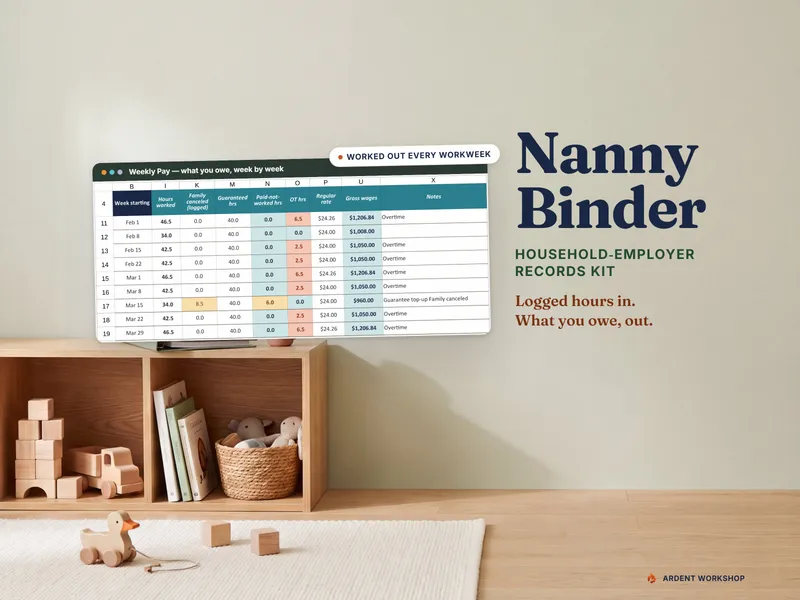
If you would rather start from finished pages than a blank document, the Nanny Binder & Household-Employer Records Kit has the caregiver pages ready to fill in: Children & Routines, House Rules & Activities, Health & Consent, Emergency & Pickup, and a Caregiver Daily Log, printable as a 12-page binder. For a free start, the Nanny Daily Log & Emergency Info Sheet is a printable two-pager with the daily log and the emergency-contacts page. Everything below works with either one, or with a word processor and a folder.
What goes in a nanny binder, in order?
Order the sections by how badly a caregiver needs them under stress, not by how natural they are to write. That puts emergencies first and the pleasant material last.
- Emergency and pickup
- Health and consent
- Children and routines
- House rules and activities
- The daily log
What belongs in the emergency and pickup section?
This is the first tab, and the one to print on paper you can pull out and hand to someone else.
- Contacts. Both parents or guardians, a backup adult who can reach the house, the pediatrician, poison control, and a neighbor. Include the house address written out, because a caregiver on the phone with a dispatcher may be new to the address.
- A what-to-do page. A short, plain page for the first five minutes: who to call first, where the first-aid kit is, where the nearest hospital or urgent care is, and where the children go if the house must be left. Write it as steps, not paragraphs.
- Pickup permissions. Name every person allowed to collect each child, with a phone number, and say plainly what the caregiver does if anyone else turns up, including a line such as “do not release the child without a call to a parent.” Put an expiry or review date on it. A permission list that is two years old is a risk, not a record.
If you want the wider version of this page for a household rather than a caregiver, how to make an emergency grab list covers it.
What health and consent information should the binder include?
Include only what a caregiver would have to act on, and make each item easy to find.
- Allergies. The allergen, what the reaction looks like, and what to do. Put the severe ones at the top of the page, not in alphabetical order.
- Medications. Name, dose, time, how it is given, and where it is kept. If a medication is on a schedule, say who gives it so it is not skipped or doubled.
- Providers. The pediatrician and any specialist, with phone numbers.
- Medical consent. A signed note that authorizes the caregiver to seek treatment if you cannot be reached, with a date on it and a date it expires. An expired consent that nobody noticed is worse than none, because everyone assumes it works. If you want to see how this kind of document is usually framed, the glossary entry on a caregiver authorization explains it.
How do you write the children and routines section?
Write one short profile per child, describing what happens on an ordinary day rather than an ideal one.
- Meals and snacks. What each child eats, what they refuse, and what is not allowed.
- Naps and bedtime. Times, the routine that gets a child there, the comfort item, and what to do when the plan fails.
- Screen time. How much, which shows or apps, and when it stops.
- Comfort and behavior. What helps when a child is upset, and what the family does about hitting, tantrums or refusal, so the caregiver is consistent with you.
- Anything that changes. Mark the items that shift with age, such as the end of naps, so you know which lines to update.
A useful test for every line is whether a stranger could follow it without asking you a question.
What do house rules and activities cover?
This section holds the rules that depend on your home, not on common sense.
- Rules on visitors, phones, guests, the kitchen, the yard and the street.
- What the children may do on their own and what needs an adult.
- Favorite activities, local parks and classes, and which outings are approved, with any transport arrangements.
- Pets. Feeding times and amounts, walking needs, where leashes and supplies are, and what the pet must never be given.
Keep the tone factual. The binder is a reference, not a performance review.
What is the daily log, and why include it?
The daily log is a one-page form the caregiver fills in during the day: meals, naps, diapers or toileting, activities, mood, medication given, and a line for anything a parent should hear about. It does two jobs. It tells you what happened without a long conversation at pickup, and it gives both sides a dated written record if a question about a day comes up later.
Print a stack of these and leave them in the binder. A log that has to be opened on a laptop does not get filled in.
What should stay out of a nanny binder?
The binder is handed to a caregiver, carried around the house, left on a counter and sometimes photographed. Treat it as a document anyone in the house might read, and ask that photos of its pages not be posted or shared. Keep these out:
- Pay records. Hours worked, rates, what you paid each week, and the totals behind them belong in your own employer file, not in the caregiver’s binder. These are the numbers a payroll service or a tax preparer asks you for, and they have a different audience.
- Social Security numbers. Do not write the caregiver’s number, or the children’s, into the binder. Do not store them in a general spreadsheet either. If you need an employee’s number for a form, keep it in a locked drawer or an encrypted folder few people can open, use it only for that form, and shred or delete it once the record’s keep-until date has passed.
- Tax forms and work-authorization documents. Forms for employment taxes and the immigration paperwork you complete when someone starts work belong in the employer file. IRS Publication 926 (opens in new tab) sets how long to keep employment tax records, and USCIS (opens in new tab) sets how long to keep the Form I-9; the retention periods are in those sources, not in this tutorial.
- Bank and card details, passwords, alarm codes you do not want shared. Give a caregiver only what the job needs.
- The whole workbook. Sharing a spreadsheet shares every tab in it. If your records live in a workbook, print the caregiver pages and hand over those, not the file.
That last point is the reason the kit puts the caregiver half and the employer half in separate sections. The printed binder pages are for the caregiver. The employer tabs, which turn logged days into weekly pay and a year-end packet, stay with you. Whether you are a household employer often comes down to how much control you have over how the work is done; what a household employer is explains the definition, what the nanny tax is covers the taxes that can follow, and organizing records when you employ a nanny covers the file you keep on your side.
How do you keep the binder current?
A binder that is correct on day one and wrong by March is a hazard. Three habits keep it honest:
- Date every page. Put a printed date in the corner so an old page is obvious.
- Review on a schedule. Check the emergency contacts, medications, consent expiry and pickup list every few months and whenever something in the household changes.
- Ask the caregiver to mark what is wrong. The person using the binder every day will notice the stale line first. Make it easy for them to say so.
If you would like the binder pages and the employer records in one place, with expiry flags on the consent and pickup lists, the Nanny Binder & Household-Employer Records Kit is built for that. It is a records workbook you own, a step up from a blank spreadsheet and a step before a payroll service, which is a separate service that runs payroll and files taxes. The kit does not do either. For a household that wants a spreadsheet or a paid service, spreadsheet vs. a nanny payroll service lays out the choice, and for household employers and for caregivers cover each side of the arrangement.