How do you know if you are a household employer?
IRS Publication 926 frames it as control. If you hire someone to care for your children in your home, and you can control not only what work is done but how it is done, Publication 926 generally treats you as a household employer. The worker is then a household employee.
In practice the signs are familiar to any family with a nanny:
- You set the schedule. Days, start and end times, and when the family needs coverage are yours to decide.
- You direct the work. You decide the routines, the rules, the meals, the screen time and what happens at nap time.
- The work happens in your home, with your household's supplies and on your terms.
- You pay for time, not for a finished project that someone else organizes.
Publication 926 also lists exceptions, for example certain family members and some employees under 18, so it is worth reading it rather than assuming. This page explains the role. It does not decide whether it applies to you.
Employee, contractor or agency: what is the difference?
The control test is what separates an employee from a contractor, and calling someone a contractor, or paying them in cash, does not change the answer. A person who runs their own business, sets their own methods and serves many clients differs from a nanny who works your schedule in your home under your rules.
An agency is a different question: who is the employer? Some agencies employ the caregiver and send them to your home. Others only match you with a nanny and leave you as the employer. Read the agreement and ask. If the answer is not clear, assume nothing and get it in writing. For the federal overtime rules, the Department of Labor notes in Fact Sheet 79B that a third-party employer, such as a home care agency, cannot claim the live-in exemption even when it employs the worker jointly with the household.
What does a household employer have to do?
The role is mostly a set of things to decide, do on time and be able to show afterward. This is the general shape. The specifics depend on your state and your situation.
- Agree the terms in writing. Rate, hours, schedule, paid leave, what happens when the family cancels, and how either side ends the arrangement.
- Pay what the hours and the agreement require, every week, on the schedule you agreed.
- Track hours. Actual hours worked, any guaranteed hours, and paid-but-not-worked time, kept week by week.
- Handle overtime correctly, as covered below.
- Complete Form I-9 to verify the employee's eligibility to work.
- Deal with the taxes, which are covered on the nanny tax page.
- Keep the records for the required period.
Who is owed overtime, and how is it figured?
Under the Department of Labor's Fact Sheet 79B, live-in domestic service workers are exempt from the federal overtime requirement but not from minimum wage. Live-out domestic workers are owed 1.5 times their regular rate for hours over 40 in a workweek under federal law. State and local law can require more, so check with your state labor department.
If a nanny works at two rates in the same week, the regular rate is the weighted average of the rates worked (29 CFR 778.115), and the overtime premium is half that rate for each overtime hour. Illustrative example: 42.5 hours at $24 plus 4 hours at $27 comes to $1,128 for 46.5 hours, a regular rate of about $24.26. The 6.5 overtime hours then carry a premium of about $78.84 on top of straight time.
What records does a household employer keep?
Whatever you decide about payroll, the records are the same. A preparer, a payroll service or an auditor will ask for them in the same form.
- The agreement, signed and dated, plus any change to it.
- Hours by day and by week, including canceled days that were still paid.
- Rates and what was paid, with the date of each payment and how.
- Paid leave taken and what remains.
- Reimbursements, such as mileage and receipts, kept separate from wages. Families choose their own mileage rate. A common reference is the IRS business standard mileage rate, 72.5 cents a mile from January 1, 2026 and 76 cents from July 1, 2026 (IRS Announcement 2026-11; see the IRS standard mileage rates page).
- Form I-9, kept for 3 years after hire or 1 year after employment ends, whichever is later, per USCIS.
- Employment tax records, kept at least 4 years after the due date of the return or the date the tax was paid, whichever is later, per Publication 926.
Keep Social Security numbers out of a spreadsheet. A shared workbook shares every tab, so give the caregiver the printed pages and not the file. Store the I-9 and any copies of identity documents apart from the other records, in a locked or encrypted place few people can open, and shred or delete them once their keep-until year has passed.
How does a household employer keep these records?
There are three rungs, and families usually climb them in order. A blank spreadsheet is free and holds whatever you remember to put in it. A records workbook adds the structure: weekly pay figured from the logged days, overtime and guaranteed hours handled the same way each week, and a year-end packet showing what to keep and until when. A payroll service runs payroll and files for a monthly fee, and it also needs the records. Compare them on the spreadsheet vs. a nanny payroll service page.
The Nanny Binder & Household-Employer Records Kit is the middle rung. It is an Excel and Google Sheets workbook with printable caregiver binder pages and a household-employer guide. It keeps each week's hours, pay and overtime, quarterly cash-wage totals flagged against thresholds you enter, and a year-end packet whose keep-until years follow the Publication 926 and I-9 rules. It does not run payroll, file anything or compute tax. If you want to see the caregiver side first, the free Nanny Daily Log & Emergency Info Sheet is a printable two-pager.
More: for household employers, what to put in a nanny binder, organizing records when you employ a nanny, and what a caregiver authorization is.
Templates that implement this
Keep the employer records in one place
2 templates
A household employer has to know what each week's pay should be and be able to show it years later. The Nanny Binder & Household-Employer Records Kit keeps those records, and the free daily log and emergency sheet is a place to start.
- $21.95 Spreadsheet
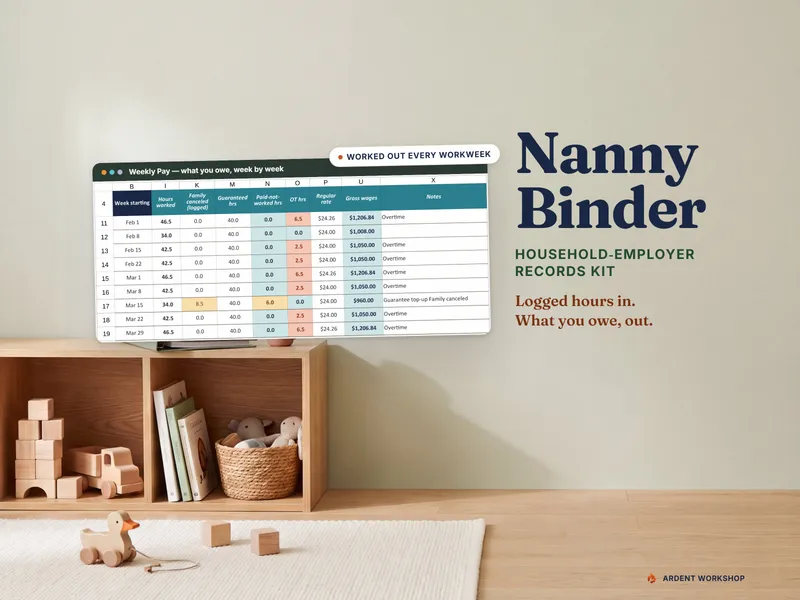
Nanny Binder & Household-Employer Records Kit — Nanny Timesheet, Guaranteed Hours, Overtime, PTO & Year-End Records (Excel + Google Sheets)
A nanny binder for Excel & Google Sheets that works out the wages you owe each week — guaranteed hours, overtime, PTO — and keeps the year's pay records.
Life AdminView details - $24.95 Spreadsheet

Caregiver / Aging-Parent Care Binder — Medications, Refill Status, Appointments & an Emergency Handoff Sheet That Writes Itself (Excel + Google Sheets)
Caregiver binder for an aging parent: medications flagged Order now or Due soon by refill date, appointments, care team and documents — plus a self-writing emergency handoff sheet.
Life AdminView details
Frequently asked questions
- Am I a household employer if I hire a nanny?
- Generally yes, if you can control not only what work is done but how it is done. IRS Publication 926 treats someone who hires a person to care for their children in their home, and who controls both, as a household employer. Exceptions exist, so check Publication 926 or ask a tax professional about your situation.
- Is a nanny an employee or an independent contractor?
- The deciding factor in Publication 926 is control. If you set the schedule, the duties and the way the work is done in your own home, the caregiver is generally your employee, even if you call them a contractor or pay them in cash. A label in an agreement does not settle it.
- What if I use an agency?
- When a nanny agency or home care agency is the employer, the agency handles the employment side. Many agencies only place a nanny and leave the family as the employer. Read the agreement to see who actually employs the caregiver. Under DOL Fact Sheet 79B, a third-party employer such as a home care agency cannot claim the live-in overtime exemption.
- Do I owe overtime to a nanny?
- Under DOL Fact Sheet 79B, live-in domestic service workers are exempt from the federal overtime requirement but not from minimum wage, while live-out domestic workers are owed time and a half for hours over 40 in a workweek under federal law. State and local law can require more, so check your state labor department.
- How long do I keep household-employee records?
- Publication 926 says to keep employment tax records at least 4 years after the due date of the return or the date the tax was paid, whichever is later. For Form I-9, USCIS says to keep it 3 years after hire or 1 year after employment ends, whichever is later.
- Does a household employer have to run payroll through a service?
- No law says a family must use a payroll service. Some families do, and some use a preparer or handle it themselves. Either way, the records are the same: dates, hours, rates, what was paid and when. A spreadsheet can keep those records, but it does not run payroll or file anything.