Preventive vs. reactive vs. deferred maintenance
Three words get used loosely and mean different things:
- Preventive maintenance is scheduled work done while everything still works — changing a filter, clearing a gutter, flushing a water heater. The trigger is the calendar, not a symptom.
- Reactive (or corrective) maintenance is work done after something breaks. The trigger is the failure. It tends to cost more — you are paying for the repair and for whatever the failure damaged on its way out — and it happens at the worst possible moment, because failures cluster in the weather that caused them.
- Deferred maintenance is preventive work you know is due and keep putting off. It is the category that quietly turns into reactive maintenance — and, on a house you eventually sell, the category a buyer's inspector finds.
What preventive home maintenance actually covers
Ardent Workshop's own schedule for an ordinary single-family home runs to 85 recurring jobs across ten systems. They fall into four rhythms:
- Monthly — the very short ones. Check the air filter, test the smoke and carbon-monoxide alarms, look under the sinks for a leak, test the GFCI outlets, wash the range-hood filter.
- Seasonal — the ones the weather forces. Clear the gutters in spring and again after leaf fall, clean the outdoor condenser before cooling season, service the heating before the first cold week, drain the outdoor spigots before a hard freeze.
- Annual — flush the water heater, clean the dryer-vent duct, sweep the chimney before the first fire, test the water heater's relief valve, professional heating and cooling tune-ups.
- Every few years — the ones nobody remembers without a written record: the water heater's sacrificial anode rod, pumping a septic tank, sealing a deck, and replacing the detectors themselves, which carry a manufacture date on the back and a limited service life.
Why the calendar is the hard part, not the work
Almost none of these jobs is difficult. What makes preventive maintenance fail is that the tasks arrive on completely unrelated schedules — monthly, twice a year, every three to five years — and none of them announces itself. A dirty filter looks like a filter. A water heater on its ninth year looks like a water heater. The failure is the first notification you get.
So the working definition of a preventive-maintenance system, as distinct from a list, is: something that tells you what is due now, in a place you pass anyway. A wall calendar, a card on the fridge, or a workbook you open on a set weekend all qualify. A twenty-tab list you saved and never reopened does not.
How to know which jobs are actually yours
A published maintenance list is usually longer than any one home needs, because it has to include every system some homes have. Of the 85 jobs in our own library, 39 exist only if a home has the thing they are about — things like central air, an accessible attic, a garage, a deck, a tank water heater, a septic tank, a well, in-ground irrigation, a fireplace, a sump pump and hard freezes — so close to half of our own list will not be yours. The first useful act of preventive maintenance is crossing those out, because a list you cannot finish is a list you stop reading.
The remaining tasks are worth ranking by what they prevent rather than by how long they take. Gutters and grading protect the foundation; the dryer vent is a fire risk; detectors are the only items with no acceptable failure mode; and a leak you find as a stain under a sink is a washer, while the same leak found as a ceiling is a ceiling.
Where the homeowner job stops
Preventive maintenance is mostly homeowner work, and a handful of it is deliberately not. Anything behind an electrical panel cover, gas appliances and gas lines, garage-door springs and cables, and the combustion and heat-exchanger checks inside a furnace are trade work — the last of those is the whole reason an annual heating service is on the calendar at all. Almost everything on a roof can be inspected from the ground with binoculars, which is worth knowing, because a fall off a ladder is the failure mode that turns a ten-minute job into a hospital visit.
And where a manufacturer's manual, an installer, or your local code says something different from a general schedule, follow them. A published interval is a sensible default; a manual is written about your actual equipment.
None of this is a home inspection. An inspector is paid to find defects that already exist, on one day, for a transaction; a preventive schedule is a rhythm meant to stop them forming. If something on your house is already wrong — a stain spreading, a smell of gas, a soft floor — that is a call to a qualified trade today, not a line item for next season.
Related templates and concepts
Preventive maintenance is the rhythm; a home maintenance log is the record of what was actually done, and a household operations manual is the wider reference for how the home runs. See printable calendar vs. a home-maintenance app for the two ways households usually try to keep the schedule, and the step-by-step guide to building a seasonal checklist if you would rather build your own. To start today, the free Seasonal Home-Maintenance Checklist puts the 40 monthly and seasonal jobs almost every home has on one printable page.
Templates that implement this
Two ways to keep a home on a maintenance rhythm
2 templates
An undated wall calendar and task-card set that puts 75 recurring jobs on the wall by season and month and moves the 10 long-cycle jobs onto record cards, and a workbook that keeps the service history, warranties and costs behind them.
- $8.95 PDF
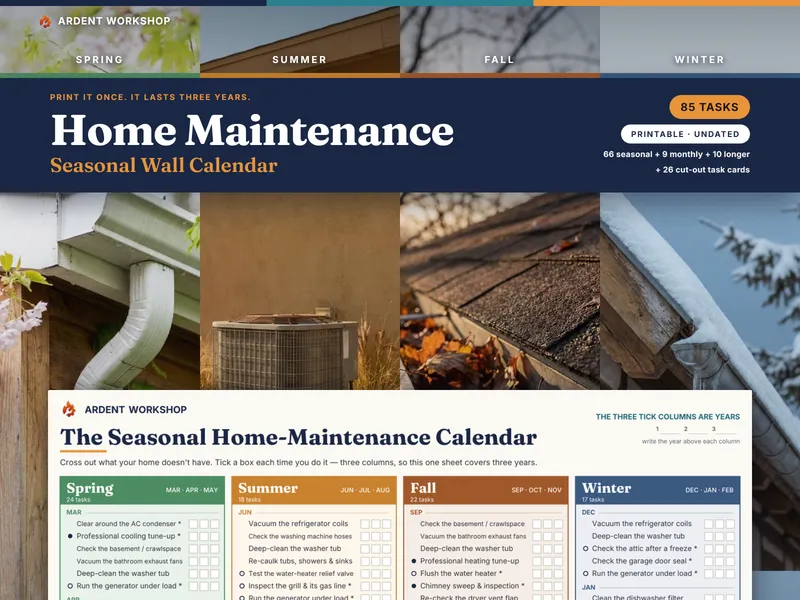
Home Maintenance Seasonal Wall Calendar & Task Cards — 85-Task Printable Set: Undated Wall Calendar, 12 Monthly Cards, Last Done & Next Due Records
85 home-maintenance tasks across 10 systems — 75 placed by season and month on one undated printable wall calendar, plus 12 monthly and 14 record cards.
Life AdminView details - $19.95 Spreadsheet
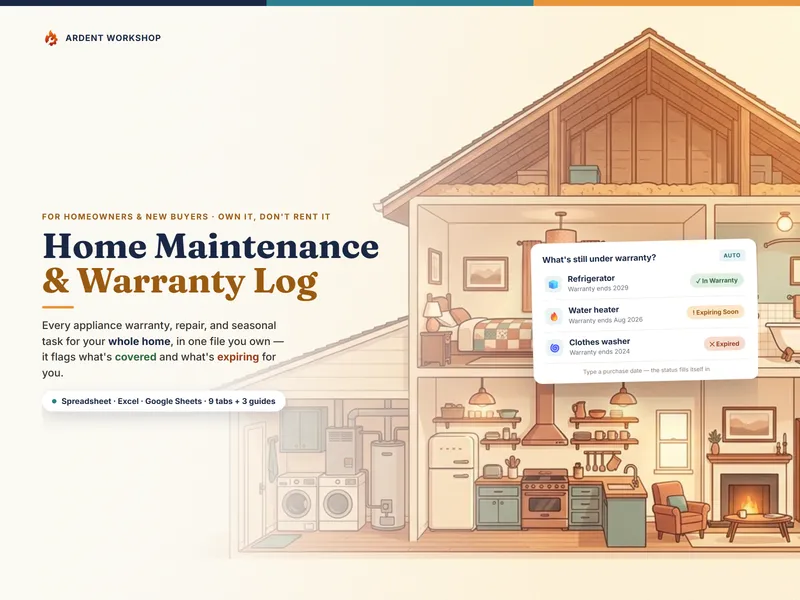
Home Maintenance & Warranty Log — Appliance Warranty Tracker, Repair Log & Seasonal Home Maintenance Checklist (Excel + Google Sheets)
Track every appliance warranty, repair, and seasonal task in one spreadsheet you own — type a purchase date and it flags what's still under warranty.
Life AdminView details