What a home maintenance log actually tracks
A useful home maintenance log answers four questions that otherwise live in scattered receipts, apps, and memory:
- Is it still under warranty? Each appliance's purchase date and warranty length, so you know whether a failure should be a free repair or one you pay for.
- What are the model and serial numbers? The two fields a warranty claim or a repair line asks for first — and the hardest to find once the sticker is dusty or hidden behind the unit.
- What's been done to it? The repair and service history — what broke, who fixed it, and what it cost — so the next technician isn't starting from scratch and you can see what a system really costs to keep.
- What upkeep is due? The recurring seasonal maintenance — filters, detectors, the furnace, the water heater — that keeps a home running and, often, keeps its warranties valid.
Why "warranty status" is the useful part
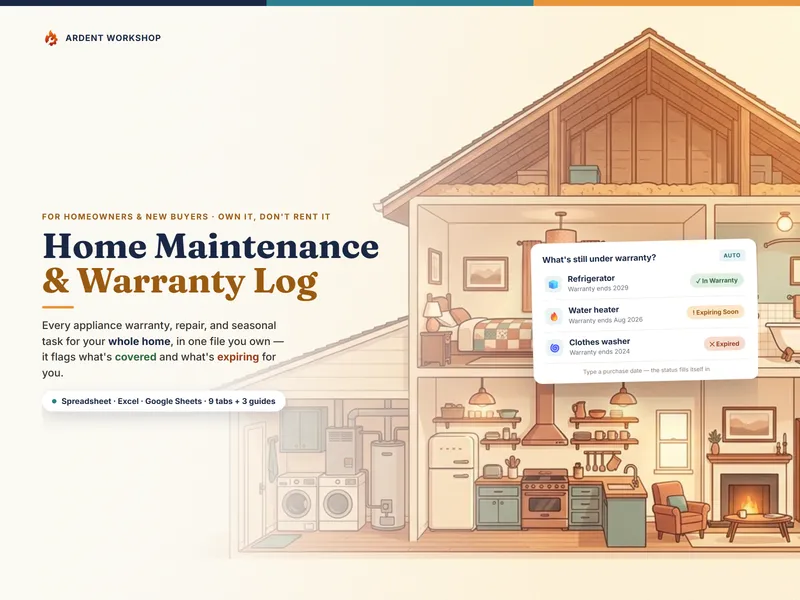
A plain list of appliances is only mildly helpful. The part that earns its keep is knowing, at a glance, what's still covered. Given a purchase date and a warranty length, a warranty end date is simple arithmetic — and from that, a status: still in warranty, expiring soon, or expired. A log that computes this turns a drawer full of receipts into a dashboard: you can scan down a column and see which items are protected, which are about to lapse (the window to register an extension or use the coverage), and which are on you now.
Home maintenance log vs. a manufacturer's app
Many appliance makers offer an app that stores their products' warranties. The limits are worth naming: it only knows about that one brand, so your fridge, furnace, and water heater end up in three different apps; it can require an account and a connection; and it can change, charge, or shut down. A home maintenance log is one file that holds every brand under your roof, plus the repairs and the upkeep, and it's yours to keep — see warranty log vs. manufacturer app for the full comparison.
How to start one in an afternoon
- Pick a tool. A spreadsheet is ideal because the warranty end date and status can calculate themselves as you type.
- Walk the house with the manuals and receipts. For each big-ticket appliance and system, record the brand, model, and serial number, the purchase date and price, and where you bought it.
- Add the warranty length in months (12 for a one-year warranty, 60 for five years). Let the log fill in when coverage ends.
- Log the next repair the day it happens — the details are freshest then and most useful a year later.
- Add the seasonal upkeep as a checklist, and tie the twice-a-year jobs to the clock-change weekends so you never have to remember the date.
- Store a copy where the household can find it, and glance at the warranty status twice a year.
The one rule that keeps it safe
A home maintenance log holds facts about what you own, not the keys to your accounts. Record model and serial numbers, purchase dates, and where the manuals and receipts live — never account logins, PINs, or full card numbers. Keep the paperwork's location in the log and the paperwork itself in a drawer or a folder; keep real logins in a password manager.
Related templates and concepts
A home maintenance log pairs naturally with other household records — a home inventory for insurance, and a household operations manual for how the whole home runs. Many households start one right after closing on a new home. Try the free Appliance & Warranty List to see the core of it in a single tab.
Templates that implement this
A workbook that keeps a home maintenance log
1 template
Track appliances and their warranty coverage — with the status calculated for you — log every repair with a running total, and work a pre-loaded seasonal maintenance schedule, all in one file you own.