Why seasonal beats “someday”
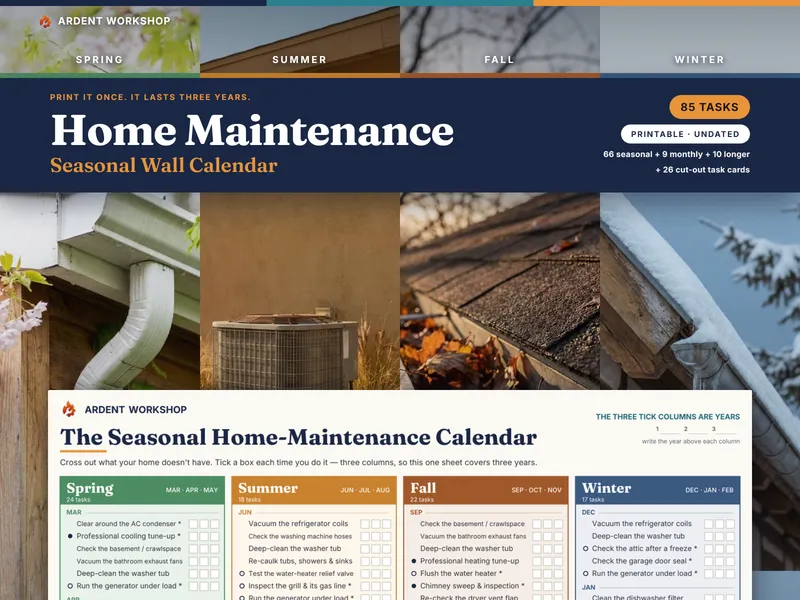
Home maintenance fails the same way every time: not because people don’t care, but because “clean the gutters” has no deadline, so it never happens — until the water backs up behind them and finds the fascia. Grouping the jobs by season gives each one a natural due date and a natural batch. You’re not maintaining a house every day; you’re spending one focused weekend a season, and letting the calendar tell you what’s next.
There’s a second reason to keep up with it, beyond avoiding damage: maintenance protects your warranties. Many manufacturers can deny a claim if a unit wasn’t serviced — an unmaintained furnace, a filter left until it choked the blower. The seasonal checklist and a warranty tracker are two halves of the same habit.
Step 1 — Spring: the reset after winter
Spring is about undoing winter and getting ahead of summer’s heat.
- Test smoke & CO detectors; replace the batteries. A working alarm is a home’s first warning of a fire or a carbon-monoxide leak; a dead battery is why many fail when they’re needed.
- Have the AC serviced before summer. A tune-up catches a weak capacitor or low refrigerant before the first heat wave — when every HVAC company is booked.
- Clean the gutters & downspouts. Clogged gutters send water into the foundation and fascia; a cheap job that prevents an expensive one.
- Inspect the roof for winter damage, test the sump pump before wet season (pour a bucket in the pit — a stuck pump is only discovered in the flood it should have stopped), and flush the water heater to clear sediment and add years to the tank.
Step 2 — Summer: protect against sun and water
- Reseal caulk around windows, doors, and tubs to keep water and drafts out.
- Clean the dryer vent & lint duct — a blocked vent is a fire risk and a slow, energy-wasting dryer.
- Vacuum the refrigerator condenser coils so the fridge doesn’t work harder than it needs to.
- Inspect and reseal the deck — sealing before the sun and rain get to it extends the life of the wood.
Step 3 — Fall: get ready before the cold
- Have the furnace serviced before winter. A fall tune-up finds a cracked heat exchanger or a CO risk before you rely on the heat.
- Drain and shut off exterior faucets; store the hoses. A hose left on can burst the pipe behind the wall in the first hard freeze.
- Clean the chimney and inspect the fireplace, reverse the ceiling fans and check the weatherstripping, and test the GFCI and AFCI outlets (press test and reset).
Step 4 — Winter: watch the risks the cold creates
- In a deep freeze, let a faucet drip. A trickle of water is far cheaper than a burst pipe.
- Clear snow and watch for ice dams at the roof edge — they push melt water up under the shingles and into the ceiling.
- Keep replacing the HVAC filter through the heating season.
Step 5 — The year-round tasks
Some jobs don’t wait for a season:
- HVAC air filter — every one to three months. The single task most worth automating in your memory.
- Run water in unused drains monthly so the traps stay full and sewer gas can’t rise.
- Test the garage door’s auto-reverse monthly (lay a board in its path).
- Check the fire extinguisher gauge quarterly.
A worked example: a season at a glance
Here’s what one season of the checklist looks like once it’s written down — the task, where it applies, and the reason it earns a spot. (Illustrative.)
| Task | Area | Why it matters |
|---|---|---|
| Service the furnace | HVAC | Finds a cracked heat exchanger or CO risk before you rely on the heat |
| Shut off exterior faucets | Plumbing | A hose left on can burst the pipe behind the wall in the first freeze |
| Clean the chimney | Fireplace | Creosote buildup is a common cause of chimney fires |
| Test GFCI outlets | Electrical | A dead GFCI no longer protects against shock near water |
Step 6 — Tie it to a rhythm, and keep it in one file
The checklist only works if you actually run it, so make it as low-effort as possible:
- Anchor the twice-a-year jobs to the clock-change weekends. Detectors, filters, and GFCI tests all pair naturally with resetting the clocks — no date to remember.
- Skip what doesn’t apply. No fireplace? Cross it off. The list is a starting library, not a set of orders.
- Date each task as you do it, so next year you can see at a glance what’s overdue.
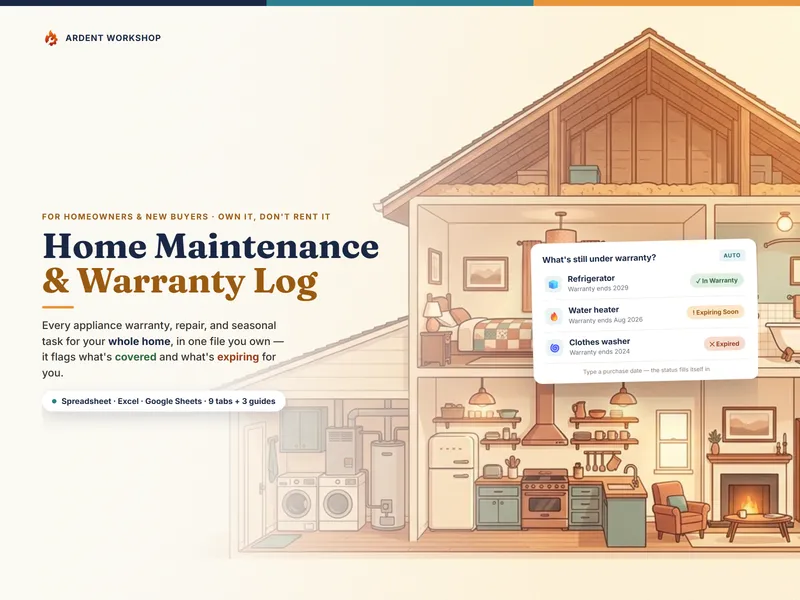
You can keep this on a sheet of paper, and for one season that’s plenty. If you’d rather start from a schedule that’s already written — twenty-two tasks grouped by season, each with the reason it matters — the Home Maintenance & Warranty Log comes pre-loaded with exactly that, alongside an appliance warranty tracker that flags what’s still covered and a repair log with a running total. It’s a workbook for Excel, Google Sheets, or LibreOffice — a file you own and keep, not a subscription app. Want to try the free piece first? The Appliance & Warranty List is a one-tab starter for the warranty side. This is a record-organizing and upkeep approach, not professional advice; for gas, electrical, or structural work, call a licensed pro.