You said “I’ll do it later,” and later never came. The dishes sat there for three days. The bathroom hasn’t been cleaned since… actually, you’d rather not think about it. And every time you bring it up, it turns into an argument about who does more around the house.
Sound familiar?
Here’s the thing: the problem isn’t laziness. It’s not that your partner, kids, or roommates don’t care. The problem is that many households drift into an invisible, unspoken system where one person ends up carrying the mental load of remembering what needs to happen — and everyone else waits to be told. That’s not a chore system. That’s a recipe for resentment.
A real chore system takes the guesswork out entirely. Everyone knows what they’re responsible for, when it needs to happen, and what “done” actually looks like. No nagging. No passive-aggressive dish-stacking. No “I didn’t know it was my turn.”
A family chore system that sticks has five parts: list every recurring task, estimate its time and difficulty, assign by preference, rotate the leftovers on a schedule, and review monthly.
If you’d rather not start from a blank page, the Chore Tracker is an Excel workbook that gets that plan out of one person’s head: pick from 96 preloaded chores, give each one a person and its days, and a built-in chart shows who has been assigned how many. The method below works with any tool, though, including a whiteboard.
Let’s build one.
Why Chore Systems Fail
Chore charts often fade fast, even in households where everyone is willing to help. Three patterns are worth watching for:
- Vague assignments. “Keep the kitchen clean” means something different to every person in your house. Without a clear definition of done, you’re setting everyone up to disappoint each other.
- Unfair distribution nobody agreed to. If one person assigned all the chores without input, the system feels imposed rather than shared. People are less likely to follow rules they had no say in creating.
- No visible accountability. When chores live in one person’s head, there’s no shared record of what’s been done and what hasn’t. That breeds both resentment (“I always do everything”) and denial (“I did it last week… I think”).
A chore system that sticks solves all three: it defines tasks clearly, distributes them fairly, and makes progress visible to everyone.
How to Build Your Chore System in 5 Steps
Step 1: List Every Recurring Task in Your Home
This is the step most people skip, and it’s the most important one. Sit down — ideally with everyone in the household — and brain-dump every recurring task. Not just the obvious ones like dishes and laundry, but the invisible work too:
- Daily: dishes, wiping counters, taking out trash, feeding pets, tidying common areas
- Weekly: vacuuming, mopping, bathroom cleaning, laundry (wash, fold, put away), grocery shopping, meal prep
- Biweekly/Monthly: dusting, cleaning appliances, changing sheets, organizing pantry, yard work
- Seasonal: deep cleaning fridge, washing windows, gutter cleaning, rotating seasonal items
Write down everything. The goal is to make invisible labor visible. When it’s all on paper, people often realize for the first time how much actually goes into running a household.
Step 2: Estimate Time and Difficulty for Each Task
Not all chores are created equal. Wiping down a counter takes a few minutes. Deep-cleaning the bathroom takes thirty. Assign a rough time estimate and a difficulty rating (light, medium, heavy) to each task.
| Task | Frequency | Time (min) | Difficulty |
|---|---|---|---|
| Dishes | Daily | 15 | Light |
| Vacuum common areas | Weekly | 20 | Medium |
| Clean bathrooms | Weekly | 30 | Heavy |
| Grocery shopping | Weekly | 60 | Medium |
| Mow the lawn | Weekly | 45 | Heavy |
| Wipe kitchen counters | Daily | 5 | Light |
| Laundry (full cycle) | 2x/week | 20 | Medium |
| Dust all rooms | Biweekly | 25 | Light |
This table becomes your negotiation tool. When someone says “I’ll just do the dishes,” you can show them that’s 15 minutes of light work versus the 30-minute heavy-lift of bathroom duty. Fair doesn’t mean everyone does the same number of tasks — it means everyone contributes roughly the same effort.
Then define done. Write one line for each task saying what it means. “Clean the bathroom” leaves room for an argument; “scrub the toilet and sink, wipe the mirror, mop the floor” doesn’t.
Step 3: Assign Based on Preference, Then Balance the Rest
Here’s a counterintuitive trick: start with preferences, not obligations. Ask everyone which chores they genuinely don’t mind doing. You’ll be surprised — some people find vacuuming meditative. Others actually enjoy grocery shopping.
Assign preferred tasks first. Then look at what’s left (the tasks nobody wants) and distribute those evenly based on the time and difficulty estimates from Step 2.
For families with kids, assign age-appropriate tasks and tie them to clear expectations, not punishments. Many 6-year-olds can put away their toys and set the table, and many 12-year-olds can handle laundry and vacuuming, but adjust for your own kids. The Chore Tracker makes this especially easy — its 96 preloaded chores are sorted by type, you assign each one to a family member, and you can attach a reward to an individual chore if that’s your style.
Step 4: Set a Rotation Schedule
For the tasks nobody loves, rotate on a fixed schedule. Weekly is a good default — it’s frequent enough that no one gets stuck with bathroom duty forever, but infrequent enough that the system doesn’t feel chaotic. (In the Chore Tracker, a rotation means changing the name in the Assigned To column when the turn passes.)
A few rotation strategies:
- Simple weekly rotation: Each person shifts to the next set of “nobody’s favorite” tasks every Monday.
- Zone-based rotation: Divide the house into zones (kitchen, bathrooms, living areas, outdoor). Each person owns a zone for the week, then rotates.
- Pick-your-poison: Each week, the person whose “turn” it is gets first pick among the remaining unassigned tasks. This adds a small element of choice that makes rotation feel less rigid.
Whatever you choose, write it down and put it somewhere everyone can see it. A shared spreadsheet, a whiteboard on the fridge, a printed chart on the wall, or a full family command center. Visibility does a lot of the reminding for you.
Step 5: Review and Adjust Monthly
No system survives first contact with real life without adjustments. Schedule a quick 10-minute household check-in once a month:
- What’s working? Keep doing it.
- What’s not working? Change it without blame. Maybe someone’s work schedule shifted and they can’t do Wednesday tasks anymore. Maybe a task takes longer than estimated. Adjust.
- Any new tasks to add? Seasonal changes, new pets, or life events create new chores. Add them before they become invisible labor again.
The monthly review is how a system keeps up with real life instead of ending up in a drawer.
Tips for Specific Living Situations
For Couples
A common trap for couples is the “I notice mess at different thresholds” problem. One partner sees crumbs on the counter and cleans immediately; the other genuinely doesn’t notice until there’s a small mountain. This is often less about who cares more than about different tolerance levels.
The fix: Define “done” explicitly for each task. “Clean the kitchen” becomes “wipe counters, load dishwasher, sweep floor, take out trash if more than half full.” When the standard is written down, you stop arguing about whether something was actually done.
For Roommates
Roommates need a system that’s impersonal and transactional — no guilt trips, no assumptions about “how things should be.” Treat it like a roommate agreement:
- Shared spaces only. Nobody polices bedrooms.
- Stick to rotation. No trading tasks informally without updating the system — that’s how things fall apart.
- Add consequences you all agree on. Missed your week? You pick up an extra task next rotation, or you owe the house coffee.
For a shared house, the Roommate & Shared-Household Operations Kit, a workbook for Excel and Google Sheets, does the rotating for you: its chore tab fills itself in for eight weeks and flags anyone carrying more than a fair share. It also covers splitting rent and bills with roommates fairly, which is usually the next argument.
For Families With Young Kids
Kids don’t need a perfect system — they need consistency and a sense of contribution. A few principles to try:
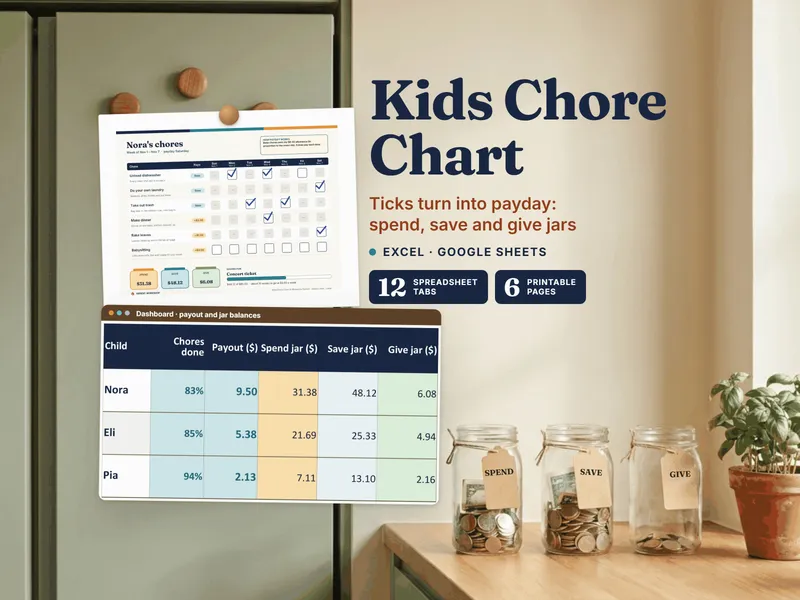
- Make it visual. Pictures, stickers, and checkboxes are easier for younger kids to follow than a text-heavy spreadsheet. Print a chart with images of each task.
- Pair up at first. Do new chores together before expecting kids to do them solo. “We clean the bathroom together this week, you do it yourself next week.”
- Celebrate completion, not perfection. A 7-year-old’s version of “clean” won’t match yours. That’s okay. Praise the effort and gently coach the skill over time.
What to Track (and How)
A chore system without tracking is just a suggestion. You need a way to record who did what and when — not as surveillance, but as a shared record that helps settle the “I always do everything” argument.
What to track:
- Task name and who it’s assigned to
- Completion status (done/not done) for each period
- Notes for exceptions (“skipped this week — traveling”)
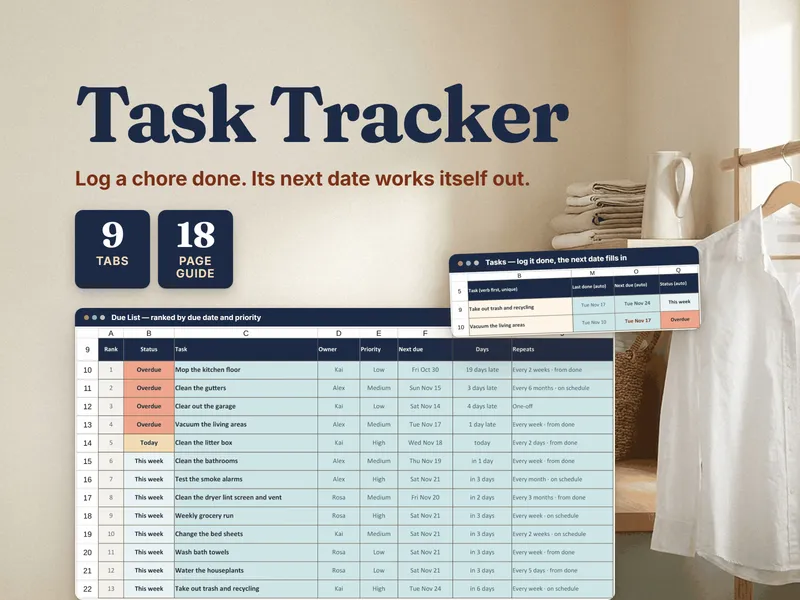
You can use a whiteboard, a shared note, or a spreadsheet. If you want something purpose-built, the Chore Tracker is built around the plan: assignments, a calendar view, a per-person view, and a Notes column for those exceptions. Its X marks set which days a chore is due rather than record that it got done, so tick off the week on a printout or keep a running note in the Notes column. For a recorded status on every task — especially if you’re also tracking things like bill payments or home projects — the Task Tracker handles recurring to-dos, deadlines, and a status for each one.
The key is picking one tool and actually using it. The best system is the one your household will stick with.
The Real Goal Isn’t a Clean House
Here’s what nobody says about chore systems: the real goal isn’t a spotless home. The real goal is eliminating the invisible mental load that one person (often one specific person) carries alone.
When tasks are written down, assigned fairly, tracked visibly, and reviewed regularly, something shifts. The person who used to carry everything in their head can finally let go. They don’t have to remind, nag, or do it themselves “because it’s easier.” And everyone else stops feeling like they’re being managed.
That’s not just a cleaner house. That’s a fairer one.
If the full list from Step 1 feels like too much, start small. Pick five tasks. Write them down. Assign them. Track them for one week. Then expand from there. A chore system doesn’t need to be perfect on day one — it just needs to exist. Those five tasks can go on the fridge today, or into the Chore Tracker if you want the list and the chart waiting for you.