Two jobs, one umbrella term
"Advance directive" gets used loosely, and that looseness causes a lot of confusion. Underneath it, there are really two separate questions, and a document (or a pair of documents) can answer either or both:
- Who decides. If you cannot make or communicate a medical decision yourself, who is authorized to make it on your behalf? This role goes by different names in different places — a healthcare proxy, a healthcare power of attorney, an appointed substitute decision-maker, an enduring guardian for health matters — but the job is the same: one named person, empowered to speak for you to clinicians.
- What you'd want. Separately from who decides, what treatments, interventions, or circumstances would you accept or refuse? This is usually called a living will, an advance decision, or a statement of wishes. It's a record of your preferences, not a person.
Some jurisdictions let a single form do both jobs at once and call the whole thing an "advance directive." Others require two separate documents with two separate names and two separate sets of formalities. There is no single answer that holds everywhere — the safest habit is to ask, of any document put in front of you, which of the two jobs it's actually doing, rather than assuming.
If the harder part is that your family has never talked about any of this, the free How to Start the Conversation mini-guide is a 14-page opening for that conversation — no signup.
When it starts working
Decision-making capacity is different from the physical ability to speak. The document and local law determine when an agent's authority or a treatment instruction applies; a person who retains capacity continues to make their own care decisions. MedlinePlus explains the roles of living wills and healthcare powers of attorney. Discuss the document's operation with your healthcare team and check your jurisdiction's requirements.
Why "the family knows what she wants" isn't enough
A conversation helps relatives understand your preferences, but memories can differ and the care team needs to know who has authority. Keep valid documents accessible and discuss them with the person you appoint and your clinicians. A binder can record where the documents are; it does not replace them.
What an advance directive is not
It is not a will — it does not distribute your estate. Some forms also address matters such as organ donation; do not assume every provision ends at death. It does not govern money: paying bills, managing accounts, or selling property while someone is alive but incapacitated is usually a separate authority, most often called a financial power of attorney, and an advance directive doesn't grant it. And it doesn't appoint anyone to the practical, ongoing work of caring for a person or their affairs — it appoints a decision-maker for medical questions specifically, in the specific circumstance that the person can't answer those questions themselves. The informal note that tells a family where all of those documents are kept is a different thing again — see what a letter of instruction is.
Where this commonly breaks down
- Signing one and telling nobody where it is. A directive that exists only in a drawer at home does nothing at a hospital forty minutes away at two in the morning. It has to be findable by the people who'll need it, not just by the person who wrote it.
- Naming a decision-maker without ever asking them. A son or daughter can be listed as the healthcare proxy and have no idea they've taken on the role, no idea what their parent would actually want, and no warning that they might be asked to make an impossible call under pressure. The appointment and the conversation are two different steps, and skipping the second one defeats the purpose of the first.
- Writing wishes too generally to act on. "I don't want to be kept alive by machines" sounds clear until a clinician has to apply it to a specific, borderline situation nobody anticipated. The more concrete the wishes — the circumstances, not just the sentiment — the more useful the document is to the person trying to honor it.
It varies by country and by state or province — deliberately not covered here
What a document is called, what formalities make it valid (witnesses, notarization, a specific form), what it can legally achieve, and even whether the two jobs above are combined or kept separate — all of that is set locally, and it changes from one country to the next and often from one state or province to the next within the same country. This page deliberately doesn't pick one jurisdiction's system and present it as the answer. Find your own jurisdiction's guidance, or ask a qualified professional, before you act on anything here.
Where to start
Before any document gets signed, there's usually a conversation that surfaces what to even put in it — and that conversation is where families tend to stall. The free How to Start the Conversation mini-guide covers the Know/Hold distinction above, the openings that tend to work, and a full first sitting on documents and where everything is — 14 pages, no signup.
Having the Talk, the full Family Wishes & Records conversation playbook, carries the whole method: four sittings, 48 questions written the way you'd actually say them out loud, and a reference on the eight jobs a signed will doesn't do. Four PDFs, 97 pages, bought once and kept — a conversation guide you own outright, not a subscription.
If you're weighing this against a document generator, see conversation playbook vs estate-planning software — what each one actually produces, and why the order you use them in matters. For the conversation itself, step by step, see how to talk to your parents about their will.
Templates that implement this
What Ardent Workshop makes for this
3 templates
A playbook for having the conversation about wills, wishes, and where the records are — plus the binders that keep what you find afterward organized.
- $12.95 PDF
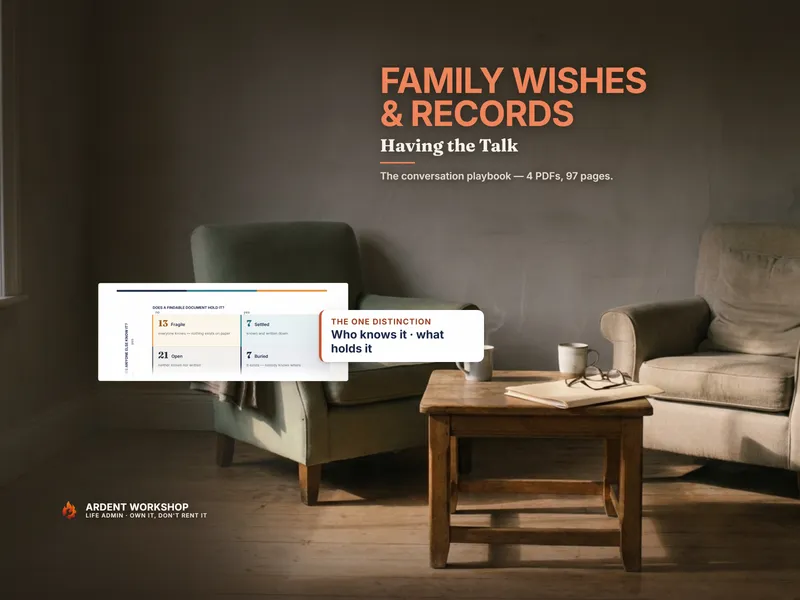
Having the Talk - Family Wishes & Records Conversation Playbook: How to Ask About Wills, Wishes & Where Everything Is
A plain-language playbook for the talk with an aging parent about wills, wishes and where the records are - 4 PDFs, 97 pages, 48 questions in four sittings.
Life AdminView details - $24.95 Spreadsheet

Caregiver / Aging-Parent Care Binder — Medications, Refill Status, Appointments & an Emergency Handoff Sheet That Writes Itself (Excel + Google Sheets)
Caregiver binder for an aging parent: medications flagged Order now or Due soon by refill date, appointments, care team and documents — plus a self-writing emergency handoff sheet.
Life AdminView details - $29.95 Spreadsheet
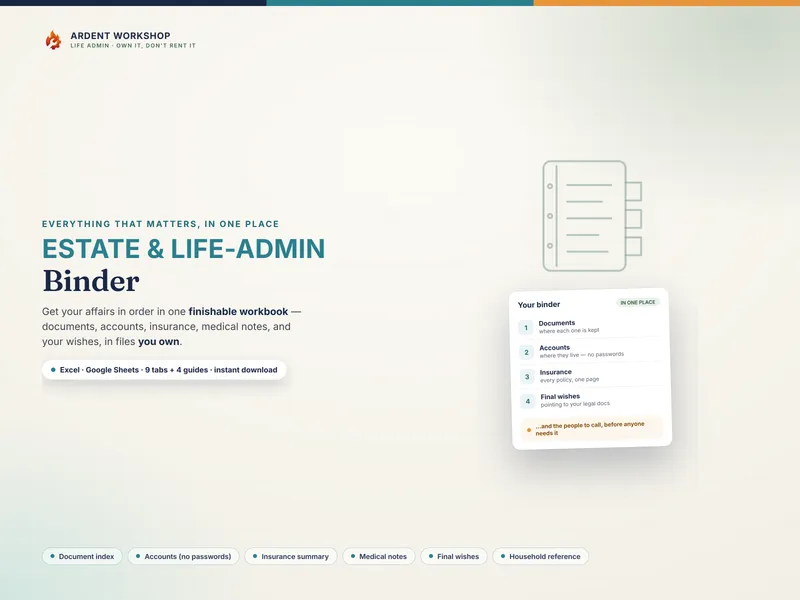
Estate & Life-Admin Binder — Important Documents, Accounts, Insurance & Final Wishes Organizer (Excel + Google Sheets)
An estate & life-admin binder for Excel & Google Sheets — organize important documents, accounts, insurance, and final wishes in one file you own.
Life AdminView details
Frequently asked questions
- Is an advance directive the same as a living will?
- A living will is one of the two things people usually mean by "advance directive" — the part that records what treatments you would and would not want. The other part names who decides for you. Some places combine both into a single document and call the whole thing an advance directive; others keep them separate, under different names. Check what your jurisdiction calls each piece before assuming a form titled one way covers the other.
- What's the difference between an advance directive and a healthcare power of attorney?
- A healthcare power of attorney (also called a healthcare proxy, or the appointment of a substitute or enduring guardian, depending on where you are) names a person to make medical decisions for you. It does not, by itself, say what those decisions should be — that's the living-will or statement-of-wishes half. "Advance directive" is the umbrella term that can mean the appointment, the wishes, or a single document doing both, so it's worth asking which one a form in front of you actually is.
- When does an advance directive take effect?
- The document and local law determine when an agent's authority or treatment instruction applies. Decision-making capacity is not the same as the physical ability to speak. A person who retains capacity continues to make their own care decisions.
- Does an advance directive cover money or property?
- No. An advance directive is about medical care and who can make medical decisions for you. Who pays your bills, manages your accounts, or sells your house if you can't is a separate kind of authority — usually a financial power of attorney — and who inherits what after you die is the job of a will. None of those three documents substitutes for the others.
- If my family already knows what I want, do I still need an advance directive?
- What a family knows and what a written document holds are not the same thing. A hospital team making a decision about you may never have met your family, and has no way to verify that what a relative says on your behalf is actually what you'd choose, even when every family member is telling the truth and agrees with each other. Family conversations can help communicate your wishes, but accessible documents give the care team a clearer record of your instructions and chosen decision-maker. Closing that gap is the job a written directive is meant to do: it turns a family's shared memory into something a stranger at a hospital can act on. Whether you should obtain one, and which one, is a question for your own jurisdiction.
- Do I need a lawyer to make an advance directive?
- It depends on where you live — some places let you complete a standard form with witnesses and no legal professional involved; others expect more formality. Because the rules, the required wording, and what a document can legally achieve vary by country and by state or province, find your jurisdiction's own guidance or a qualified professional rather than relying on a form built for somewhere else.
- What happens if I don't have an advance directive?
- Who gets asked to decide for you, and by what standard, falls to whatever your jurisdiction's default rules say — which vary widely, and which may not match who you'd have chosen or what you'd have wanted. Having a directive doesn't just add a document; it replaces a default you didn't choose with a decision-maker and a set of wishes you did.