Sources checked September 28, 2026.
There are two separate things a family can be missing: nobody has asked the questions, or nobody has written the answers down. Estate-planning software is built for the second problem — it takes what you tell it and turns it into a draft to review and execute under the applicable requirements. That is what it is built for, and if a family's gap is a missing document, software (or a legal professional) is the right next step. Its blind spot is the first problem: a questionnaire alone cannot establish whether a relative’s answers reflect the person’s own instructions. Check whether the service includes appropriate review.
The quick verdict
- Estate-planning software is for a family that already knows what the person wants — because they have asked, plainly, and been told — and now needs that answer turned into a signed instrument. Check its supported documents and jurisdiction; use qualified help when the situation needs it.
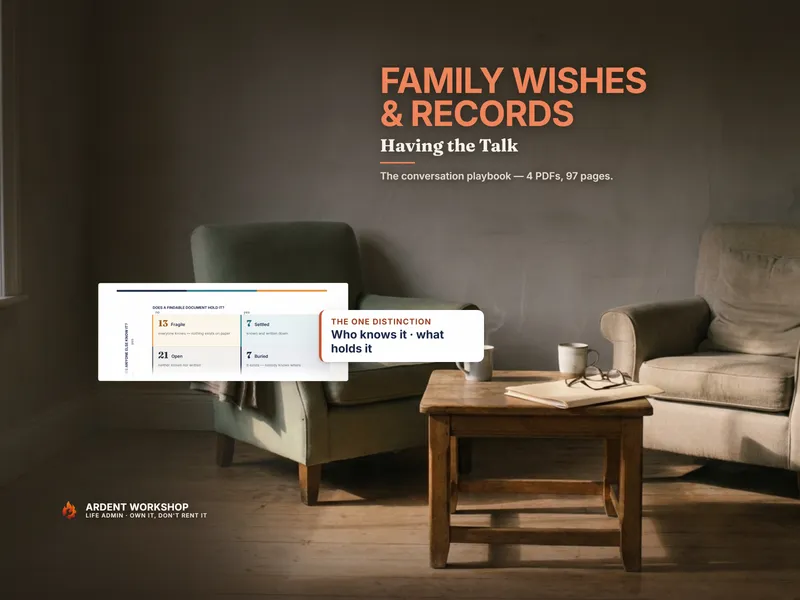
- A conversation playbook is for the other situation: a family that has never actually had the conversation, and would be guessing if they sat down at a questionnaire today. It gets you the answers, and a written record of them, to take into a drafting or advice session.
Two questions: understanding wishes and recording them
For each important wish or document, ask two questions: does the person want others to know it, and is there an accessible record? A playbook provides prompts for that conversation. Software may also include planning questions, document storage or professional review; compare what the specific service does rather than assuming it only generates forms.
A relative’s confident answer is not a substitute for the person’s own instructions or lawful authority. Record uncertainty instead of guessing. For example, write “ask about the preferred healthcare decision-maker” rather than filling in a name the person has not chosen. Keep the conversation voluntary and seek appropriate help if capacity, pressure or conflicting instructions are concerns.
Side by side
| What matters | Conversation playbook | Estate-planning software |
|---|---|---|
| What it produces | Answers, gathered by asking, and a written record of what was said | A draft to review and execute under applicable requirements |
| Which axis it addresses | Whether anyone else knows the person's wishes | Whether a document holds an answer, once you have one |
| Cost shape | One-time purchase, kept and re-read as circumstances change | Licensed rather than owned — per document generated, or for a term |
| Ownership | The file is yours — no account needed to open it later | The document is yours; the tool that made it is an account you keep |
| Jurisdiction | Jurisdiction-neutral by design — asks what a document must do, not what it is called | Necessarily tied to the jurisdiction it drafts the instrument for |
| When circumstances change | Re-run a sitting and re-tick the ledger for what changed | Re-answer the questionnaire and regenerate the document |
| A year later | A dated written record of what the person actually said, and where things are | A signed document — if it is still findable and still current |
| Legal effect | None — it prepares the conversation; it is not an instrument | May draft a legal instrument; validity depends on the document and applicable law |
Where estate-planning software genuinely wins
When the person knows what they want and the situation fits a service’s scope, software can organize answers into a draft. Compare supported jurisdictions, revision options and access to professional review. Check names, choices and signing instructions rather than treating questionnaire completion as the finish line. A playbook can supply useful notes for that review, including unanswered questions.
Where the conversation playbook wins
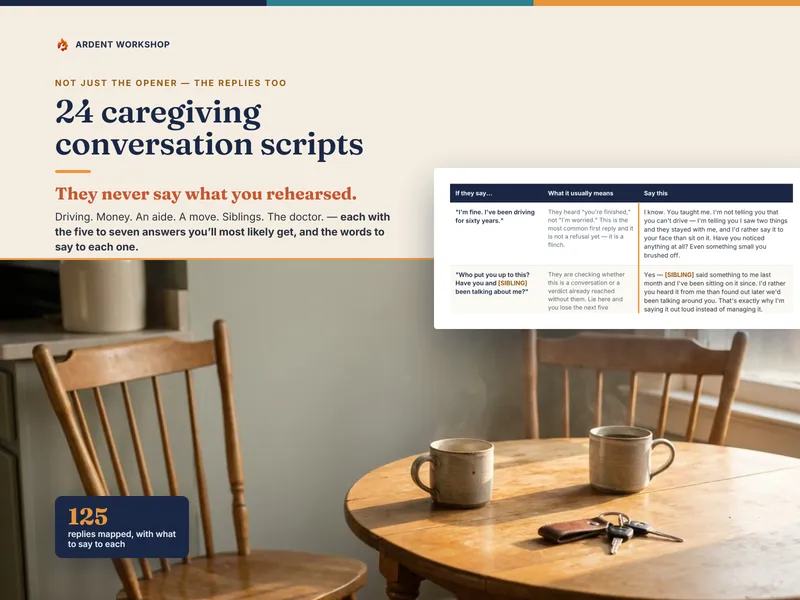
On getting the right answers, first. No questionnaire can tell you whether the person filling it in actually knows what their parent wants, or is estimating. A playbook exists to close exactly that gap — by giving the family a way to ask, in an order that covers the ground, with a place to write down what was actually said. The free How to Start the Conversation mini-guide is 14 pages of exactly that, with no signup, if you want to see the shape of it before deciding.
On surfacing what a document alone cannot find. A signed will or directive says nothing about whether the family knows it exists, can find it, or has ever discussed the wishes behind it. A family can have a perfectly drafted document and still be stopped cold, because nobody knows where it is. A conversation is what turns "we have a document somewhere" into "we know exactly where it is and what it says."
And on jurisdiction. A conversation asks what a document needs to do — who decides on care, who can act on money, where the originals live — without naming a specific form, so the same questions work wherever the family lives. Software that drafts an actual instrument cannot do that; the instrument itself has to be built for one place, which is exactly why it is a poor fit for the earlier, more general step of simply finding out what someone wants.
The order that tends to get reversed
One easy pattern to fall into is software first: a family opens a questionnaire and answers it on behalf of a parent they have not actually sat down with, because the software is right there and the conversation is not. The resulting draft may reflect assumptions the parent never agreed to. When practical, start with a short conversation — it does not need to be exhaustive, just deliberate — and the drafting session after, once the family actually knows the answers instead of guessing them.
What neither one is
A conversation playbook does not determine which legal instrument is needed, and a software recommendation is not automatically suitable. MedlinePlus distinguishes advance directives and healthcare proxies. For wills, California’s execution rules are one example of jurisdiction-specific requirements. Get appropriate advice about document choice and execution; the playbook’s role is to organize the wishes, questions and document locations you bring.
A conversation is preparation, not a condition you must finish before seeking help. Do not delay an urgent appointment while trying to complete every question. Preserve the person’s choices and distinguish current instructions from older notes.
Which one first
Free and ungated, if you want to see the method before buying it: How to Start the Conversation mini-guide carries the one idea, four openings that work and three that do not, and the whole of the first sitting — twelve questions, with a worked example already filled in. 14 pages, no signup, no email asked for.
For the full method, Having the Talk runs all four sittings, 48 questions in total, and produces the written record you can bring to the document-drafting session — whichever tool you use for it — to check answers and identify gaps. Four PDFs, 97 pages, bought once and kept: files on your own drive, with no account and nothing to renew.
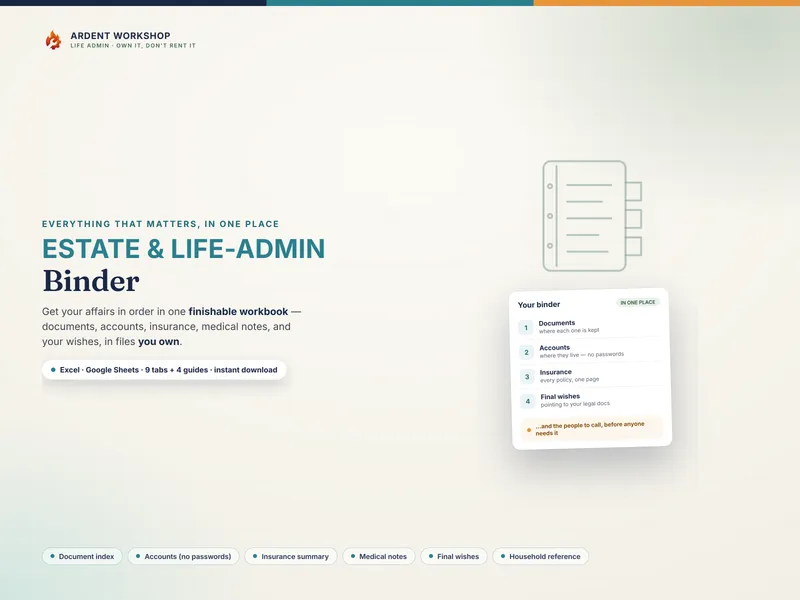
Background reading: what an advance directive is, and what a letter of instruction is. For the conversation itself, step by step, see how to talk to your parents about their will. If what you are actually weighing is where a household's records should live rather than how to gather them, that is a different comparison: spreadsheet vs estate-planning app.
Frequently asked questions
- Should I use a conversation playbook or estate-planning software first?
- If wishes are unclear, a short conversation can help prepare questions and record the person’s own preferences before drafting. There is no mandatory sequence: urgent legal needs or questions about capacity may call for professional help immediately. Conversation notes improve preparation but do not guarantee that a generated document is accurate or valid.
- Does a conversation playbook replace a will or a directive?
- No. A playbook records a conversation and where documents are kept; it does not itself create a will or appoint a decision-maker. Software may help draft documents within its supported scope. The person’s wishes, authority, applicable law and execution requirements still need attention.
- We already used estate-planning software. Is a conversation playbook still worth it?
- It can still help. Review whether the person’s wishes have changed, whether the relevant people know the documents exist, and where the current originals are kept. Keep conversation notes separate from signed documents; a new note does not automatically amend a will or directive.
- Is a conversation playbook legal or financial advice?
- No. It is a structured way to have a conversation and write down what was said — general guidance, not legal, medical, tax, or financial advice, and not a substitute for any of them. It never tells a family which document to obtain or sign; that decision, and the paperwork behind it, belongs with a qualified professional in the reader's own jurisdiction.
- Does this work in any country?
- That is the point of a conversation, as opposed to a document: it does not need to know which jurisdiction you are in. A good playbook asks what a document needs to do — who decides on medical care, who can act on money, where the originals are kept — rather than naming a specific form, so the same set of questions works whether the family ends up at a solicitor's office, a notary, or an attorney's, wherever they live. Software that drafts an actual instrument cannot avoid being jurisdiction-specific, because the instrument itself has to be.