You know this conversation is overdue. What you don’t know is the first sentence.
That’s not a small gap — it’s the whole reason this stays unstarted for years. Everyone in the family has a vague sense that “something should probably be figured out,” and nobody wants to be the one who brings it up, because bringing it up feels like announcing that you think your parent is dying, or that you’re after something. Neither is true, and most of the dread comes from not having a shape for the conversation at all.
Here’s a shape that works: find out on your own what your family actually knows and can prove, pick an opening that doesn’t sound like an accusation, spend the first real conversation on documents rather than feelings, and stop before it gets uncomfortable. Do that, and the second conversation is much easier than the first.
Do the twenty minutes on your own first
Before you say a word to anyone, sit down alone and go through the things that matter — the will, who’s authorized to act if your parent can’t, the list of accounts, the funeral wishes — and ask two separate questions about each one:
- Does anyone besides your parent know this?
- Does a document exist, somewhere findable, that says so?
Families rarely separate those two questions, and the gap between them is where the trouble tends to live. “It’s all handled” is an answer to the first question. It tells you nothing about the second. A parent can be completely confident that everything is arranged and still be the only person alive who knows where any of it is.
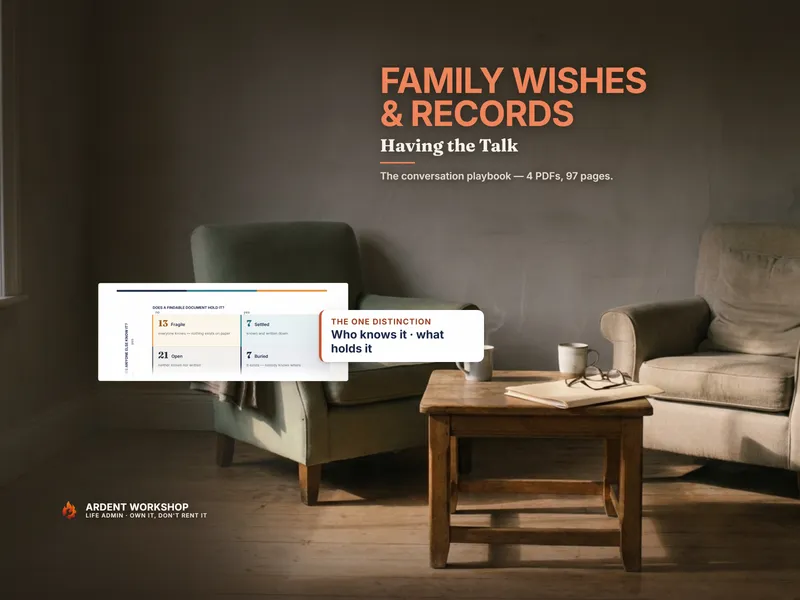
Cross the two questions and four positions fall out:
| Position | Known? | Held (a document exists and can be found)? | What it actually means |
|---|---|---|---|
| Settled | Yes | Yes | Someone else knows, and could put their hands on the paper. Confirm it once a year and move on. |
| Fragile | Yes | No | The family can describe the plan accurately but couldn’t produce it tomorrow. This looks like “handled” from the outside. |
| Buried | No | Yes | A signed document exists somewhere. Nobody in the family knows it, or where to look. |
| Open | No | No | Neither a document nor an answer exists yet. This is where the first conversation should start. |
Go through it honestly, one item at a time, before you talk to anyone. Expect more of it to sit in Fragile and Open than feels right — not because nothing was ever done, but because doing something and telling somebody turn out to be two different acts, and it’s easy to manage only one of them.
Pick an opening that actually works
The opening that tends to work best is to make it about yourself first: that you sat down and did your own, or that you tried and got stuck and could use their input. It works because it removes the one implication that shuts this conversation down before it starts — that you think they’re declining, or that you’re circling something of theirs.
A few openings that hold up:
- “I finally did mine, and it made me realize I have no idea what your plan is.”
- “I want to make sure I’d know what to do — could we go through where things are, sometime this month?”
- “I got stuck on a couple of things doing my own paperwork. Can I ask you how you handled it?”
And a few that tend to backfire, worth naming so you can steer around them:
- Leading with money or inheritance. Even asked with the best intentions, it’s easily heard as “what do I get,” and the conversation rarely recovers.
- Raising it at a holiday gathering, with everyone present. An audience turns a private conversation into a performance, and your parent is likely to manage the room instead of answering you.
- “Before anything happens to you.” Meant kindly, it lands as a countdown. Talk about now, not about the thing you’re both trying not to name.
Start with documents, not wishes
Make the first real sitting about locating what already exists, not about decisions or feelings. This is the least emotionally loaded ground you can stand on, and it produces the fastest visible win — which is exactly what makes a second sitting possible.
Four questions cover it:
- Where is the signed will physically kept?
- Who is the professional who prepared it, and how would someone reach them?
- Who already has a key to the home, or could let someone in? (Who holds it — never the code or the combination.)
- Where do the identity documents live?
Notice what isn’t in that list: what the will says, who gets what, or whether it should be changed. Those are real questions, and they matter — but they belong to a later sitting, once documents-and-locations has already gone well once. Nothing here asks your parent to decide anything. It only asks them to point.
Stop while it’s still going well
End a sitting early, while everyone is still comfortable, and you make the next one possible. Push a sitting until someone is tired, short with you, or visibly relieved it’s over, and it tends to be the last one you get for a while.
Watch for the shift: the moment your parent stops answering and starts managing you — reassuring you, changing the subject, checking the time — is the signal to wrap up, not to push through for one more question. Twenty comfortable minutes are worth more than sixty that end badly.
Write down what was said, within the hour
While it’s fresh, write three or four lines: what was actually said, in the words your parent used, dated, noting who was in the room. Then read it back once, out loud, before anyone gets up from the table.
That last step — reading it back — is easy to skip, and it does a lot of the work. It heads off a lot of later disagreement about what was actually decided, because everyone heard the same summary at the same moment and had a chance to correct it on the spot.
One firm rule: record where a thing is and who holds it — never a password, a PIN, a safe combination, or a full account number. Those change, they don’t belong in a shared family record, and locating a document is a different problem from getting into one.
Expect an errand list, not a finish line
Here’s the honest reframe, and it’s worth saying out loud to whoever you’re doing this with: a conversation can only move the knowing axis. It can turn Open into Fragile — now everyone knows the plan, even if nobody can produce it. It can turn Buried into Settled — now the family knows where the document already was. What a conversation can never do on its own is turn Fragile into Settled, because that requires actually locating, copying, or filing something, and that’s an errand, not a sentence.
Don’t measure the sitting by whether the will is now sitting on the kitchen table. Measure it by whether the next step is now clear and short enough that someone will actually do it.
If they shut it down
Sometimes the answer is a flat no, or a change of subject that never comes back around. That is often less about the will itself than about what your parent thinks the conversation implies about them — that they’re failing, that you’ve decided something without them, that this is the beginning of losing control of their own life.
You don’t fix that by explaining your good intentions again, more forcefully. You fix it, if you fix it, by backing off and coming back in a month with something smaller: not “let’s finish this,” but “can you just tell me who your solicitor or attorney is, in case I ever need to reach them?” A smaller ask, asked again later, tends to get further than the same ask pressed harder.
Where to start
You can run all of this with a notebook and the questions above, and plenty of families do exactly that. If you’d like the model laid out for you — the four positions, the openings that work, and the whole of the first sitting, written to hand your family — the free How to Start the Conversation guide covers that in 14 pages. No signup, no email asked for.
Having the Talk is the full version: four PDFs, 97 pages, 48 questions organized across four sittings, so the conversation stays this small and this manageable all the way through — not just for the first twenty minutes. You buy it once and keep it: files that sit on your own drive, with no account and nothing to renew.
Worth knowing before the sitting on documents: what an advance directive is, what a letter of instruction is, and — if someone in the family is about to open a document generator — how a conversation playbook compares with estate-planning software.