Almost every family means to have this conversation. Almost none of them know how to start it — and that, not squeamishness and not money, is why it keeps getting postponed. A task with no visible edge is a task nobody can tell they have begun.
Having the Talk gives that task an edge. It is a reading-and-asking playbook, not a binder you fill in alone: four PDFs and 97 pages that take a family from “we should talk about this sometime” to a written record of what was actually said, and a short list of what is still open. The ledger inside is filled in by hand, on paper or on screen; there is no software of any kind.
It is written for the adult child who has to raise this with an aging parent — the person who knows the conversation is overdue and does not know what the first sentence is.
The one idea: knowing something is not the same as holding it
Every fact a family needs carries two entirely separate questions. Does anyone besides the person themselves know it? And does a findable document hold it, so that a stranger — a hospital clerk, a bank, a lawyer nobody has met — could act on it without being told?
Those two questions are independent, and almost nobody separates them. Four positions fall out:
- Settled — someone else knows it, and a document backs it up.
- Fragile — everyone knows. Nothing on paper says so.
- Buried — it is written down somewhere. Nobody knows that, or where.
- Open — neither known nor written.
The dangerous square is Fragile, and it is the one nobody worries about, precisely because it feels solved. A family can recite exactly what their mother wants at the end of her life. At a hospital desk that is worth nothing, because the people making the decisions have never met them and have no reason to take their word for it.
Why a conversation produces a to-do list, not a finish line
Here is the thing the playbook computes, and the reason it is arranged the way it is: a conversation can only move one of those two axes. Asking a question turns an Open item into a Fragile one, and a Buried item into a Settled one. It cannot make a Fragile item held — no amount of talking creates a document.
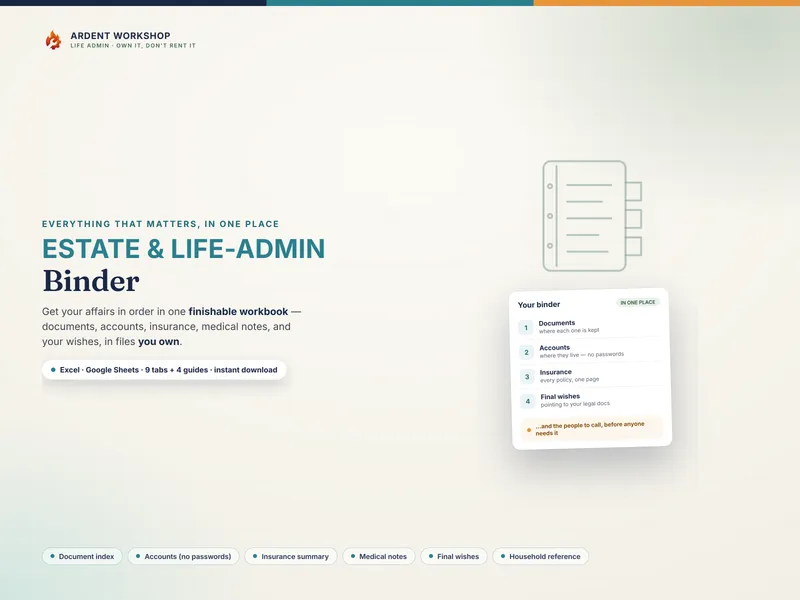
So a good sitting does not end in “done.” It ends in a short, ranked list of errands that did not exist as a list the day before. The playbook shows that arc on one invented worked family, and the ledger produces it for yours. When the asking is finished and the filing starts, the Estate & Life Admin Binder is where those answers go.
The 72-hour test
Not every item matters equally, and the ones that matter most are not always the ones a family worries about. So 18 of the 48 items are marked for a single question: would someone need this within three days if that person simply could not be asked? The ledger counts those 18 on their own, and the playbook then splits the unresolved ones into the ones nobody knows and the ones nobody wrote down — two problems that need completely different work. What you get is a number rather than a worry.
Four short sittings, not one impossible summit
| Sitting | What it settles | Plan for |
|---|---|---|
| One | The documents, and where everything is | about 45 min |
| Two | The money and the obligations | about 50 min |
| Three | The care and the medical wishes | about 60 min |
| Four | The practical and the sentimental | about 40 min |
Each chapter carries its own opening move, its questions in a deliberate order, a stop rule, how to end it so there is a next one, and the specific way that particular sitting tends to go wrong. Documents go first because they are the least emotionally loaded and produce the fastest visible win.
There is also arithmetic for which sitting to run first — score each one by what it costs to leave its unanswered questions unanswered, divided by how long asking them would take. The ledger prints every item’s weight, effort and asking time, so you can run it on your own family rather than taking anyone’s word for the order.
When it does not go to plan
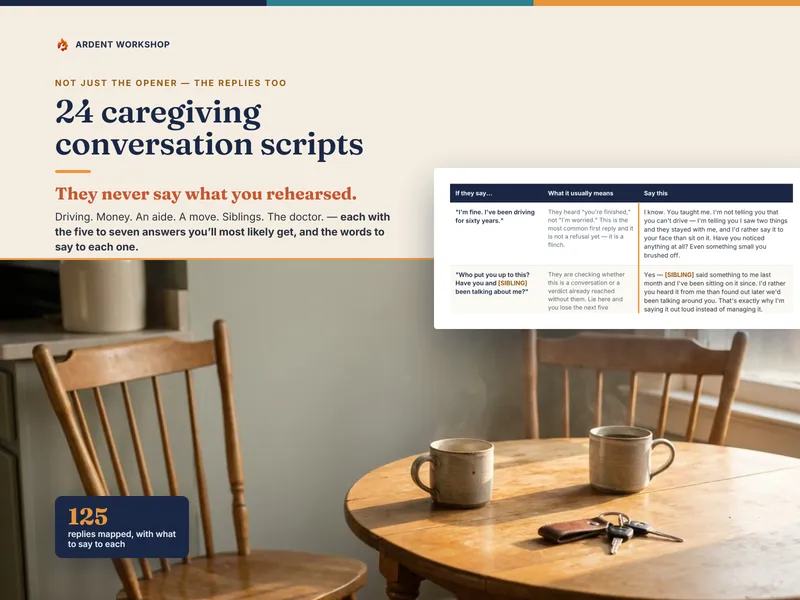
Two full chapters are about the conversations that stall. Eight things a parent actually says to close the subject down — “it’s all taken care of,” “you’re being morbid,” “when the time comes you’ll know what to do” — with what each usually means underneath, what to say in the moment, and how to reopen it in a month without starting from the beginning. Then five sibling roles, including the one who thinks it is morbid and the one already counting, written without contempt for either. If this turns out to be the first of many such conversations, Caregiver Conversations: Scripts & Letters covers the calls and letters that tend to follow.
And a section on the answer that is a genuine, settled no: what a family can still do without that person’s participation, and how to hold it without resentment.
Written to travel
Document names and formalities differ by country and by state. So this playbook names what documents do — a directive that names who decides, a document that lets someone act on money during life — rather than what they are called in any one place, with a plain-language glossary of the 42 terms you will meet along the way. It will send you to a professional better briefed than you would otherwise arrive; it will never tell you which document to obtain.
What it is not
General guidance only. This is not legal, medical, tax, or financial advice, and it is not a will, a directive, or any other instrument. The worked family is invented for illustration, and the five-point weights the ledger uses are this playbook’s own editorial judgment rather than measured data.
Every page asks where a thing is and who holds it — never a password, a PIN or a combination. Nothing is uploaded anywhere; keep the ledger you fill in wherever you already keep private family papers.
Try the opening for free
If you would rather see the method before buying it, the opening is free and ungated: How to Start the Conversation carries the one idea, four of the openings that work and the three that do not, and the whole of Sitting One — twelve questions, with a worked example already filled in. No signup, no email. It is also the right thing to send the sibling who is not going to read a whole playbook.
Own it, don’t rent it
No subscription, no account, no vault that stops working when someone stops paying for it. Four PDFs you download once and keep — and re-read in five years, when something has changed and the answers need revisiting.