How a VTuber actually works
Three pieces sit behind every VTuber stream, and knowing them explains most of what fans argue about:
- The model. The character art itself, drawn by an illustrator. Most VTubers stream with a 2D model, typically rigged in Live2D — layered artwork set up so it can turn, blink, and change expression. A 3D model, which allows full-body movement, is a separate commission, which is why a 3D debut is treated as a milestone in its own right.
- The rigging and tracking. Software maps the performer's webcam face — and sometimes hand or full-body capture — onto the model, so the character reacts in real time. This is why VTuber streams feel live rather than animated.
- The performer. A real person, streaming live, and usually anonymous — a separation the fandom treats as the performer's to keep. The artist and the rigger, by contrast, are normally credited: fans call them the model's mama and papa, which is the closest the format has to a screen credit.
The term is a contraction of "virtual YouTuber." Kizuna AI, who debuted in late 2016, is generally credited with the phrase. The name stuck even though YouTube is no longer the only home for the format — Twitch is the other major platform, and many VTubers stream on both.
VTuber agencies and indies: the real dividing line
Agency or indie is the fandom's most load-bearing distinction, and the first thing a fan will tell you about a talent. It changes what you can expect from them.
An agency (sometimes called a company or corpo) signs talents, commissions the character design, handles rigging, scheduling, licensing, merch production, concerts and rights management, and takes a cut of the revenue in return. Agency talents debut in cohorts — a generation or a wave — often under a regional branch, so a fan's shorthand for a talent is "agency, then generation." The two best-known agencies are Japanese: hololive production, operated by Cover Corporation, and Nijisanji, operated by ANYCOLOR — both of which ran English-language branches alongside their Japanese rosters as of 2026. Other agencies operate at smaller scale, in Japan and elsewhere, and the list changes as companies launch, merge, and close.
An indie is independent: they commission their own model, keep full control of what they stream and what they sell, and keep the revenue — along with every cost and every piece of admin. Indies have no generation and no branch, which is why a well-built roster leaves those fields free text rather than forcing an agency structure onto everyone.
The practical difference for a fan is predictability. Agency talents come with scheduled events, official merch drops, ticketed concerts, and a membership tier that renews monthly. Indies are looser: a Twitch subscription, a Ko-fi, a limited merch run when they feel like it. Neither is better, but they cost you in different shapes, and a following that mixes both is where spending gets hard to see.
The vocabulary, in plain English
Most of the fandom's shorthand is Japanese, and most of it is genuinely useful once translated. These nine come up in the first week; a further handful follows the table.
| Term | What it means |
|---|---|
| Oshi | The one you support above all the others. From a Japanese verb meaning to push or back someone. Having several is normal; having a single oshi is a statement. |
| Oshimark | The emoji a talent asks fans to use as their marker, in chat and in usernames. Scanning a comment section for oshimarks tells you whose audience turned up. |
| Zatsudan | A free-talk stream — no game, no set topic, just talking. Usually the format regulars love most and the hardest to explain to anyone else. |
| Utawaku | A singing or karaoke stream, often taking requests from chat. Often left unarchived, usually for music-licensing reasons. |
| Unarchived | A stream deliberately not left up afterward. If you weren't there live, there is nothing to catch up on — which is why fans guard the karaoke slots on their calendars. |
| Superchat | A paid, highlighted chat message (YouTube spells its own product "Super Chat"). The most visible form of support, and the one most likely to be sent in the moment. |
| Membership | A recurring paid tier, usually monthly — YouTube channel membership, a Twitch subscription, or an agency fan club — normally unlocking members-only streams (mengen) and emotes. |
| Graduation | A talent retiring the character and leaving. The word is used for both amicable departures and contract endings, and what happens to the archive varies by agency. |
| Clipper | A fan who cuts highlights from long streams and reposts them, often subtitled. Clips are a common first encounter with a VTuber. |
A handful more come up constantly: a debut stream is a talent's first appearance and the date anniversaries count from; a guerrilla stream is one announced minutes before it starts; a collab is two or more talents streaming together; a watchalong is a talent reacting to something in sync with chat; and an endurance stream is one that runs until a goal is met, however long that takes.
Why VTuber spending is unusually hard to see
Fans of most hobbies can at least guess what they spend. VTuber support resists that, for a structural reason: the money and the attention arrive through completely different doors, and neither leaves a record the other can see.
- Memberships renew silently. A monthly tier bills whether or not you watched, and there is no prompt that asks you whether it is still earning its place.
- Superchats are impulsive. They happen because a song landed at eleven at night, not because you budgeted for them.
- Merch is announced mid-stream. Drops and voice packs are time-limited by design, so the decision window is short.
- Attention is scattered. Hours are spread across YouTube, Twitch, archives and clips, so no single platform holds your watch history.
- Schedules are in someone else's time zone. Japanese agencies post in Japan Standard Time, which is UTC+9 all year with no daylight saving; English-language agencies and indies post in their own local time.
The consequence is a specific, common, and completely undramatic situation: a membership still billing every month for a talent whose schedule moved to a slot you can never make. Nobody notices, because nothing puts the charge and the hours on the same page.
How to keep track of a following
- Write down who you follow. Talent, agency or indie, the generation or wave, and the day you started. It sounds trivial until you try to remember the fourth one.
- Look up each debut date once. It is the field everyone skips, and it is what makes anniversary countdowns possible.
- Log hours roughly, not perfectly. "About ninety minutes, archive" is accurate enough to be useful; a stopwatch is not the point.
- Put memberships on one monthly scale. A quarterly fan club and a monthly membership are not comparable until you convert them.
- Convert event times to your own clock when you log them, not when the stream starts. That is the difference between catching an unarchived karaoke and reading about it afterward.
The free My Oshi List does the first two of those — one tab holding talent, agency, generation, tier and following-since, with days following and each debut anniversary counted for you. It is an .xlsx you download and keep, with no signup and no email; Excel and LibreOffice open it directly, and Google Sheets takes it as an import.
The paid VTuber Stream & Oshi Tracker does the rest. It adds:
- a stream log and a support log, joined into what each talent costs you per hour watched;
- the gap between the share of your money a talent takes and the share of your attention;
- an events tab that converts an announced time in any zone to your own clock and counts down;
- a per-agency rollup and a 28-term glossary in the file.
It is one workbook for Excel, Google Sheets and LibreOffice, and the Google Sheets version arrives as a one-click "Make a copy" link rather than an import.
Common questions
What does "oshi" mean?
Your oshi is the talent you support above all the others — from a Japanese verb meaning to push or back someone. Having several is normal; declaring a single oshi is a statement.
Are VTubers real people?
Yes. A VTuber is a live performer streaming in real time; only the on-screen appearance is animated. The performer is usually anonymous, and the fandom treats that anonymity as theirs to keep.
How do VTubers make money?
Through the same mix as other streamers, weighted differently: paid channel memberships and subscriptions, superchats, merchandise and voice packs, ticketed concerts and events, sponsorships, and original music. Agency talents share that revenue with the company; indies keep it and cover their own costs.
What is the difference between an agency VTuber and an indie?
An agency supplies the character design, rigging, management, merchandising and events, and takes a share of revenue; the talent debuts in a generation or wave under a branch. An indie commissions their own model, keeps full control and all the revenue, and carries every cost and every piece of admin themselves.
Related terms and templates
Tracking a wider fandom? See what a media backlog is, or cost per hour watched — the same arithmetic applied to streaming subscriptions. Neighboring fandoms with their own vocabulary: K-pop photocards and wuxia. For the catalog itself, browse the Trackers line, or the wider Ardent Workshop glossary.
Templates that implement this
Track the talents you follow
4 templates
Who you follow, what you watch, and what you spend supporting them — in one owned spreadsheet.
- $6.95 Spreadsheet

VTuber Stream & Oshi Tracker — Support-per-Hour Workbook for Excel & Google Sheets
A VTuber tracker for Excel & Google Sheets that joins your stream hours to your membership, merch and superchat spending — and shows which oshi gets which.
TrackersView details - $4.95 Excel
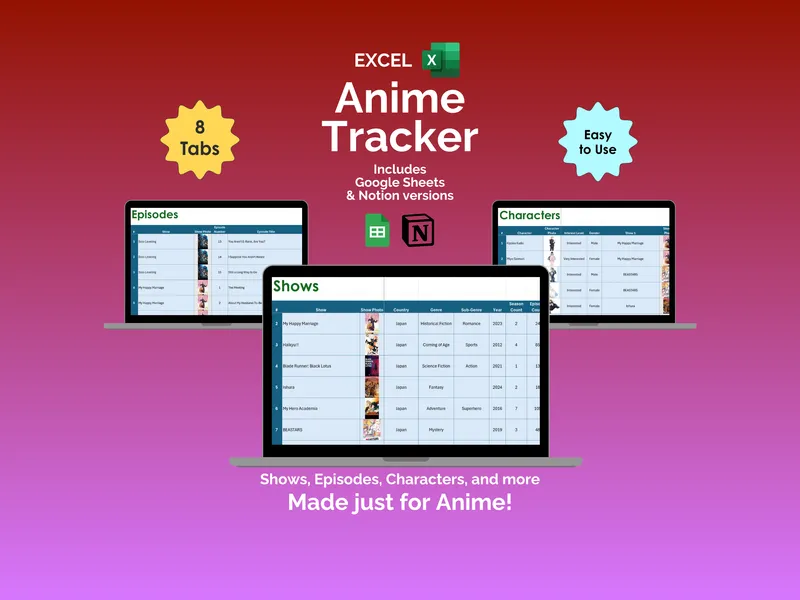
Anime Tracker - Excel
Three shows in progress, zero clue where you left off. This anime tracker Excel spreadsheet logs shows, episodes, characters, critic ratings, and viewing stats across 8 tabs.
TrackersView details - $6.95 Spreadsheet
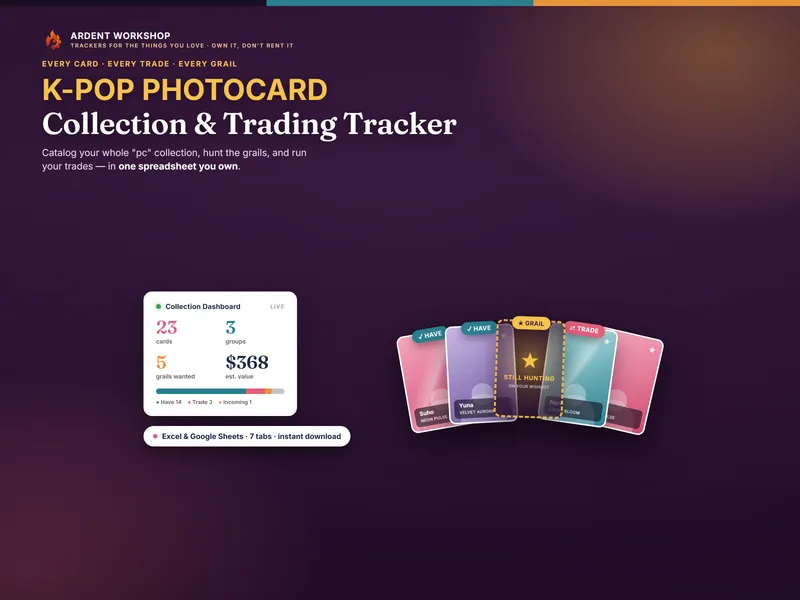
K-Pop Photocard Collection & Trading Tracker — Excel & Google Sheets
A K-pop photocard collection and trading tracker for Excel & Google Sheets — catalog every card, hunt grails, run trades, and see it on a live dashboard.
TrackersView details - $12.95 Spreadsheet

Streaming-Service Value & Watchlist Workbook — Cost Per Hour Watched, Keep/Rotate/Cancel Verdicts & a Rotation Planner for Excel & Google Sheets
A streaming tracker for Excel & Sheets that joins what each service costs to what you actually watched — cost per hour, a verdict, and a rotation plan.
TrackersView details