In ten minutes you can know two things you almost certainly don’t know right now: what your hobby cost you last year, and what a single session of it actually costs you.
Not a guess. An actual number, pulled from actual receipts.
The short version: pick one hobby and one twelve-month window, pull receipts from three places (marketplace order history, card statement, and the hobby’s own platform), sort every line into four buckets — collection, consumables, subscriptions, events — total them, then divide by the collection items and by times used.
Why hobby spending is invisible
Hobby spending hides not because it’s large but because it never arrives as one line item. A $34 expansion here, a $12 sleeve pack there, a $180 splurge in March, a club membership that renews so quietly you’ve forgotten the amount. Rent arrives once a month in a way you cannot miss; your hobby arrives a few dozen times a year in amounts small enough to feel free.
So the annual total lives nowhere — not in your head, not on a statement, not in the app. Which is why the honest answer to “how much do you spend on this?” is almost always “not that much, I think.” The audit’s only job is to replace that sentence with a number.
How to track hobby spending in 10 minutes
Four passes. Set a timer if you like — it genuinely fits in a coffee break.
-
Pick one hobby and one year. One — not all of them. Last calendar year or the trailing twelve months, either works, as long as you don’t move the goalposts halfway through. (30 seconds.)
-
Pull the receipts from three places. The only part that takes real time:
- Your marketplace order history, searched by the category.
- Your card or bank statement, searched for the three or four merchants you buy from most. Search by name, don’t scroll — that’s how you catch the local shop you forgot.
- The hobby’s own platform — club fee, digital subscription, in-app purchases, convention badge.
Copy every hit into one list, date and amount. A local file is fine; you never need an account number. Don’t categorize yet. (4 minutes.)
-
Sort every line into four buckets, total each one, and add the four. The four-bucket table in the next section is the whole method. (4 minutes.)
-
Divide twice. Annual total ÷ items in bucket 1 ≈ all-in cost per item (everything you spent, spread across the things you kept). Annual total ÷ times you used the hobby ≈ cost per use. Don’t count sessions exactly — estimate: typical sessions per month × 12, or scan your calendar for game nights, class dates, and finished projects. (1 minute.)
Nine and a half minutes, worst case.
The four buckets (and where to find each one)
Most hobby spending sorts cleanly into four buckets, and splitting them matters because they behave differently: one is a shelf you could sell, one is gone forever, one renews whether you show up or not.
| Bucket | What’s in it | Where to find it | Sample year spend |
|---|---|---|---|
| 1. The collection | The things themselves — sets, games, books, cards, kits, tools | Marketplace order history, hobby-shop charges | $640 |
| 2. Consumables & supplies | Paint, glue, sleeves, yarn, filament, dice bags, storage | Small repeat charges on your statement | $185 |
| 3. Subscriptions & memberships | Monthly boxes, digital services, club dues, print magazines | Your recurring-payments list — the easiest bucket to miss | $216 |
| 4. Events & travel | Conventions, tournaments, meetups, badges, parking, the hotel | Calendar cross-check against your statement | $310 |
| Annual total | The four buckets added together | — | $1,351 |
In prose, so it’s readable on any screen: $640 + $185 + $216 + $310 = $1,351 for the year.
(Those figures — and the item and session counts in the next section — are an illustrative worked example, not survey data. Your buckets will look nothing like them; that’s the point of using your own receipts.)
Bucket 3 is the one most likely to surprise you. A $12 monthly box is $144 a year, and it renews whether you opened the last three or not — the same blind spot that makes how much you’re spending on subscriptions worth its own look.
Cost per use: the hobby spending number that changes what you buy
Annual total is the number that surprises you. Cost per use is the number that changes your behavior, because it’s the only one that separates an expensive thing you love from an expensive thing you merely own.
Say the sample year’s bucket 1 held 18 items, and you estimate 40 sessions:
- $1,351 ÷ 18 items ≈ $75 all-in per item. That’s every dollar — supplies, dues, travel — spread across the 18 things you kept, so it lands well above what those items averaged. It shows whether you’re buying a few big things or a constant trickle of small ones.
- $1,351 ÷ 40 sessions ≈ $34 per session. This is the honest one. Put it next to what an evening out costs you — a couple of movie tickets, a round of golf, dinner — and decide for yourself whether the hobby is earning it.
That’s the point: a spending audit isn’t a guilt exercise. It gives you a benchmark, and the benchmark is what makes the next part possible. Walk the shelf with that $34 in your head and sort it, by eye, into three piles:
- Earning its place — you reach for it constantly. Buy more like this.
- Overpriced but loved — barely used, and you’d buy it again anyway. Keep it, guilt-free.
- Sealed, unplayed, unread — it cost real money and returned nothing. That’s your buying pattern showing you something.
The by-eye version takes a minute. The precise version — cost per use on every individual item — needs a use count per item, which is exactly what a tracker exists to keep.
How to keep your hobby spending number up to date
The one-time audit is worth ten minutes. The version that keeps working is a file you add a row to when you buy something — so next year’s audit is already done, and cost-per-use updates itself every time you use the thing.
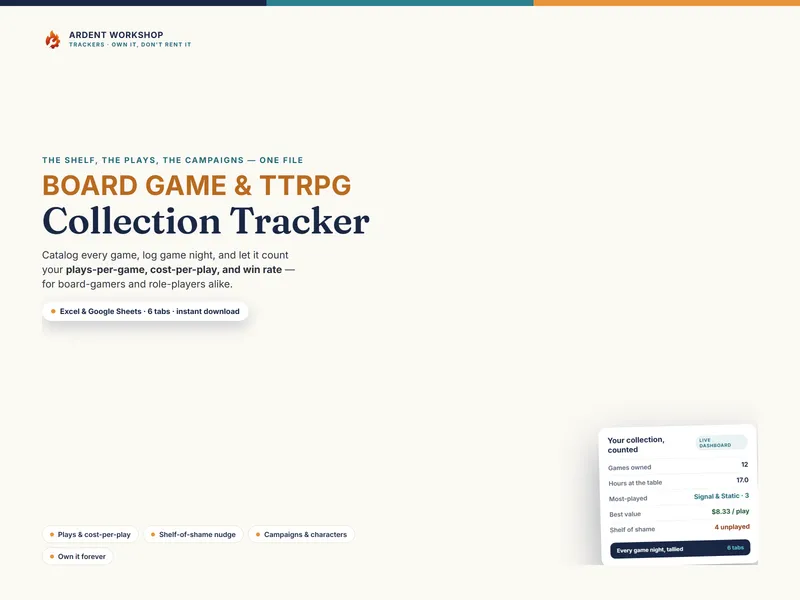
- Board Game & TTRPG Collection Tracker — computes plays-per-game and cost-per-play on every row, and surfaces the “shelf of shame” for you.
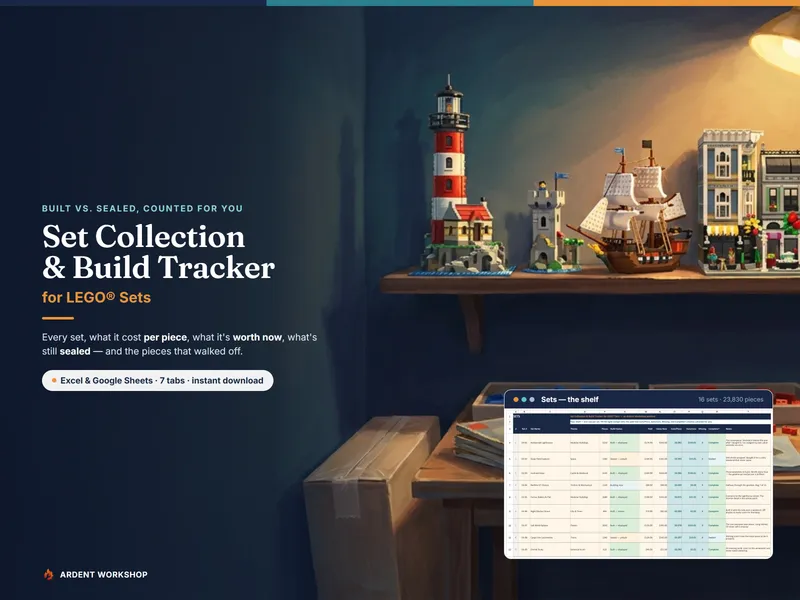
- Set Collection & Build Tracker — the same for LEGO sets, with cost per piece and a count of what’s still sealed.
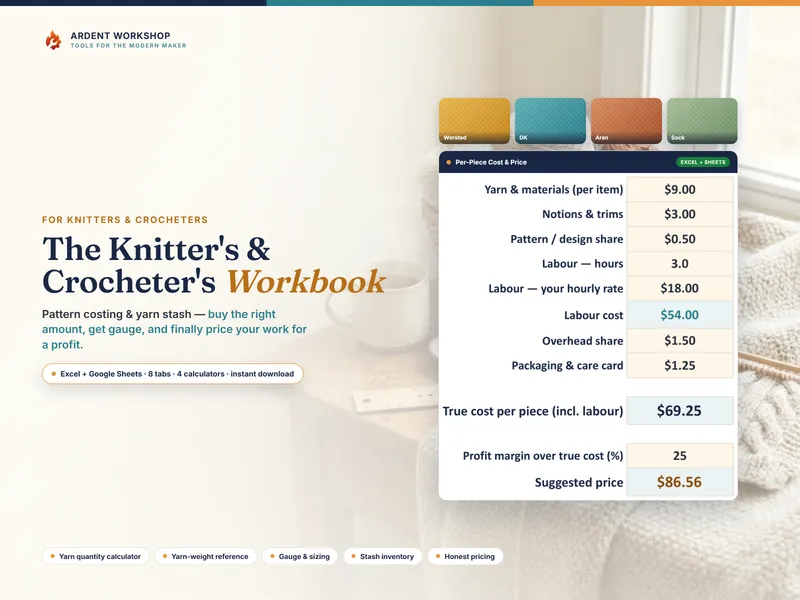
- Knitter’s & Crocheter’s Yarn Workbook — stash quantities and per-project cost.
- Another hobby? The rest of the Trackers line works the same way. If you’d rather try the format free first, the board game starter is a single pre-filled tab that logs the shelf itself — title, type, played, rating — and the paid version is what adds the price and cost-per-play columns this audit runs on.
All are files you own outright — no account, no monthly fee quietly joining bucket 3.
If your shelf isn’t inventoried yet, do that first: how to catalog a collection covers the fields to capture and how to clear a decade of accumulation in three passes. The spending audit is then just one more column.
The move, one more time: one hobby, one year, three places to look, four buckets, two divisions. Ten minutes, and you’ll never answer “not that much, I think” again.