What wuxia means
Wuxia (武侠) joins two ideas: wu (武), martial, and xia (侠), the chivalrous hero. Put together it is the story of a martial hero — someone of extraordinary skill who lives by a personal code of honor, usually outside and above the law of the state. The genre is centuries old in Chinese fiction, and it is the wellspring the modern drama and animation labels grew out of.
The world a wuxia story moves through is the jianghu (江湖, literally "rivers and lakes") — a parallel society of sects, martial schools, wandering swordsmen, and outlaws that runs alongside the imperial one and settles its own scores by its own code. A wuxia hero's power is hard-earned: a decade in a training hall, a stolen manual, a master's secret technique. They are extraordinary, but they are people. They can be poisoned, outnumbered, and killed. Hold on to that — it is the single fact that decides whether a show is wuxia or one of its cousins.
Wuxia vs. xianxia: the line is divinity
Xianxia (仙侠, "immortal hero", roughly "shyen-shyah") is wuxia's most-confused sibling, and the rule that separates them is simple: wuxia stays mortal; xianxia ascends. Xianxia takes the martial-hero frame and adds Daoist myth — cultivation toward immortality, heavenly tribulations (lightning sent to test you at a breakthrough), spirit swords, celestial courts, reincarnation, and lifespans measured in centuries.
The tell is unmistakable once you know it: if anyone flies unaided, ascends to a heavenly realm, or survives divine lightning, you are watching xianxia. If the hero's power came from training rather than from heaven, it is wuxia.
The rest of the family: xuanhuan and guzhuang
- Xuanhuan (玄幻, "mysterious fantasy", roughly "shwen-hwahn") is freeform fantasy that borrows from Chinese myth but is not bound by its rules — invented power systems, beast companions, whole continents of the author's own design. It feels like xianxia, but the cosmology is homemade rather than inherited. The rough rule: xianxia is Daoist; xuanhuan is whatever the story needs.
- Guzhuang (古装, "ancient costume") is the umbrella label for anything in period dress — it tells you about the wardrobe, not the plot. A rigorous dynastic epic and a fluffy costume romance are both guzhuang. Wuxia, xianxia, and palace-intrigue dramas are usually guzhuang too, which is why the term explains so little on its own.
These are conventions, not rules. A series can sit in two of them at once, and the marketing will happily call a xianxia a wuxia if it thinks that sells better. The point of knowing the tells is that you can trust what you are watching over what the banner says. (For the wider vocabulary of these shows, the Ardent Workshop glossary keeps the fan and collector terms in one place.)
A quick reference
| Genre | Chinese | The tell |
|---|---|---|
| Wuxia | 武侠 | Power comes from training, not heaven. The hero stays mortal. |
| Xianxia | 仙侠 | Cultivation, immortality, divine lightning — someone ascends. |
| Xuanhuan | 玄幻 | Fantasy with a homemade cosmology, not inherited Daoist myth. |
| Guzhuang | 古装 | Just tells you it is in period dress — the wrapper, not the genre. |
Why the labels are worth knowing
C-dramas and donghua (Chinese animation) run long — forty, fifty, sixty episodes is normal — so choosing what to start is a real commitment, and the genre is a big part of the choice. Knowing that a show is xianxia rather than wuxia tells you to expect cultivation arcs and a hundred episodes; knowing it is guzhuang tells you almost nothing until you look closer. The genre guide is the map, and the tells are how you read it.
That is exactly what the C-Drama / Donghua Tracker keeps in the file with your watchlist: all ten genres explained with the Chinese, the hallmarks, and the tell, next to a tracker that works out how many hours are left in every series you are watching. Prefer to try it first? The free watchlist starter is a single tab that computes the hours left — no signup. For another corner of Asian fandom with its own vocabulary, see what a VTuber is.
Templates that implement this
Track the C-dramas and donghua you're watching
3 templates
Catalog every series, see how many hours are left to finish each one, and keep the wuxia/xianxia genre guide right in the file.
- $6.95 Spreadsheet

C-Drama & Donghua Tracker — Hours-Left Watchlist for Excel & Google Sheets
A C-drama and donghua tracker for Excel & Google Sheets that counts the hours left in every series you're watching — plus a wuxia and xianxia genre guide.
TrackersView details - $4.95 Excel
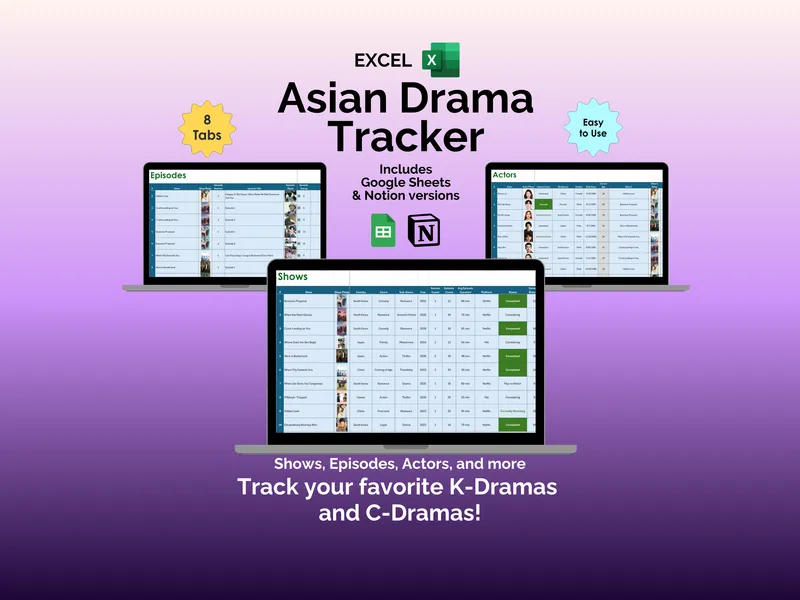
Asian Drama Tracker - Excel
You remember the feelings, not the episode numbers. This Excel Asian drama tracker logs your K-Drama and C-Drama watchlist, ratings, actors, and viewing journal in one file.
TrackersView details - $4.95 Excel

Anime Tracker - Excel
Three shows in progress, zero clue where you left off. This anime tracker Excel spreadsheet logs shows, episodes, characters, critic ratings, and viewing stats across 8 tabs.
TrackersView details