Where photocards come from
A photocard isn't sold on its own — it comes packaged with something else, and the source is a big part of what makes one card more sought-after than another:
- Album inclusions. The standard pull. Every physical album version (A, B, digipak, and so on) includes a randomly inserted card, so which member you get is usually luck.
- Preorder benefits (POB). A bonus card given for ordering an album early, or from a particular shop — different shops often offer different POB cards for the same release.
- Lucky draws. Won from a one-in-many draw event. Rarer, and usually the priciest cards on the trade market.
- Fansign and event cards. Handed out at fansigns, fanmeets, or pop-ups. Among the hardest to find — and the easiest to fake, so proof matters.
- Broadcast, promo, and collab cards. Given out during music-show promotions, brand collaborations, or with magazines — outside the usual album line-up.
How photocard trading works
Because the member you pull is random, almost no one completes a collection from album pulls alone. Trading is how collectors fill the gaps — and it runs on a shared shorthand:
- WTT / WTS / ISO. Want to trade / want to sell / in search of — the tags collectors post their cards under.
- Grail. The card you want most and would trade up for — usually a rare version of your bias from a sought-after era.
- Bias. Your favorite member, whose cards you most want to complete.
- Group order (GO). A bulk buy of albums or merch split among many buyers to share shipping — a common way preorder cards arrive.
A trade is a negotiation, not a fixed price. A card's worth is set by rarity, era, condition, and how badly two people each want it. Most trades happen on community boards and dedicated apps, where reputation and feedback keep things honest. For higher-value cards, collectors ask for proof — a timestamped photo of the actual card, often with a handwritten note — before committing.
Why condition matters
Condition is the single thing a photocard trade can go wrong over, so serious collectors grade honestly, from the card's worst feature rather than its best. A common scale runs Mint (flawless), Near Mint (one tiny flaw, display-perfect), Good (light honest wear), Played (clearly handled), and Damaged (a crease, bend, or tear). Cards are kept in sleeves and top loaders, and graded down when in doubt — a trader who finds a card better than described comes back; one who finds it worse doesn't.
Why collectors track their photocards
A photocard collection grows fast, and a phone's camera roll stops being enough surprisingly quickly. Without a list, collectors buy doubles of cards they already own, lose track of trades they agreed to, and forget which version of an era they still need. A proper catalog records, for every card:
- Group, member, album, and version — so a "have" and a "want" are unambiguous.
- Era / release — the comeback or album the card belongs to, which shapes its value.
- Type and condition — where it came from and how clean it is, the two things a trade hinges on.
- Status — have it, want it (a grail), a duplicate up for trade, incoming, or already traded away.
With those fields in one file, the rest follows: a wishlist of grails to hunt, a board of duplicates to trade, and a running count of what you own and what each era still needs.
How to start a photocard collection
- Pick a focus. Most collectors go deep on one member (their bias) or one group rather than chasing everything — it keeps the hunt rewarding instead of endless.
- Protect your cards. Sleeve every card and use top loaders for the valuable ones. Condition is value.
- Track from day one. Log each card as it arrives, with its status, so you never buy a double or lose a trade.
- Trade with a plan. Keep a wishlist with a budget and a priority, so you trade with a ceiling instead of in the heat of the moment.
The free photocard starter sheet is one tab that does exactly that — log a card per row with a Have or Want flag — and the full K-Pop Photocard Collection & Trading Tracker adds condition and type, a wishlist, a trade board, and a live dashboard that counts the whole collection for you.
Related templates and concepts
To track the music alongside the cards, see the K-Pop Tracker for comebacks, releases, and your bias list, or browse the full Trackers catalog. Building a broader media collection? Start with what a media backlog is, or — for the other fandom built on agencies, generations, and a single favorite — read what a VTuber is.
Templates that implement this
Track and trade your photocard collection
4 templates
Catalog every card, hunt your grails, and run your trades in one owned spreadsheet — or track the music itself with the K-Pop Tracker.
- $6.95 Spreadsheet
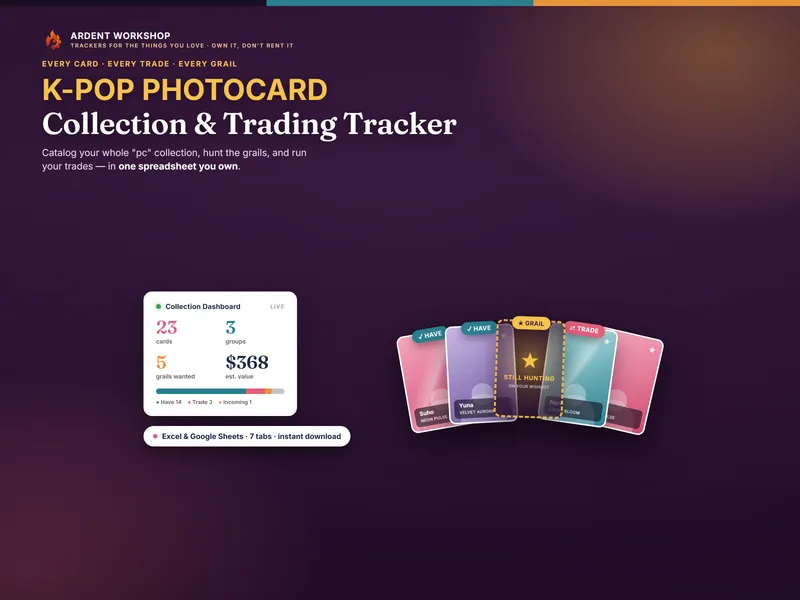
K-Pop Photocard Collection & Trading Tracker — Excel & Google Sheets
A K-pop photocard collection and trading tracker for Excel & Google Sheets — catalog every card, hunt grails, run trades, and see it on a live dashboard.
TrackersView details - $5.95 Excel
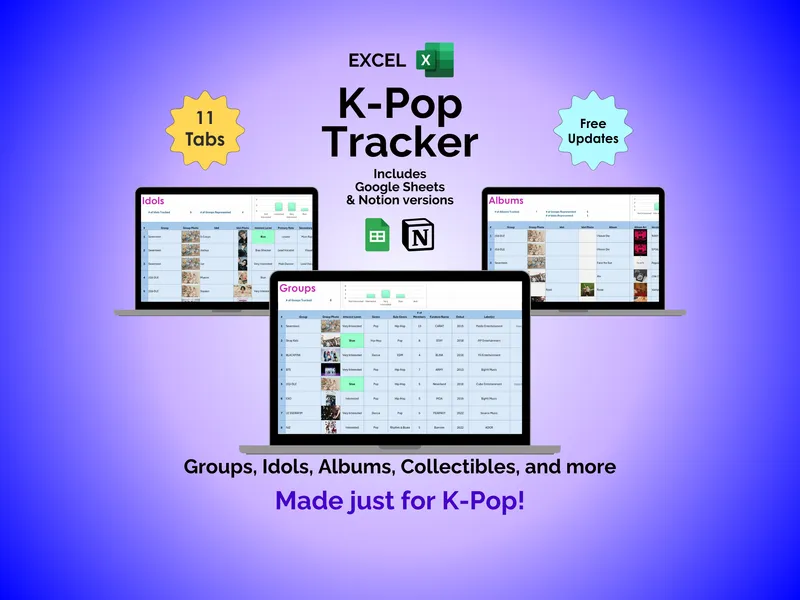
K-Pop Tracker - Excel
Comeback week again, and your photocard binder is now sentient -- this 11-tab excel kpop tracker wrangles groups, idols, albums, and collectibles in one calm spreadsheet.
TrackersView details - $5.95 Sheets
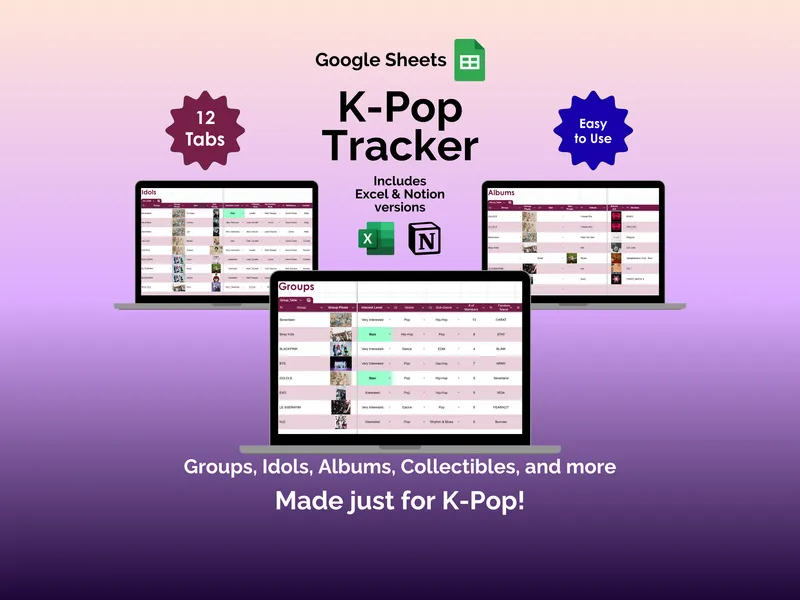
K-Pop Tracker - Google Sheets
Tired of your bias list, photocard wishlist, and concert dates living in three different apps? This Google Sheets K-pop tracker pulls it all into 12 tabs.
TrackersView details - $4.95 Excel
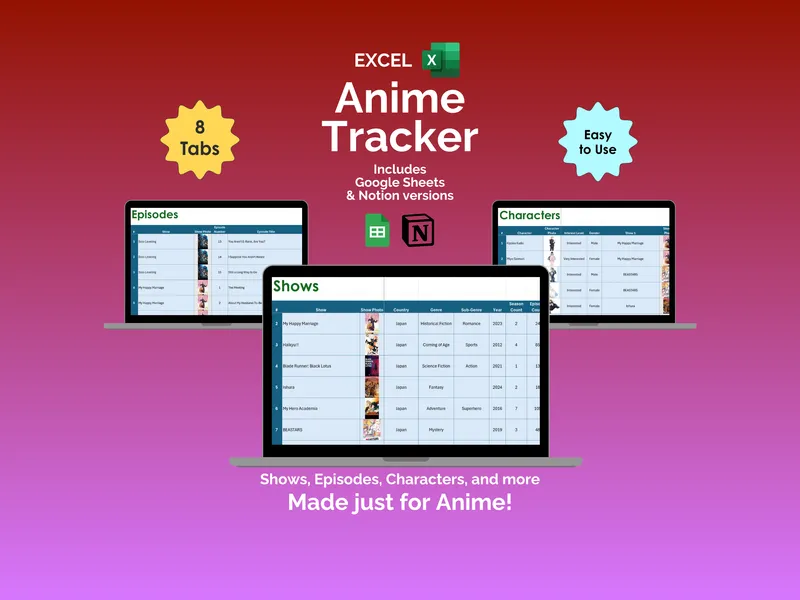
Anime Tracker - Excel
Three shows in progress, zero clue where you left off. This anime tracker Excel spreadsheet logs shows, episodes, characters, critic ratings, and viewing stats across 8 tabs.
TrackersView details