The formula
Cost per hour watched is deliberately simple. For one service, over one period:
cost per hour watched = monthly cost ÷ hours watched per month
A service costing $10.00 a month that the household watched 0.9 hours on works out at about $11.11 an hour. One costing $83.00 a month that carried 52.6 hours of live TV, sports and recorded drama works out at $1.58. The cheap-looking service is the expensive one. That inversion is the whole reason the metric exists — a monthly price on its own tells you nothing about whether the money bought anything. (These are illustrative figures, not published rates.)
Getting the two inputs right
The monthly cost is not always the number on the invoice. Services bill on different clocks, and they have to be put on one scale before they can be compared: a quarterly price divided by three, an annual price divided by twelve, and an every-four-weeks price multiplied by 13/12 — because four weeks is not a month, and a service that bills every four weeks bills you thirteen times a year, not twelve. Add-ons belong in the cost too: an ad-free upgrade, an extra member slot, a sports tier or a channel pack are all part of what the service costs you.
The hours are the half almost nobody writes down, and the good news is that they do not need to be precise. Episodes watched times their typical length, divided by sixty, is enough. A film is one episode at its runtime. Live television and sports have no episode list, so they are logged as sittings — how many times someone sat down to it, and how long a typical sitting ran. You are looking for the difference between two hours a month and forty, not for four decimal places.
What counts as a good number
There is no universal answer, and anyone who gives you one is selling something. A household that watches one prestige series a month and loves it is buying something genuinely different from one that leaves live TV on all evening. The metric's job is not to tell you what good value is — it is to apply your answer consistently to every service, instead of relitigating each one separately.
The practical form is two thresholds you set once and stop thinking about: a figure at or below which a service is obviously worth it, and a figure at or above which it wants a reason. The workbook and the free checker both ship with $2.00 and $6.00 an hour as their defaults, which is a reasonable place to start. Move them until the verdicts match what you already believe about the two or three services you feel certain about, then trust what they say about the ones you do not.
The look-back window, and its one honest limitation
Hours only mean something over a period, so cost per hour watched is always computed inside a look-back window — ninety days is a sensible default, long enough to cover a season and short enough to reflect how you watch now.
The limitation worth knowing: unless you log every individual evening, a title's hours have to be credited to a single date — usually when you last watched it. That means a short window drops older titles out altogether while making a recent binge look like your normal rate, and a long window smooths both. Shrinking the window does not simply make every service look worse. Pick a window, log a title's hours as what you watched inside it, and the figure is as accurate as this decision needs it to be.
What the number cannot see
Cost per hour watched is a strong signal, not a verdict on its own. Three things sit outside it:
- The queue. Two services can have identical, terrible cost per hour and deserve opposite treatment. The one with four titles waiting is a candidate for subscription rotation — cancel now, come back for a concentrated month later. The one with an empty queue is simply finished.
- Who is watching. A service kept for one household member who watches little but loves it can be worth a bad number. That is a fine reason, as long as it is a reason rather than inertia — write it down.
- Bundled benefits. A subscription that carries something you use elsewhere is not only buying you hours.
Working it out without doing it by hand
The arithmetic is trivial; the bookkeeping is what stops people. Every service on one monthly scale, hours logged per title against the service it lives on, and the two joined — that is three tables and a set of lookups, and it is exactly what a spreadsheet is for.
The free streaming cost-per-hour checker does the single-tab version for up to six services, pre-filled with a worked household. The Streaming-Service Value & Watchlist Workbook adds the watchlist that produces the hours for you, the queued-titles count that separates a rotate from a cancel, a renewal countdown that catches free trials before they convert, and a twelve-month rotation plan priced against paying year-round. To see the method applied end to end, read how to decide which streaming service to cancel.
Either way, you own the file — and it only ever needs a price and an hours figure, so there is no reason for a card number or a login to go anywhere near it.
Templates that implement this
Templates that work it out for you
4 templates
A workbook that joins what each service costs to what you actually watched, and returns a verdict per service.
- $12.95 Spreadsheet

Streaming-Service Value & Watchlist Workbook — Cost Per Hour Watched, Keep/Rotate/Cancel Verdicts & a Rotation Planner for Excel & Google Sheets
A streaming tracker for Excel & Sheets that joins what each service costs to what you actually watched — cost per hour, a verdict, and a rotation plan.
TrackersView details - $3.95 Excel
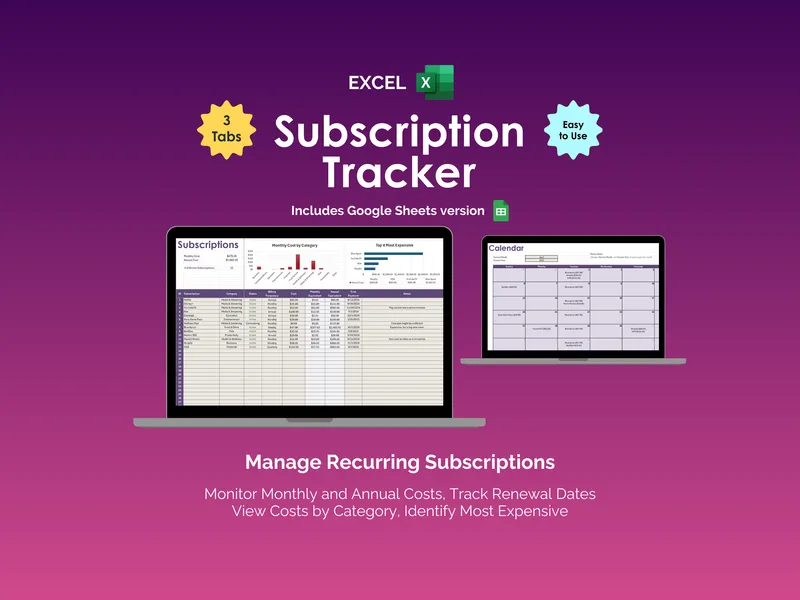
Subscription Tracker - Excel
A downloadable Excel and Google Sheets spreadsheet template for tracking your own subscription expenses, renewal dates and monthly totals. One-time purchase; no recurring charge for this template.
Personal FinanceView details - $4.95 Excel
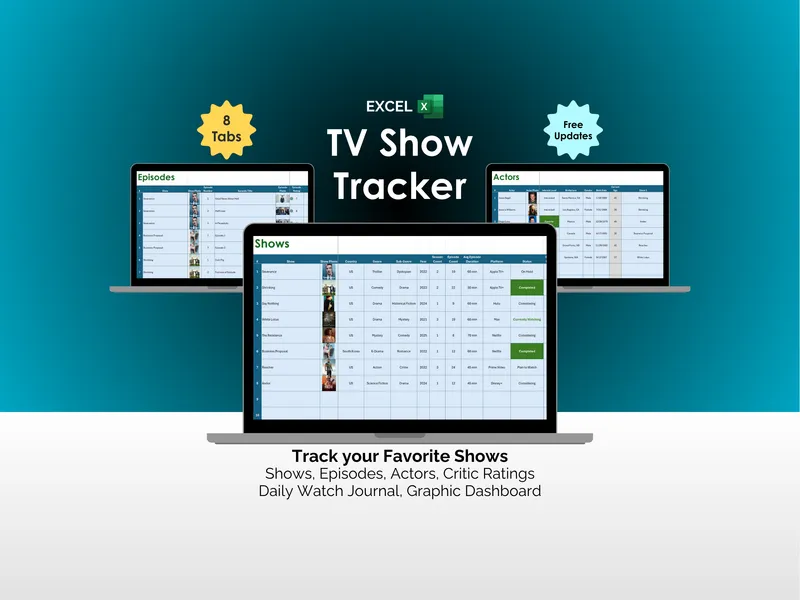
TV Show Tracker - Excel
Streaming has a quiet, persistent problem: the watching is easy, the remembering is what breaks you. This excel tv show tracker fixes that across 8 tabs.
TrackersView details - $4.95 Excel
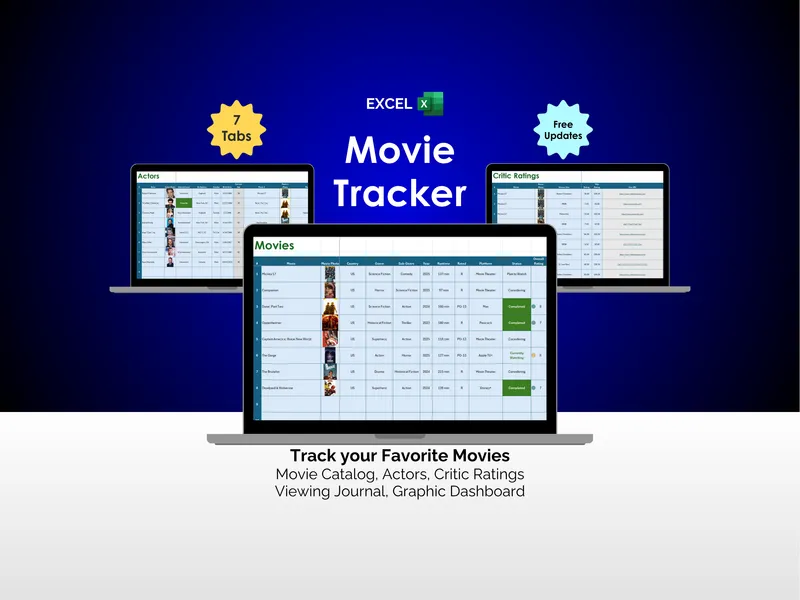
Movie Tracker - Excel
It's Friday night and you can't remember if you already saw that one. This Excel movie tracker logs 500 films, links actors, and sets critic scores beside your own on one tidy dashboard.
TrackersView details