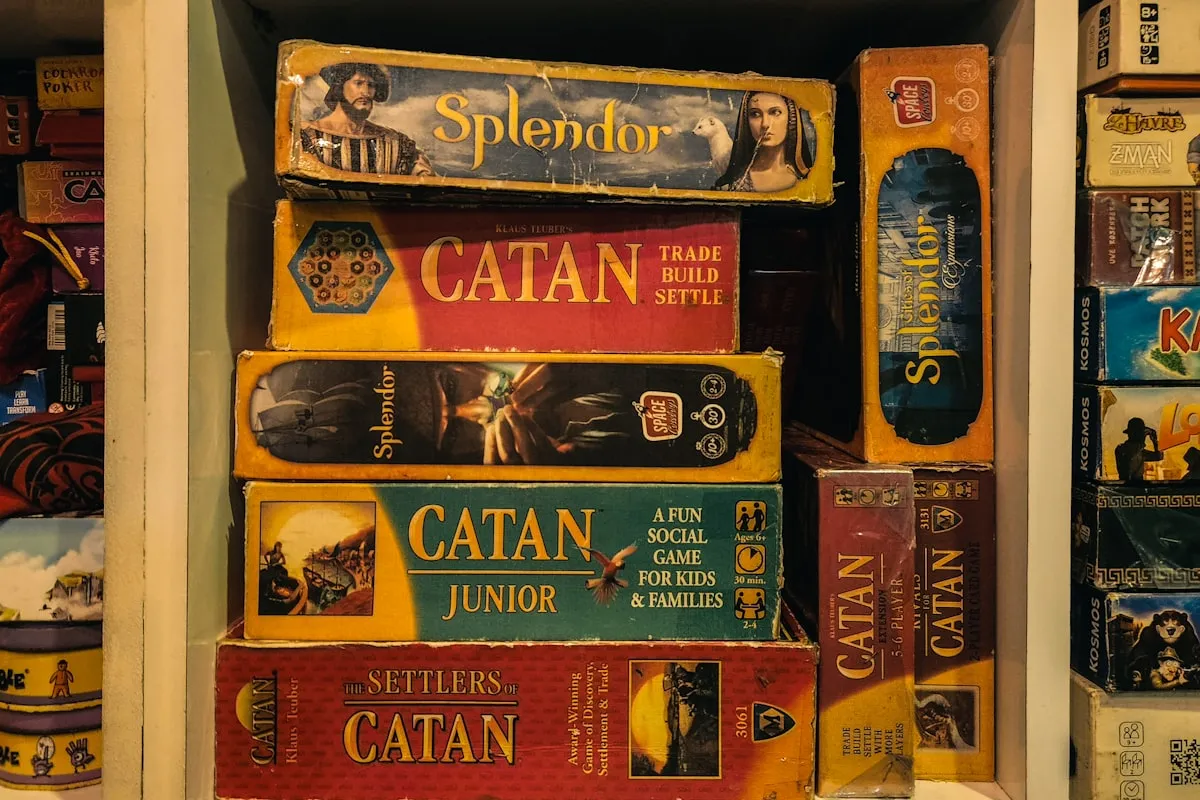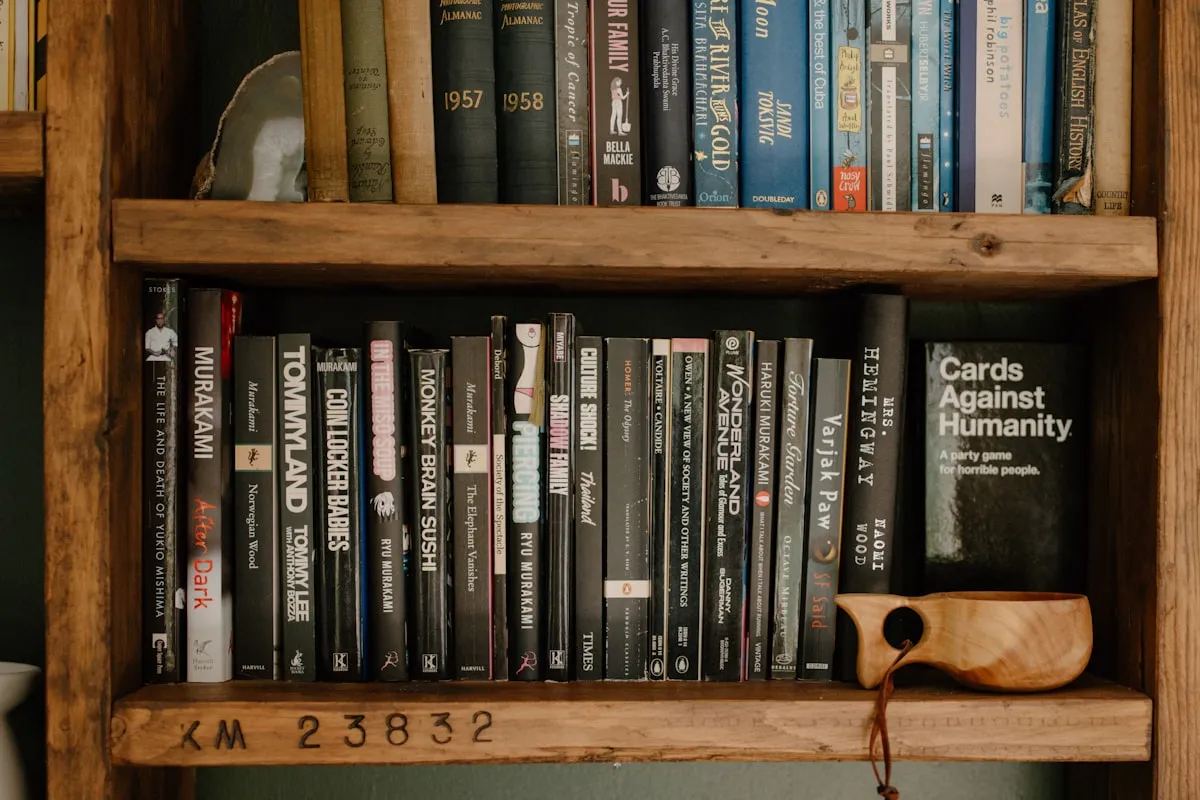
You are standing in a shop aisle holding something you have wanted for about a year. It is the right edition, the price is fair, and there is exactly one on the shelf. The question in your head is not do I want this. It is do I already own this?
You scroll your phone for thirty seconds, find nothing conclusive, and buy it. Two weeks later you find the first copy behind the second row on the shelf in the spare room.
That moment is not a memory problem. It is a data problem, and it has a specific diagnosis: a collection is an inventory you never wrote down. Once you see it that way, the fix stops being “be more organized” and becomes something much smaller and much more finishable.
The short version: catalog a collection in three passes. Sweep every shelf recording identity fields only — title, identifier, format, location, status. Enrich just the rows where condition, price paid or current value change a decision. Set three maintenance rules so the catalog stays true.
Your shelf is a database with no query function
A shelf is genuinely good at one job: storing things where you can see them. What it cannot do is answer a question when you are not standing in front of it.
Try asking your shelf any of these:
- Do I own the second volume, or did I only ever borrow it?
- What have I actually spent on this in the last three years?
- Which of these did I lend to someone, and when?
- Which of these are still sealed — and how many?
The shelf holds every one of those answers. It just has no way to hand them to you. A collection catalog is the missing query layer: one list where every item you own is a single row, and every fact worth knowing about it is a column.
There are three moments when a shelf quietly stops being enough:
- Duplicates. You cross the line where you can no longer hold the whole collection in your head. There is no fixed number, but the wall tends to arrive somewhere in the low hundreds of items — and you usually discover it by buying something twice.
- Distribution. Items stop living in one place. Some are lent out, some are in a box in the garage, some are at your parents’ house. The shelf now describes a fraction of what you own.
- Value. You start wondering what the whole thing is worth — because you are insuring it, thinning it, splitting it, or leaving it to someone.
Any one of those is the signal. All three at once is why the catalog so often gets built at 11pm after finding the duplicate.
What a collection catalog actually is (and isn’t)
A collection catalog is a record of what you own — one row per physical or digital item, with the fields that let you find, value, and account for it.
That makes it a different document from two things it gets confused with:
- It is not a watchlist or a to-read pile. Those track what you intend to consume, and they run on completely different fields — we cover how to manage your watchlist separately.
- It is not a whole-house home inventory. That is a different document, one row per appliance or piece of furniture, covering everything you own — here is why every home needs a home inventory spreadsheet. A collection catalog is narrower and much deeper: it needs edition, condition, and identifier fields that a household list has no use for.
Keep them separate. Merging them produces a document that is bad at both jobs.
The 12 fields, tiered by pass
Collection spreadsheets commonly die of column bloat — too many fields to fill, so none of them get filled. The pattern is easy to picture: 30 columns added on day one, six of them ever used, the whole thing abandoned somewhere in the first fifty rows.
Here is the working set, tiered by the pass it belongs to. Five of these you fill for every single item during the first sweep. Five more come in the second pass, on the rows that earn them. Two are optional.
| Field | When | Why it earns a column |
|---|---|---|
| Title / set name | Pass 1 | The thing you’ll search by first |
| Identifier | Pass 1 | ISBN, set number, catalog number, card code — makes “do I own this?” a lookup, not a guess |
| Format / edition | Pass 1 | First printing vs reprint, vinyl vs CD, hardback vs paperback — same title, different object |
| Location | Pass 1 | Living room shelf, garage bin 3, Mom’s attic. The answer to “where is it” |
| Status | Pass 1 | Defaults to owned; you type it only when the answer is something else — sealed, lent out, sold |
| Condition | Pass 2 | Mint, good, played, water-damaged. Drives value and whether you’d rebuy |
| Date acquired | Pass 2 | Turns the catalog into a history — and answers “how fast is this growing?” |
| Price paid | Pass 2 | The only honest input to what the collection has cost you |
| Source | Pass 2 | Shop, fair, marketplace, gift. Tells you where your good finds come from |
| Current value | Pass 2 | An estimate is fine. Needed for insurance and for thinning decisions |
| Rating | Optional | Your own score, so the catalog can recommend back to you |
| Notes | Optional | Signed, misprint, missing a piece, borrowed from a friend in 2019 |
Pass 1 = every row, in the first sweep. Pass 2 = only the rows worth the extra typing. Optional = add them if you want the catalog to rate things back to you (Rating), or to hold the one-off details no other field has room for (Notes).
The rule that keeps this list from growing: every column must answer a question you actually ask. If you cannot name the question, do not add the column. You can always add it in six months once the question shows up.
How to catalog a collection in one weekend: the three-pass method
These projects usually stall for one reason: trying to do all 12 fields on every item in one sitting. Picture row four eating eleven minutes because you went looking for an original release date — at that rate the project is over by row nine.
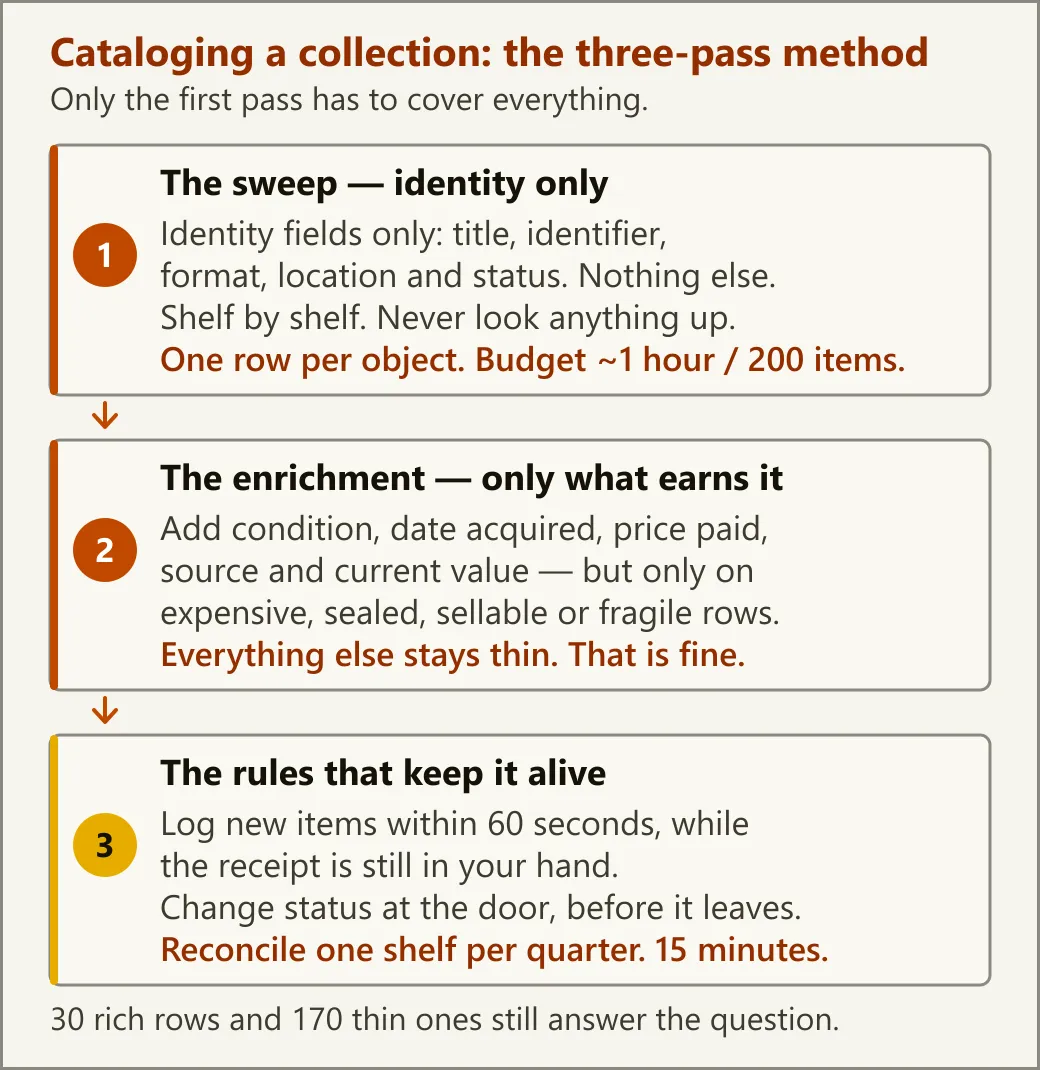
Split it into three passes instead. Each pass is a different kind of work, and only the first one has to cover everything.
Pass 1: the sweep (identity only)
Set up five columns before you stand up — title, identifier, format, location, status — and put a laptop on a chair beside the shelf. You will be typing, not tapping, and a phone is the slowest possible way to fill a five-column row while standing at a bookcase.
Then go shelf by shelf, left to right, and record only those five fields. Nothing else. No prices, no ratings, no looking anything up. Status defaults to owned for everything you touch — you only type it when the answer is something else, like sealed or lent out.
This pass is deliberately dumb, and that is what makes it fast. As a planning figure, budget about an hour per 200 items — roughly 15 to 20 seconds each, which is the pace of typing five short fields without looking anything up. Work in physical order so you never have to remember where you stopped: the gap on the shelf is your bookmark.
Two rules that save the whole weekend:
- Never leave the shelf to look something up. If a title is ambiguous, type what you can see and move on. Photograph the cover or the barcode and keep walking.
- One row per object, not per title. Two copies of the same book are two rows. That is the entire point.
Pass 2: the enrichment (only what earns it)
Now go back and fill in the rest — condition, date acquired, price paid, source, current value — but only for the rows where the answer changes something. In practice that is four groups:
- Anything that cost more than you’d casually replace
- Anything still sealed, boxed, or graded
- Anything you might sell, trade, or insure
- Anything fragile, borrowed, or irreplaceable
Rating and Notes ride along here too, on the rows where you actually have something to say. Everything else stays at identity level forever, and that is a completely valid end state. A catalog where 30 rows are rich and 170 are thin still answers “do I own this?” perfectly — which is the question you actually asked in the shop.
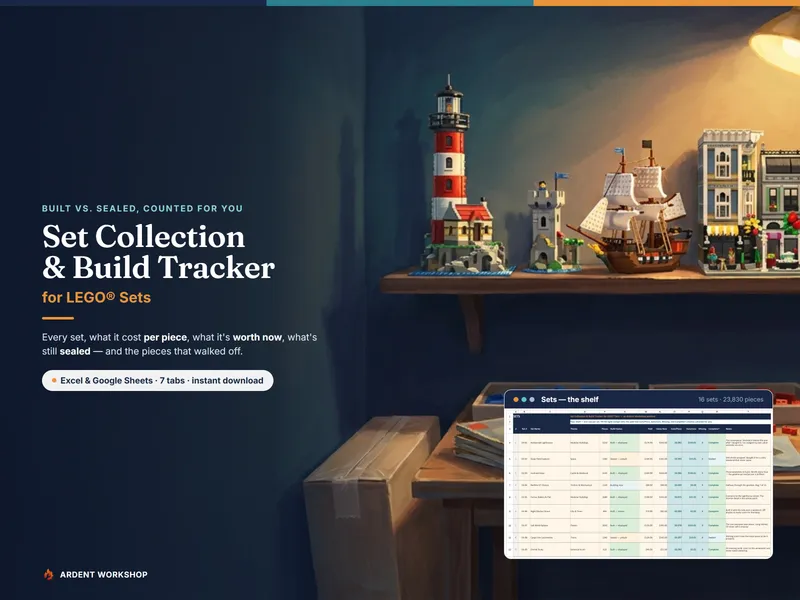
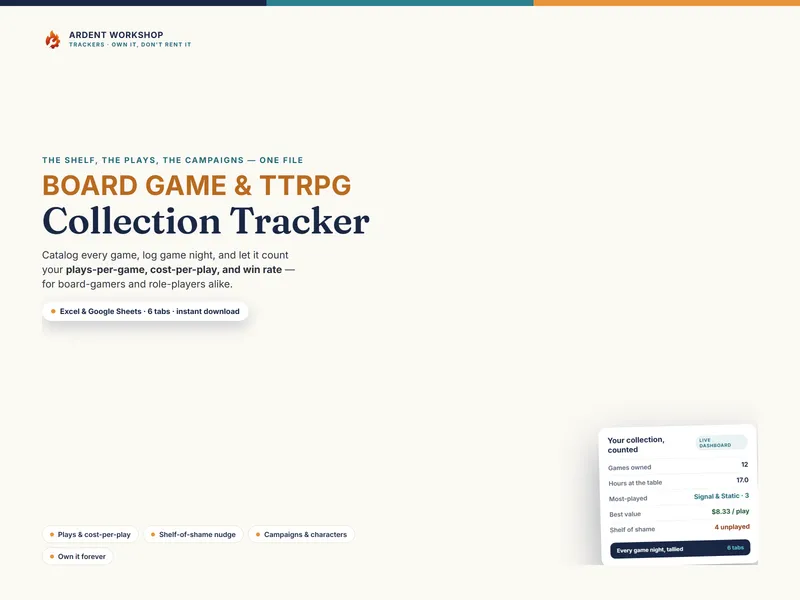
Cost per piece, cost per play, gain or loss against what you paid: those are numbers a sheet should compute from price paid and current value, not columns you hand-write formulas for. Our collection trackers ship with the math already wired in — the LEGO Set Collection & Build Tracker and the Board Game & TTRPG Collection Tracker lean hardest on it.
Pass 3: the rules that keep it alive
A catalog is only true on the day you finish it. Three rules keep it from drifting:
- The 60-second rule. Log every new item within a minute of buying it, while the receipt is still in your hand. This is the one rule worth enforcing, because price paid is the hardest field to reconstruct later.
- Status changes at the door. The moment something leaves the house — lent, sold, gifted — change the status field before you hand it over. Not later.
- One shelf per quarter. Pick a shelf, reconcile it against the catalog, fix what drifted. 15 minutes, four times a year, and the catalog never needs re-doing.
What your collection is worth — and why your insurer cares
If your collection has real replacement value, the catalog stops being a hobby document and becomes a claim document. The principle is the same one insurers apply to a whole house.
The National Association of Insurance Commissioners puts it plainly in NAIC’s home inventory guidance for consumers (opens in new tab): “An accurate home inventory gives your insurance carrier the information they need to help settle your claims.” The California Department of Insurance home inventory guide (opens in new tab) adds the practical part — photograph or video what you own, capture descriptions and serial numbers, label the photographs with date stamps, and keep the record where the fire will not reach it. That guide suggests a safe-deposit box, your work office, or a relative’s house.
Three things to do while you are already in the catalog:
- Photograph the shelves, not just the highlights. Wide shots of full shelves take a few minutes and document dozens of rows at once.
- Store a copy off-site. A catalog that burns with the collection has done nothing. Cloud storage, or a copy on a drive at someone else’s house.
- Ask your insurer what it needs. Whether a collection sits inside standard contents cover or has to be listed separately is a question with a real answer — get it from your insurer rather than assuming either way.
If you want that documentation to cover the whole house rather than one collection, the Home Inventory spreadsheet is built for exactly that job, room by room.
Four mistakes that kill a catalog
- Starting with 30 columns. 30 columns means 30 decisions on every row, and rows with 30 decisions do not get filled in. Start with the five Pass 1 fields.
- Cataloging from memory. Sitting on the sofa listing what you think you own produces a catalog that is confidently wrong. Stand at the shelf.
- No identifier column. Without ISBNs, set numbers, or catalog codes, “do I own this?” is still a judgment call — and judgment is what bought the duplicate.
- Letting an app own the data. If your catalog lives only inside a service, it lasts exactly as long as that service’s business model.
Own the file, not the account
That last one deserves its own paragraph, because it is the failure mode people find out about at the worst possible time.
Collection apps live and die by a business model you do not control. If a service closes, changes hands, or moves what used to be free behind a paid tier, the exit you are offered is often a CSV — a much thinner thing than what you typed in, and a CSV rarely carries your images.
A spreadsheet you own has no business model. It opens in Excel, Google Sheets, or LibreOffice, it works on a plane, and nobody can change its terms. That is the entire argument for keeping the catalog in a file rather than renting it: the collection took you fifteen years to build, and the record of it should not be easier to lose than the shelf.
If you would rather start from a file that already has the fields and the formulas than build one from a blank grid, we make one per collection type — for books, comics, music and collectibles, LEGO sets, board games, and K-pop photocards. One file, no account, no monthly rent. Not on the list? Browse the whole Trackers line. And if your collection is series-based — volumes, issues, seasons — how to track anime and manga covers the volume-gap problem specifically.
The takeaway
The payoff is small and specific: the next time you are standing in a shop holding the thing you have wanted for a year, the question takes four seconds instead of two weeks and a duplicate. That is all a catalog buys you, and it is worth more than it sounds — because cataloging a collection is not a memory exercise or a tidiness project. It is writing down an inventory that already exists.
Open a sheet, put five columns at the top, and start at the left end of the shelf — or start from a tracker that already has the columns built.