Owning twelve HR templates is easy. Knowing which one to open on Monday morning is the problem — and it’s why twelve-template kits turn into twelve half-finished spreadsheets by March.
This bundle is twelve complete people-ops workbooks — the same files that each sell on their own, not samples or cut-down editions — plus a thirteenth that only comes with the bundle. The People-Ops Command Center scores your team on twelve weighted dimensions, ranks the gaps by what each one actually costs you, and names the exact workbook that closes your biggest one. Then it sequences the rest across a 90-day rollout and keeps every workbook on its own cadence.
Two acts: analyze the team, then run it
Everything here is one or the other, and the order matters more than any individual file.
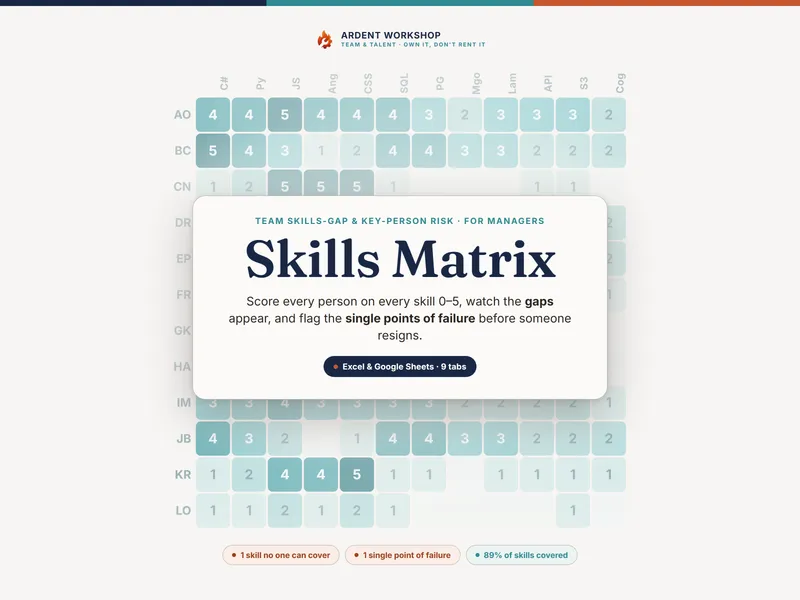
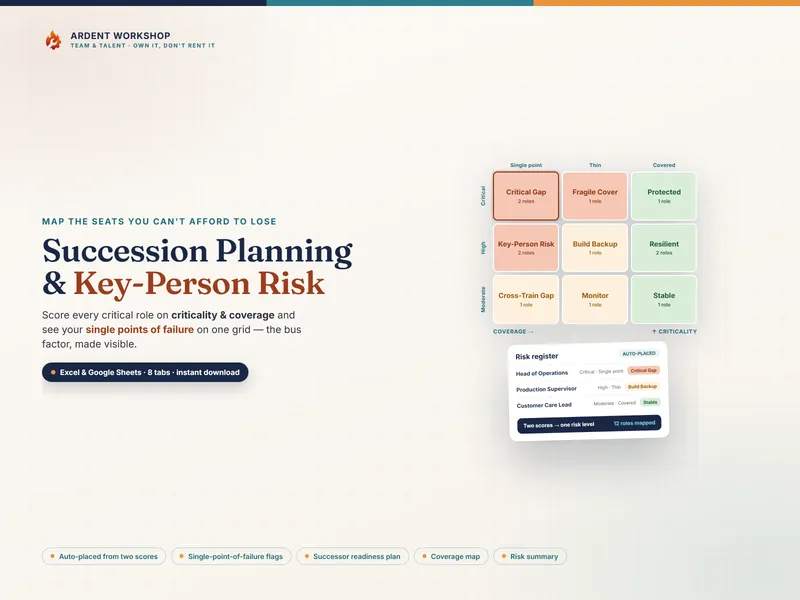
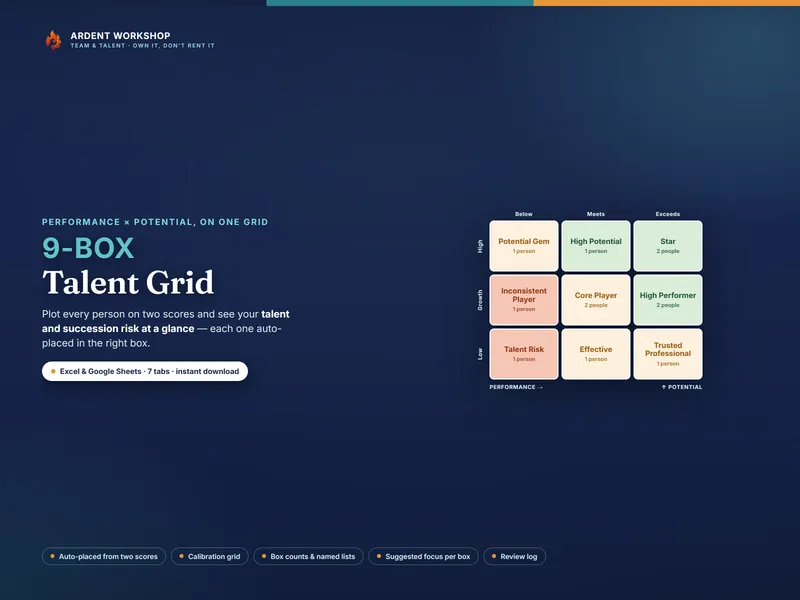
Act 1 — Analyze the team (seven workbooks). The Competency-Matrix Framework Builder decides what “good” means in each role. The Skills Matrix scores who can actually do it. The Training / ILUO Matrix records who is signed off and who can teach. The Training-Needs Analysis turns the gaps into a costed, prioritized plan. The Cross-Training & Coverage Planner asks whether the work still happens when someone is out for two weeks. The Succession Planning & Key-Person Risk Workbook names the seats that would stall the business and who could step into them. The 9-Box Talent Grid runs the talent review.
Act 2 — Run the team (five workbooks). The Onboarding / 30-60-90 Plan structures a new hire’s first ninety days. The 1:1 Meeting & Goal-Tracking Workbook carries last meeting’s actions to the top of this meeting’s page. The OKR & Goal-Setting Workbook sets goals with measures you could settle an argument with. The Performance-Review & Calibration Workbook calibrates ratings across managers before they’re final. The Performance-Review Phrasing & Feedback Wording Bank gives you the sentence you were reaching for.
You can run Act 2 without Act 1 — plenty of managers do. What you get is a very well-organized conversation about the wrong things.
The thirteenth file — the one none of the twelve contains
- Readiness Scorecard. Rate twelve statements 0 to 3. Each gap is weighted by what it costs a small team to get wrong, ranked, and matched to the workbook that closes it. In the worked example the ranking pulls succession planning to first — the default twelve-week plan had it in week 8.
- 90-Day Rollout. Type one start date and every week’s target computes from it. Each row flags itself Done, Due now, Upcoming or Overdue against today, so a slipped week is visible instead of forgotten.
- People-Ops Calendar. Record when you last ran each workbook and it computes the next-due date, the days until, and a flag that turns before you notice the slip. This is the tab that stops a quarterly cycle quietly becoming an annual one.
- Team Roster. Type your people once — and underneath, a table giving the exact tab, the exact cell, which columns map and how many rows there is room for in each of the ten workbooks that take a roster (the OKR workbook is keyed on objectives and the phrasing bank works one person at a time, so they take none). They do not all take the same paste, and several hold live formulas right where you would naturally put one. Every workbook was opened and checked to build that table.
- Dashboard. Readiness and rollout progress as live bars, a readiness split for each act, overdue cycles, and your top three gaps by name.
Honest about where they overlap
Twelve workbooks about one team overlap, and pretending otherwise would be dishonest. The Skills Matrix and the Training / ILUO Matrix are structurally the same artifact — a people-by-capability grid — and the real distinction is capability versus training state. Three of the twelve touch key-person risk, and only one is the deep treatment. The guides name all four overlapping pairs and say exactly what separates each, and the Toolkit Map repeats the note beside each workbook. You should never do the same work twice, or feel you bought the same grid twice.
Own it, don’t rent it
Comparable B2B tooling for this combined job rents per seat, per month, forever. These are files you buy once and keep: edit the formulas, print the wall charts, share them inside your organization. They still work if you stop paying anyone anything — including us.
Everything opens in Excel, Google Sheets and LibreOffice Calc, and all thirteen workbooks ship a one-click “Make a copy” Google Sheets link, so there’s nothing to import and nothing to rebuild.
Not sure you need all twelve?
Neither were we, which is why the scorecard is free. The People-Ops Readiness Scorecard is the Command Center’s ranking engine on its own — twelve questions, weighted and ranked, ending in the name of the one workbook to open next. No email, no signup. Score yourself first; if the answer comes back “most of these”, that’s what this bundle is for.
A planning aid, not advice
The Command Center’s example company, its people, their dates and every score are fictional and illustrative — they’re there so the formulas, flags and rankings are visibly working the moment you open the file. Each of the twelve component workbooks ships its own worked team, chosen to suit its job: a software team on the Skills Matrix, a production floor on the ILUO matrix, a contact center on the training-needs analysis. These are management templates, not HR, legal, or professional advice. A score, band or ranking is a prompt for a conversation, never a verdict on a person and never a basis on its own for a pay, promotion, discipline or termination decision. Employment law, documentation duties and data-protection obligations vary by country, state and employer size; where a decision carries legal weight, take it with your own HR or legal advisors.