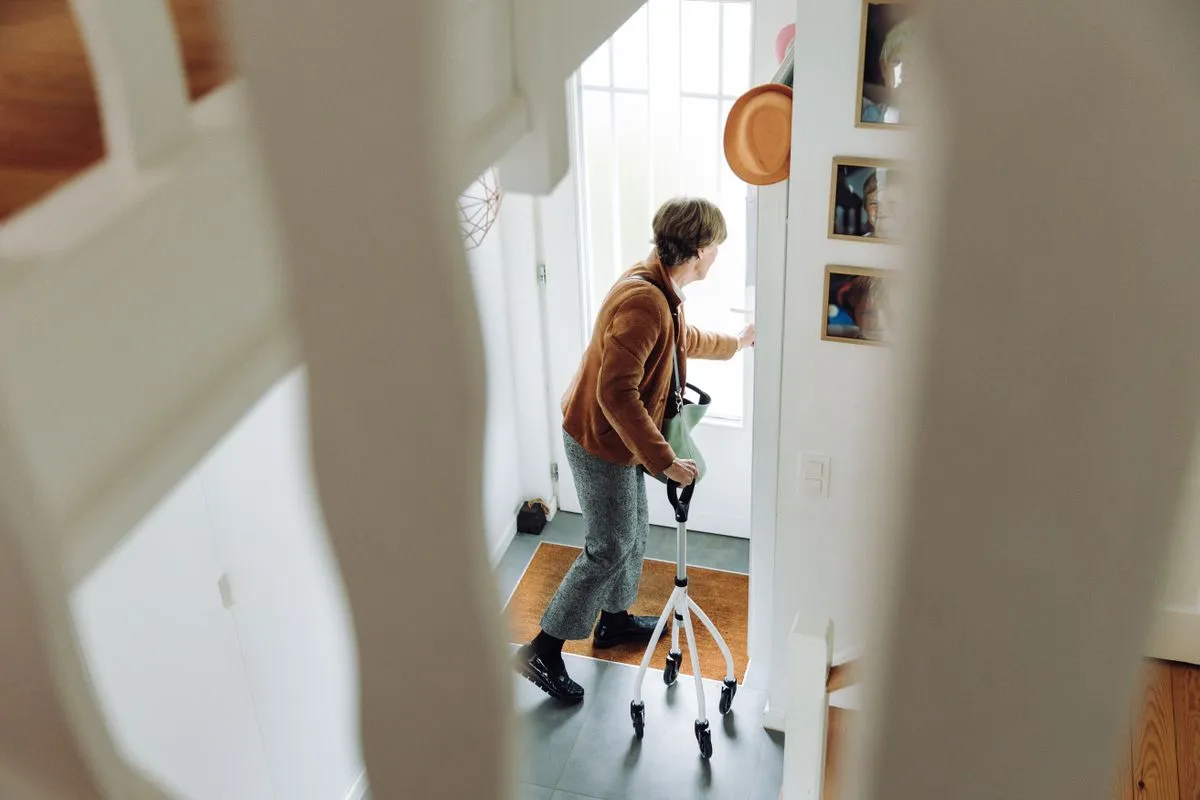
Picture the version of this everyone imagines: a contractor, a walk-in shower, a ramp at the front door, a stair lift gliding up the banister. The house, rebuilt around the parent who wants to stay in it. Done.
Here’s the hard truth: that plan is often why nothing happens. The walk-in shower needs a quote, a budget conversation and a decision, and the decision keeps getting postponed. Meanwhile the tub still has no grab bar, the hallway is still dark at 3 a.m., and the rug by the bed still curls at the corner.
An aging-in-place checklist fixes the first problem — knowing what to look at. It doesn’t fix the second, which is knowing what to do first. A list of forty findings has no order, and that’s where many families stall. The Aging-in-Place & Home-Safety Modification Planner exists for exactly that gap: it scores what you find in each room and ranks every fix by safety gained per dollar. But the method matters more than the tool, so here it is either way.
What is an aging-in-place checklist?
An aging-in-place checklist is a room-by-room list of the hazards and missing supports that make a home harder or riskier to live in as someone gets older — trip hazards, poor lighting, missing handrails and grab bars, things stored out of reach. You walk the house with it, mark what needs work, and turn those findings into a list of modifications. (If you want the concept itself first, here’s what aging in place means and why families choose it.)
The stakes are mostly about falls. According to the CDC, more than one in four people aged 65 and older falls each year (opens in new tab), and older-adult falls lead to about 4.5 million emergency department visits a year. It’s also what people want: in AARP’s 2024 Home and Community Preferences Survey (opens in new tab), 75% of adults 50 and older said they want to stay in their current homes as they age.
The checklists below draw on the public guidance that already exists — the CDC’s Check for Safety home fall prevention checklist (PDF) (opens in new tab) and the National Institute on Aging’s Preventing Falls at Home: Room by Room (opens in new tab) — organized in the order we’d walk a house.
Start with the bathroom
The bathroom is the first room to check because it combines hard surfaces, water, and the movements older adults find hardest: sitting down, standing up, and stepping over a tub wall.
The data backs this up, though it is the oldest figure in this guide. A 2011 CDC analysis of nonfatal bathroom injuries treated in US emergency departments (opens in new tab) estimated 234,094 such injuries in 2008, and 81.1% were caused by falls. The rate of injuries on or near the toilet climbed sharply with age — from 4.1 per 100,000 people aged 15–24 to 266.6 per 100,000 among those 85 and older.
Check for:
- Grab bars beside the toilet and both inside and outside the tub or shower — screwed into studs or proper anchors, never suction-mounted.
- Non-slip strips or a rubber mat on the floor of the tub or shower.
- A non-slip bath mat outside the tub, not a loose cotton one.
- A night light that comes on automatically, so a 3 a.m. trip doesn’t start in the dark.
- Toilet height. If standing up takes a push off the sink or towel bar, a raised seat or a taller toilet goes on the list.
- A shower chair or transfer bench if standing through a whole shower is tiring.
- A towel bar being used as a handhold. That’s the clearest sign a grab bar is missing — towel bars aren’t built to take body weight.
Entrance and outside steps
The entrance is where the home meets weather, steps and carried bags at the same time. Check for:
- A sturdy handrail on every outside step, ideally on both sides.
- Bright lighting at the door and along the path, on a motion sensor or timer.
- Steps in good repair — no cracked, loose or uneven treads.
- A place to set things down beside the door, so keys and groceries don’t compete for one free hand.
- A threshold or step height that’s become hard to clear. (A ramp is a contractor job; the rest of this list mostly isn’t.)
Stairs and hallways
Stairs and hallways are where poor lighting and clutter do the most damage, because people move through them quickly and often in the dark. Check for:
- Handrails on both sides of every staircase, running the full length and solidly attached.
- Light switches at the top and bottom of the stairs and at each end of a long hallway.
- Nothing stored on the stairs — not the basket of things waiting to go up.
- Carpet firmly attached to every step, or bare treads with non-slip strips.
- Plug-in motion-activated lights along the route from the bedroom to the bathroom.
Bedroom
The bedroom matters because one of the riskiest walks in the house is the one from the bed to the bathroom at night. Check for:
- A lamp or light switch reachable from the bed, before feet touch the floor.
- Night lights along the path to the bathroom.
- A clear path — no cords, shoes or laundry baskets between the bed and the door.
- Bed height that lets them sit with feet flat on the floor.
- A phone or flashlight within reach of the bed, in case the power goes out or they need help.
Kitchen
The kitchen risk is reaching — for the high shelf, the low drawer, the heavy pot. Check for:
- Everyday items within easy reach, around waist height, so nothing daily needs a stool or a deep bend.
- A steady step stool with a handle on top, if one is used at all — never a chair.
- No throw rugs in front of the sink or stove.
- Spills cleaned up immediately, and floors that aren’t slick when wet.
- Good task lighting over the counter and the stove.
Living areas and the whole house
Living areas fail on trip hazards: rugs, cords and furniture that has quietly narrowed the walking path. Check for:
- Throw rugs and small area rugs removed, or firmly secured to the floor.
- Cords and wires coiled or taped along the wall, out of walkways.
- Chairs with arms that make sitting down and standing up easier.
- Clear walking paths wide enough for a cane or walker, if one is in use or likely.
- Working smoke and carbon monoxide detectors on every floor.
- Emergency numbers posted where anyone in the house can find them.
How to decide what to fix first
Rank every finding by safety gained per dollar spent, not by how serious the room looks. This is the step most checklists leave out, and it’s the one that decides whether anything gets done.
For the full step-by-step version — quotes, budget and re-walks included — see how to plan home modifications so a parent can age in place. The short version: give each finding a safety benefit from 1 to 5, give it a rough cost band from 1 (under about $50) to 5 (a major contractor job), and divide. High benefit and low cost floats to the top. Here’s how it plays out with illustrative numbers — your own benefits and costs will differ:
| Fix | Safety benefit (1 to 5) | Cost band (1 to 5) | Score | Order |
|---|---|---|---|---|
| Non-slip strips in the tub | 4 | 1 | 4.0 | Do first |
| Night lights, bed to bathroom | 3 | 1 | 3.0 | Do first |
| Grab bar beside the toilet | 5 | 2 | 2.5 | Do first |
| Second stair handrail | 4 | 2 | 2.0 | Do next |
| Raised toilet seat | 3 | 2 | 1.5 | Do next |
| Walk-in shower conversion | 5 | 5 | 1.0 | Do later |
Notice what happened to the walk-in shower. It’s the most protective change on the list and it still lands last, because in this scoring the three Do-first fixes each buy more safety per dollar, and two of them can be done this weekend. That isn’t a reason never to do it — it’s a reason not to let it block everything else.
This is the logic built into the Aging-in-Place & Home-Safety Modification Planner: 62 checks across eight areas, each with a severity, scored as you walk, and a Modification Plan that sorts every fix into Do first, Do next and Do later. If you’d rather start with paper, the free Home-Safety Walkthrough Checklist is a printable room-by-room list of the higher-risk checks.
Do the walk-through with your parent, not to them
A safety checklist about someone’s home can sound, from their side of the table, like a verdict that they’re declining. The way through is to make it a shared project rather than an inspection:
- Bring the list, not the conclusion. “Can we walk through this together?” lands differently from “I’ve decided you need grab bars.”
- Lead with the cheap and reversible. Night lights and non-slip strips are easy to say yes to, and they build trust for the bigger conversations.
- Let them help rank it. They know which step feels wobbly and which chair is hard to get out of.
The same instinct runs through how to talk to an aging parent about tracking their health — the conversation decides whether the system gets used at all.
Common questions about aging-in-place checklists
How much does it cost to make a home safe for aging in place?
Less than most families expect for the first round, and far more than they expect for the last. Non-slip strips, night lights and cord clips are small purchases; grab bars and stair rails are modest but need proper installation; a walk-in shower, a ramp or a stair lift is a contractor project with a real quote. Ranking by safety per dollar lets you do the first two tiers now while you plan the third.
What is the most important aging-in-place modification?
For most homes, grab bars in the bathroom — beside the toilet and in and beside the tub or shower. Both the CDC and the National Institute on Aging put them on their checklists, and the bathroom is where hard floors, water and the hardest movements of the day all meet. They must be anchored to studs or rated anchors; a suction-cup bar or a towel bar is not a substitute.
Who can do a professional aging-in-place home assessment?
An occupational therapist is the professional trained to assess a specific person in a specific home. A checklist like this one can’t see how your parent actually moves, so if there’s been a fall, a new diagnosis or a noticeable change in balance, ask their doctor for a referral to an occupational therapist for a home safety evaluation.
Make the checklist a plan
The checklist tells you what’s wrong. The order tells you what to do on Saturday. Walk the house room by room, write down every finding, rank them by safety per dollar, and start at the top — the expensive ideas can wait their turn without holding everything else up.
The Aging-in-Place & Home-Safety Modification Planner was designed for exactly this: the 62-point walk-through, room risk scores, the ranked Modification Plan, contractor quotes and a budget in one file your family owns. And once the house is sorted, the other half of the job is the paperwork — here’s how to organize an aging parent’s records so they’re ready before a crisis forces you to find them.