
When a parent dies in the US, only a handful of things genuinely have to happen in the first 72 hours: the death has to be pronounced and certified, you need to find out whether they left instructions before you buy a funeral, you need to order far more certified death certificates than seems reasonable, the house and the mail need securing, and the death has to be reported to Social Security. Nearly everything else — closing accounts, paying debts, selling the car, dividing belongings — belongs to week two or later. Doing those early is how people create work that cannot be undone.
Most checklists for this moment are sixty undated items long. They tell you to notify the pension plan and cancel the magazine subscription in the same breath, as though those are the same size of task, and they leave you refreshing a list at 2 a.m. trying to work out what is actually on fire.
Almost none of it is on fire. That is the useful thing nobody says out loud.
The first two weeks after a parent’s death are not a race to finish. They are a narrow window in which a small number of irreversible things can go wrong — an account emptied before anyone knows who is entitled to it, a phone line canceled that turns out to hold every login code, a well-meaning relative handing out furniture that was supposed to be sold to settle a medical bill. The job in those two weeks is to notify widely, commit to almost nothing, and keep a record of every call.
Here is the order.
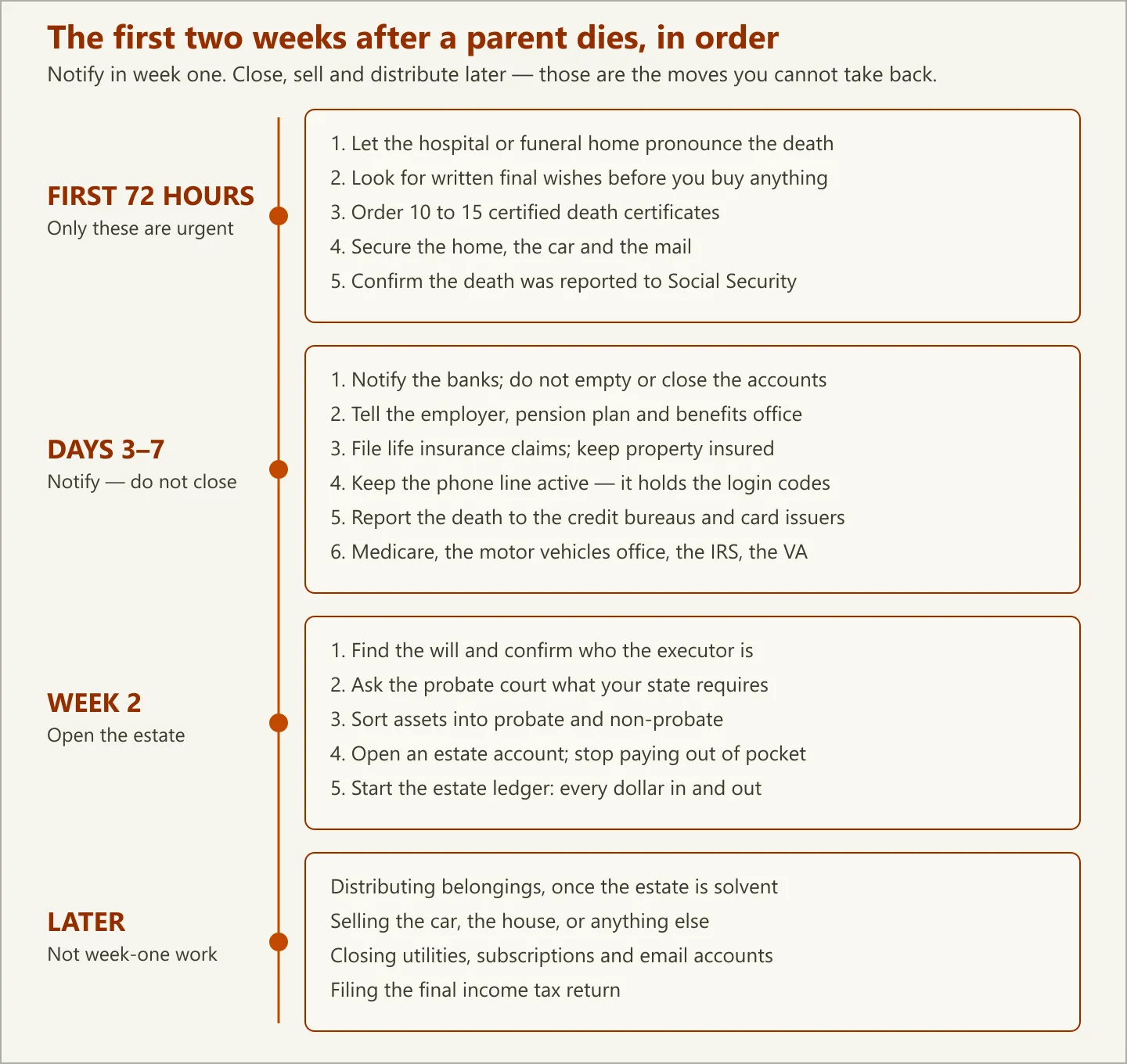
The Rule That Puts Everything Else in Order
There are two halves to the rule, and together they decide the sequence of everything below.
-
Almost nothing moves without a certified death certificate. A certified copy — the one issued by a state or county vital records office, carrying an official seal or the issuing office’s security features — is the document that unlocks a life insurance payout, a bank’s death-claim process, a title transfer, a pension survivor benefit. Until those exist, most institutions can only take a note. This is why ordering them is a first-72-hours task rather than an admin chore: it is the bottleneck on everything else.
-
In week one you notify, you do not close. Notifying is reversible. It puts a hold on the account, stops the automatic payments, and starts the institution’s own internal process running while you are still finding paperwork. Closing is not reversible. Neither is spending, transferring, canceling, or distributing. Every regret in estate administration lives on the second list.
If you remember nothing else: tell everyone, close nothing, write it all down.
The First 72 Hours: The Five Things That Actually Have to Happen
These five are urgent because each one blocks something downstream, or because delay makes it materially harder. Nothing else in this post is urgent.
-
Let the hospital or funeral home pronounce the death. A death has to be legally pronounced and certified by someone authorized to do it before any paperwork exists at all. In a hospital, hospice or care facility, staff handle this. At home with hospice, call the hospice line, not 911. At home without hospice, call 911 and have the do-not-resuscitate order or POLST form ready to hand over if one exists — without a valid form in front of them, responders will generally begin resuscitation, and which forms emergency services can honor is set by state.
-
Look for written final wishes before you buy anything. Before you sit down with a funeral director, spend twenty minutes looking for instructions your parent may already have left: a prepaid funeral contract, a burial plot deed, a cemetery society membership, a letter of instruction, a final wishes page in a binder, or a note about military service. This twenty minutes is worth more than any other twenty minutes in the first week. Funeral decisions get made fast, under pressure, by people who are not sleeping, and they are the least reversible spending in the whole process. If your parent already chose and paid, you need to know that before the conversation, not after.
A veteran’s discharge paperwork belongs on this list too — a DD-214 or other separation document is what the VA asks for when you claim burial benefits or a national cemetery plot, and it is far easier to find in a filing cabinet than to request from a federal records center in the middle of the same week.
-
Order 10 to 15 certified death certificates. More on the number below. The funeral home usually orders certified copies for you from the state or county vital records office, and the marginal cost of extra copies at that moment is far lower than the cost of ordering them one at a time, six weeks later, from three states away.
-
Secure the home, the car and the mail. An obituary is, among other things, a public notice that a house may now be standing empty. Lock it, take the spare key from under the planter, move valuables and firearms somewhere secured, and make sure the mail is being collected by a person rather than accumulating in a visible pile. Mail is also evidence: for the next two months, the envelopes arriving at that address are the single best map of which accounts, insurers, subscriptions and creditors actually exist.
-
Confirm the death was reported to Social Security. According to USAGov’s guidance on which agencies to notify when someone dies (opens in new tab), “the funeral director should report the death to the Social Security Administration (SSA) for you. If they do not, you must do this as soon as possible.” Note the word should. Ask the funeral director directly whether they have done it, and get the date. This one matters in both directions — it starts survivor benefits, and it stops payments that would otherwise have to be returned.
How Many Certified Death Certificates Do You Need?
Order 10 to 15 certified copies to start, and expect to order more later. Under-ordering is the easy mistake here, because the number sounds absurd until you count the institutions.
Here is an illustrative count for a fairly ordinary estate — one house, one car, a checking account, a retirement account, two small life policies, and Social Security:
| Who asks for one | How many | What they usually want |
|---|---|---|
| Life insurance carriers | One per policy | Certified copy, usually kept |
| Banks and credit unions | One per institution | Certified copy, often kept |
| Brokerage and retirement plan custodians | One per custodian | Certified copy |
| Social Security, VA, pension plans | One each | Certified copy |
| Motor vehicles office | One per vehicle titled | Certified copy |
| County recorder, for real estate | One per property | Certified copy |
| Probate court | One | Certified copy |
| Card issuers, utilities, subscriptions | Usually none | A photocopy or a phone call |
That is easily nine or ten before anything unusual appears, and the top half of the table is made of organizations that keep the copy rather than returning it. Requirements vary by institution and by state, so the practical move is to ask each one, on the notification call, whether they need a certified copy or will accept a scan — and to keep two spares in a folder nobody is allowed to raid.
Days 3 to 7: Notify Everyone, Close Nothing
Week one is a phone week. The goal is that every institution holding your parent’s money, coverage or obligations knows they have died — and that not one of them has been given an instruction yet.
-
Banks and credit unions. Call each one, say the account holder has died, and ask what they need. Do not empty the account, do not close it, and do not keep using the debit card, even for funeral costs. Accounts with a payable-on-death beneficiary or a surviving joint owner generally pass outside the estate; accounts without one generally do not. Which is which decides who is allowed to touch that money, so find out before you move a dollar.
-
The employer, pension plan and benefits office. If your parent was still working, or retired from somewhere with a pension, the human resources or benefits office is a single call that can surface a final paycheck, unused vacation, an employer life insurance policy nobody knew about, a 401(k) with a named beneficiary, and continuing health coverage for a surviving spouse. This call is easy to skip, and it is one of the highest-value ten minutes of the two weeks.
-
Insurers — file the life claims, keep the property covered. File claims on the life policies. Do not cancel the homeowners or auto policy on a house and a car that still exist and can still burn, flood or be stolen. An unoccupied house is a coverage conversation with the insurer, not a cancellation — many policies restrict what they cover once a home is vacant, so tell them and ask what the policy requires. If you are not sure which policies exist, the method that works for organizing your insurance policies works here too: pull twelve months of bank and card statements and look for payments to insurers.
-
Keep the phone line active. This is one of the most expensive mistakes to undo, and one of the easiest to make. Your parent’s mobile number is often the second factor for their bank, their brokerage, their email and their insurer. Cancel the line in week one and you lock yourself out of the accounts you are about to spend three months unwinding. Keep it running, keep paying the bill, and cancel it near the end.
-
Credit bureaus and card issuers. USAGov’s advice (opens in new tab) is to “report the person’s death to banks, credit card companies, credit bureaus, and other financial organizations.” This is what stops new credit being opened in your parent’s name. Ask each credit bureau to note the death on the file.
-
The rest of the government list. The same USAGov page (opens in new tab) names the others worth a call in week one: Medicare, the state motor vehicles office to cancel a license and start a title transfer, the IRS, the State Department for a passport, the local election office, the VA, and — where they apply — the Defense Finance and Accounting Service or the Office of Personnel Management.
Online accounts, social media and email are not a week-one job, and they have their own rules and their own paperwork. That is a separate project, covered in our guide to what happens to your online accounts when you die.
Week 2: Open the Estate and Start the Ledger
Week two is when the legal container gets built. Until it exists, there is no bank account belonging to the estate, no authority to act, and no clean way to pay a bill.
-
Find the will and confirm who the executor is. Find the most recent signed will and read the part that names the executor, sometimes called a personal representative. Everything in week two depends on knowing whether that is you. If there is no will, a court appoints someone — the Federal Trade Commission’s guidance on deceased relatives’ debts (opens in new tab) puts it plainly: “If there’s no will, the court may appoint an administrator, personal representative, or universal successor and give them the power to settle the affairs of the estate.”
-
Ask the probate court what your state requires. Probate rules, timelines, fees and small-estate shortcuts are set by state law and vary enormously. Call the probate or surrogate’s court in the county where your parent lived and ask what the process is for an estate of this size. Many states have a simplified small-estate procedure with a dollar threshold, and finding out you qualify for it is worth a great deal.
-
Sort assets into two piles: probate and non-probate. Anything with a named beneficiary or a surviving joint owner — life insurance, retirement accounts, payable-on-death bank accounts, jointly titled property — generally passes directly to that person and never enters the estate. Everything else does. This distinction decides who gets paid, in what order, and out of which pot, and it surprises families constantly: a beneficiary designation on a retirement account generally overrides what the will says, even when the will is newer and the designation is twenty years stale — though spousal-consent rules and some state statutes can change the result.
-
Open an estate account and stop paying out of pocket. Once you have letters testamentary or the equivalent authority, open a bank account in the name of the estate, with its own tax ID. From that point on, estate money pays estate bills, and your own money stays out of it. Executors who front costs personally for months end up with a reimbursement claim they have to prove, which is a worse position than simply waiting two weeks.
-
Start the estate ledger on day one. Every dollar that comes into the estate and every dollar that goes out gets a dated line: what it was, who it went to, and which receipt backs it up. Beneficiaries are generally entitled to an accounting, and a court may require one — what form it takes is set by state law. Reconstructing eight months of transactions from memory and a shoebox is the most miserable task in this entire process, and it is completely avoidable by writing things down as they happen.
This is the shape of the Executor’s Estate Settlement Records & Task Binder — sixty tasks dated forward from the date of death, an asset inventory that sorts probate from non-probate, a creditor claims log, and the estate accounting building itself as you go rather than at the end.
-
Note the tax deadlines without acting on them yet. The IRS says to file a deceased person’s final return (opens in new tab) “the same way you would if the person were alive,” and that “if a refund is due on the individual income tax return of the deceased, claim the refund by submitting Form 1310, Statement of a Person Claiming Refund Due a Deceased Taxpayer.” A fiduciary also files Form 56 (opens in new tab) to tell the IRS who is now responsible. None of this is due in week two — but knowing it exists stops the surprise later.
That is where this post stops. Getting appointed, taking control of the assets, running the creditor clock, paying valid debts, filing the returns, and distributing and closing are the months that follow, and they have their own sequence — our tutorial on settling an estate, step by step picks up exactly here and runs to the end.
What Not to Do in the First Two Weeks
Every item here is something that seems helpful, gets done early by well-meaning people, and creates a problem that is expensive or impossible to reverse.
-
Do not distribute belongings. Not the watch, not the car, not the furniture, not the things you are sure they wanted someone to have. Until you know whether the estate is solvent, personal property may be needed to pay creditors, and an executor who gave it away can be personally on the hook.
-
Do not pay unsecured debts out of your own money. Establish who owes what first, in the order your state’s law requires. Paying a credit card in week one because a collector called is how families end up funding a debt that was never theirs.
-
Do not cancel the phone number. Mentioned above, worth repeating, because it is the easiest one to do without thinking.
-
Do not cancel the homeowners or auto insurance. The house and the car still exist and still carry risk.
-
Do not close bank accounts. Notify them and let their process run. Direct deposits and automatic payments are still moving in and out, and you want them visible.
-
Do not sign a funeral upsell without a night’s sleep. Caskets, urns, packages and monuments are sold at the worst possible moment for careful judgment. If there is no prepaid contract, ask for the itemized price list and take it home. (If you are reading this before you need it, the Funeral & Final-Arrangements Planning Binder exists so those choices get made once, calmly, in advance, with the costs written down.)
-
Do not answer a debt collector’s questions about who the representative is until you know. More on that below.
The Money That Arrives, and the Money That Goes Back
Money moves in both directions after a death, and the direction that surprises people is outward.
The benefit for the month of death is not payable. Under 20 CFR 404.311 (opens in new tab), “we will find your entitlement to old-age benefits ends with the month before the month you die.” USAGov states the consequence flatly (opens in new tab): “Any Social Security benefits the person was receiving will stop. You must return any payment for the month the person died.” Because Social Security pays in arrears, that is usually a deposit that has already landed. Leave it alone until Social Security has confirmed what is owed.
If it has already been spent — and after a funeral in week one, it often has — say so when you call Social Security, rather than waiting for them to find it. An overpayment is not automatically forgiven, but it is not automatically unforgivable either: 20 CFR 404.506 (opens in new tab) provides that there is “no adjustment or recovery” where someone is without fault and recovery “would either defeat the purpose of title II of the Act, or be against equity and good conscience.” That is a request you have to make, which is why raising it early matters.
The lump-sum death payment is $255, and it is not automatic. Under 20 CFR 404.390 (opens in new tab), “if a person is fully or currently insured when he or she dies, a lump-sum death payment of $255 may be paid to the widow or widower of the deceased if he or she was living in the same household with the deceased at the time of his or her death.” If there is no such surviving spouse, all or part of it may go to someone else under the rules in section 404.392. There is a deadline: 20 CFR 404.621 (opens in new tab) states that “an application for a lump-sum death payment must be filed within 2 years after the death of the person on whose earnings record the claim is filed.” The regulation lists two exceptions to that deadline: good cause for filing late — which it defines to include “circumstances beyond your control, such as extended illness, mental or physical incapacity, or a language barrier” — and an extension under the Soldiers’ and Sailors’ Civil Relief Act of 1940.
Veterans may be owed a burial allowance, and the amount turns on whether the death was service-connected. The VA’s burial allowance tables (opens in new tab) are split in two, and reading the wrong one understates the claim by half. For a death that was not service-connected, on or after October 1, 2025, the VA pays “a $1,002 burial allowance and $1,002 for a plot.” For a death that was service-connected, the maximum burial allowance is $2,000 where the veteran died on or after September 11, 2001, and $1,500 before that. Either way the claim goes on VA Form 21P-530EZ. (Rates as published by the VA and checked in August 2026; the non-service-connected figures are adjusted each October 1.)
The VA’s clock is its own, and it runs from the burial rather than the death. For a non-service-connected death, “you must file a claim within 2 years after the Veteran’s burial” — but the VA lists two situations with “no time limit for filing”: where the veteran “died while under VA care either at a VA health facility or a facility contracted by VA,” and where “you’re claiming the allowance for plot or interment, or for transportation.” For a service-connected death the VA sets no time limit on the burial or transportation allowance at all.
Then the ordinary inflows: life insurance proceeds, a final paycheck and unused vacation, pension survivor benefits, refunds from insurers and prepaid services, and any tax refund. Each of these is a separate claim with its own form and its own certified death certificate — which is why the number in that table was 10 to 15.
Who Pays a Deceased Parent’s Debts?
The estate pays them. In most cases, you do not. The FTC’s guidance on debts and deceased relatives (opens in new tab) states it directly: “As a rule, a person’s debts do not go away when they die. Those debts are owed by and paid from the deceased person’s estate. By law, family members usually don’t have to pay the debts of a deceased relative from their own money. If there isn’t enough money in the estate to cover the debt, it usually goes unpaid.”
The exceptions are worth knowing precisely, because a collector will not volunteer them. The same FTC guidance lists them: you may be personally responsible if you cosigned the obligation, if you are the deceased person’s spouse living in a community property state, if you are the spouse in a state that requires you to pay certain kinds of debt such as some healthcare expenses, or if you “were legally responsible for resolving the estate and didn’t follow certain state probate laws.” That last one is the reason executors should not improvise.
You also have protections on the phone. Under the Fair Debt Collection Practices Act, as the FTC summarizes (opens in new tab), collectors may discuss the debt only with a defined list of people — the spouse, a parent if the deceased was a minor child, a legal guardian, a lawyer, the executor or personal representative with power to pay debts from the estate, and a confirmed successor in interest. “Debt collectors may not discuss the debts of a deceased person with anyone else.” They can contact other relatives once to ask for the representative’s contact details, and generally no more than that, and they cannot discuss the debt while doing it.
So if a collector calls in week one and you are not yet sure whether you are the representative, the correct answer is that you will get back to them.
The One Document That Makes All of This Survivable
Everything above generates the same artifact: a phone call with an outcome. And the reason estate administration goes badly is almost never that someone didn’t know the steps — it is that four months in, nobody can remember whether the pension form was mailed, which of the three life policies was actually claimed, or what the reference number was for the bank that needed the certified copy resent.
Keep one running log, and give every call a row:
- Date you called
- Who you called, and the number that actually reached a human
- Reference or claim number they gave you
- What they need from you, in their words
- What they will do, and by when
- Next date to chase it
Nothing else in this process compounds the way that log does. It turns “I think I did that” into a line you can point at, and it is the backbone of the accounting a court or a sibling may eventually ask for.
If you would rather not build it from scratch right now, the Executor’s Estate Settlement Records & Task Binder is that log plus the task calendar — a file you keep, not a subscription.
And if your parents are living and this has been an uncomfortable read: the version of this where somebody already wrote down where everything is is a fraction of the work. Having the Talk is a script for asking, and the Estate & Life-Admin Binder is where the documents, accounts, insurance and final wishes go.
Our guide to organizing an aging parent’s records covers where to put the answers, and once an estate is settled, how long to keep the documents is the question that comes next.
Common Questions About What to Do When a Parent Dies
How many certified death certificates should I order?
Order 10 to 15 to start, and expect to order more later. Life insurers, banks, brokerages, Social Security, the VA, pension plans, the motor vehicles office and the county recorder each typically want their own certified copy and often keep it, while card issuers and utilities will usually accept a photocopy or a phone call.
Do I have to report the death to Social Security myself?
Usually not, but you do have to confirm it happened. USAGov (opens in new tab) says the funeral director should report the death to the Social Security Administration for you, and that if they do not, you must do this as soon as possible — so ask the funeral director directly and get the date they filed it.
Am I responsible for my parent’s credit card debt?
Usually not, but the answer depends on your state and on what you signed. The FTC’s position (opens in new tab) is that debts are owed by and paid from the estate, and that family members usually don’t have to pay a deceased relative’s debts from their own money, with exceptions for cosigners, spouses in community property states, spouses in states that require payment of certain kinds of debt, and representatives who did not follow state probate law.
Can I use my parent’s bank account to pay for the funeral?
Not unless your name is on the account, and even then it is worth pausing. Using a deceased person’s debit card, or draining an account before the bank has processed the death, can create a debt you personally owe back to the estate, and USAGov (opens in new tab) is flat about the benefit itself: you must return any payment for the month the person died.
How soon do I need to start probate?
Sooner than feels natural, and it is a phone call before it is a filing. Probate deadlines, thresholds and procedures are set by state law and vary widely, so contact the probate court in the county where your parent lived during week two and ask what an estate of this size requires — many states have a simplified small-estate route that is much faster.
Why the Order Matters
The point of an order of operations is not efficiency. Nobody grieving needs to be efficient.
The point is that doing things in this order means fewer of them have to be done twice. Notify in week one and every institution starts its own clock while you are still finding paperwork. Order enough certificates and you never lose ten days waiting on a reorder. Keep the phone line and you keep the keys. Write down every call and you never have to reconstruct the month you were least able to concentrate.
Two weeks of restraint and one running log. That is genuinely most of it.
And if clearing a parent’s home has you looking at your own, that is a natural moment to start Swedish death cleaning: making those decisions yourself, while you can, so nobody has to make them for you.
Sources and methodology
Two figures in this post are rate-sensitive and were checked in August 2026: the Social Security lump-sum death payment, which is set at $255 in the regulation itself, and the VA burial allowance, whose non-service-connected rates the VA adjusts every October 1. Everything else here is procedural, and is set either by federal regulation or by the law of the state the estate is administered in.
- USAGov: agencies to notify when someone dies (opens in new tab)
- 20 CFR 404.311: when entitlement to old-age benefits begins and ends (opens in new tab)
- 20 CFR 404.390: the $255 lump-sum death payment (opens in new tab)
- 20 CFR 404.621: the two-year deadline for filing for a lump-sum death payment (opens in new tab)
- 20 CFR 404.506: when a Social Security overpayment may be waived (opens in new tab)
- VA burial allowance amounts, eligibility and deadlines (opens in new tab)
- IRS: file the final income tax returns of a deceased person (opens in new tab)
- IRS: about Form 56, Notice Concerning Fiduciary Relationship (opens in new tab)
- FTC: debts and deceased relatives (opens in new tab)