There’s a shop you’d never guess was held together with tape.
Orders go out on time. The listings look sharp. Customers get answered within a few hours. From the outside, it looks like a real operation — the kind with systems and a team and someone whose whole job is to make sure nothing slips.
Pull back the curtain and it’s one person. And every single one of those smooth-running processes — how the product photos get framed, which box size fits which order, the exact wording for a “where’s my package” reply, when to reorder the ribbon before it runs out — lives in exactly one place: their head.
That works beautifully right up until the moment it doesn’t. A bad flu. A family emergency. A vacation you can’t fully unplug from because you’re the only person who knows how anything works. Or the good problem — enough sales that you finally hire help, and discover you have no way to hand any of it over except by standing over their shoulder for three weeks.
Here’s what most solo sellers don’t realize: the thing standing between you and a business that can run without you isn’t more hustle. It’s documentation. A shop manual. And you already own every word of it — it’s just trapped in the one place nobody else can read.
Here’s how to get it out.
What a shop manual actually is
A shop manual is your business’s knowledge written down so it lives somewhere other than your memory. That’s the whole definition. It’s not a corporate binder full of policy language. It’s the answer to a simple question: if you couldn’t work tomorrow, what would someone need to know to keep your shop running?
You might also hear this called standard operating procedures, or SOPs — the written, repeatable steps for the tasks your business does over and over. Same idea, less intimidating word. A shop manual is just your SOPs plus the reference information that surrounds them (where things live, who your suppliers are, what “good” looks like), gathered in one place.
The reason it feels unnecessary is the same reason it’s so valuable. When you’ve done something a few hundred times, the steps stop feeling like steps. Packing an order isn’t a procedure to you — it’s just what your hands do. The philosopher Michael Polanyi called this tacit knowledge, summed up in his famous line — from his 1966 book The Tacit Dimension — that “we can know more than we can tell” (opens in new tab): the skills we’ve absorbed so deeply we can no longer explain them without effort.
That’s the trap. The knowledge that’s most automatic to you is exactly the knowledge that’s never been written down — because to you, it doesn’t feel like knowledge at all. It feels like breathing.
Why keeping it all in your head costs more than you think
The bill for an undocumented shop comes due in layers. Most sellers only feel the top one.
Layer 1: You can’t take a real day off. If every process routes through you, then time away isn’t rest — it’s a pause button on the entire business. You answer messages from the beach. You keep the shop in “vacation mode” because there’s no one to run it in normal mode.
Layer 2: You can’t delegate without becoming a bottleneck. The first time you hire help — even a few hours a week — you hit the wall. There’s nothing to hand them except yourself. Training becomes a live, one-on-one performance you have to repeat for every task and every new person. (This is the exact wall that makes people give up on help and conclude “it’s faster to just do it myself.” It’s faster this week. It’s not faster this year. Once you know what to delegate first, a manual is what actually lets you hand it over.)
Layer 3: Quality drifts and you can’t say why. Without a written standard, “good” is whatever you remember doing last time. Your packaging gets a little less consistent. A helper does it their way because no one told them yours. You feel the slippage but can’t point to the rule that broke, because the rule was never written.
Layer 4: Your best knowledge is also your biggest risk. When the entire operation depends on one person’s memory, that person is the single point of failure — the bus factor of a one-person shop is exactly one. Nothing is backed up. There’s no restore point for how the business runs.
Layer 5: You can’t sell what only exists in your head. This one’s invisible until you want out. Business appraisers and M&A advisors are blunt about it: a company that can’t run without its founder is worth dramatically less — sometimes unsellable. As one Forbes column on business valuation (opens in new tab) put it, the businesses that command premium prices are the ones that “can operate, grow and generate cash flow without relying on the founder.” Documented processes are the difference between owning an asset and owning a job you can never quit.
You don’t have to be planning an exit to care about layers 1 through 4. But it’s worth knowing that every hour you spend writing things down is quietly building equity, not just convenience.
What actually goes in a shop manual
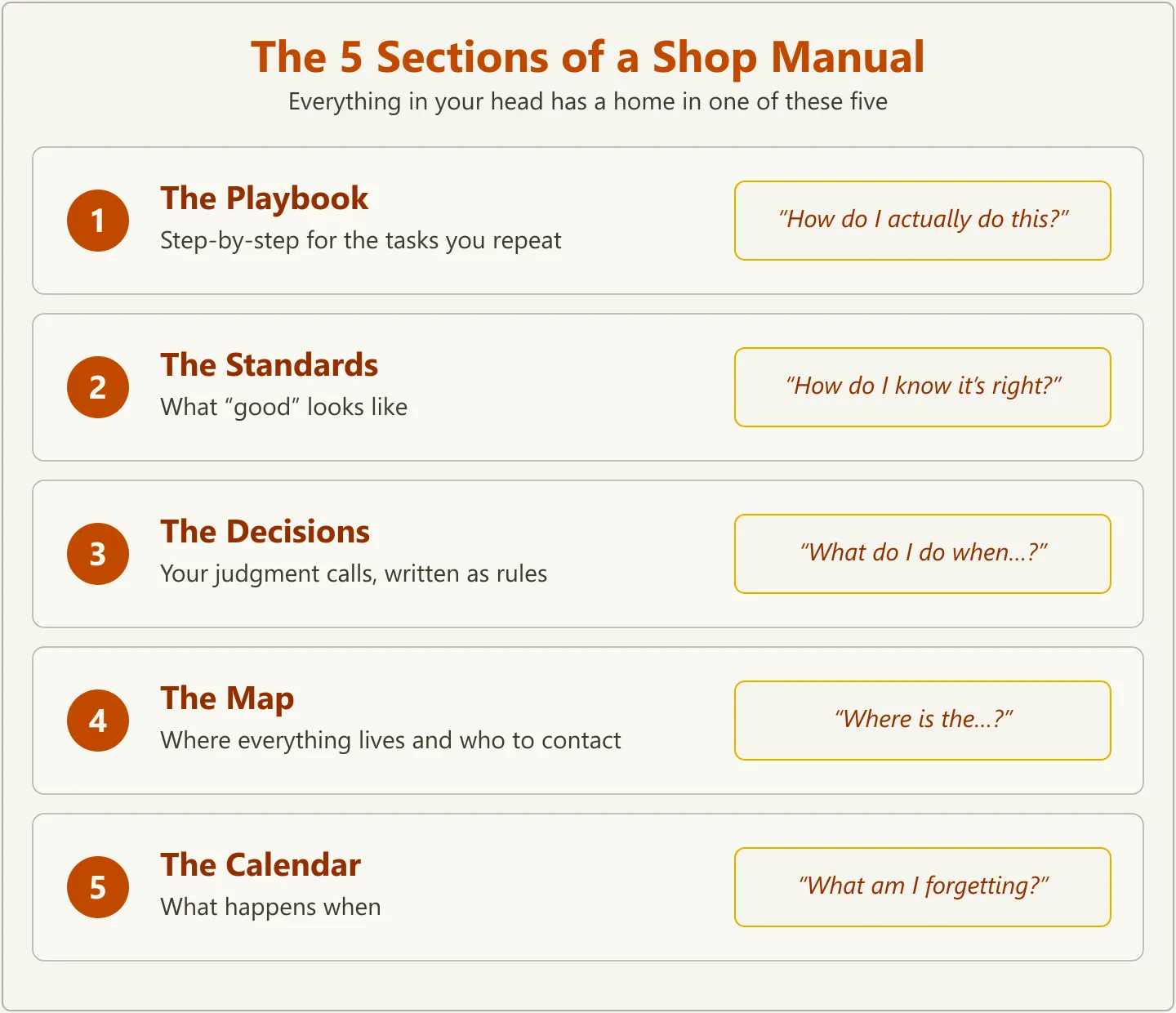
Here’s where people freeze: they imagine documenting everything, panic at the scale, and write nothing. You don’t need everything. A working shop manual has five sections, and most of what you do slots cleanly into one of them.
| Section | What it holds | The question it answers |
|---|---|---|
| The Playbook | Step-by-step for the tasks you repeat | “How do I actually do this?” |
| The Standards | What “good” looks like | “How do I know it’s right?” |
| The Decisions | Your judgment calls, written as rules | “What do I do when…?” |
| The Map | Where everything lives and who to contact | “Where is the…?” |
| The Calendar | What happens when | “What am I forgetting?” |
The Playbook is the part people picture first — the ordered steps for listing a product, packing an order, restocking a material, running your end-of-week numbers. If you do it more than a few times a month, it belongs here.
The Standards are the quiet quality-keepers. Photo specs (angle, lighting, background). Packaging rules. Your maximum response time. What a finished item has to pass before it ships. Standards are what let someone else produce your quality instead of just their own.
The Decisions are the section almost no one writes — and the one that makes a manual feel like you. When do you offer a discount? How do you handle a refund request? At what stock level do you reorder? These are the rules-of-thumb living in your gut. Writing them down is what lets a helper make your call instead of interrupting you to ask.
The Map is pure reference: where files live, account logins (stored securely — never in a plain document), supplier names and contacts, which shelf holds what, how the label printer connects. It’s the least glamorous section and the one your future helper will open forty times a day.
The Calendar is the cadence — the weekly, monthly, and seasonal rhythm. Reorder supplies mid-month. Refresh listings before the holiday rush. The summer slowdown you plan around. It’s the difference between running your shop and reacting to it.
You don’t need all five to be complete on day one. You need each to exist — a home for the next thing you write down.
How to write your first SOP without stopping everything
The reason most shop manuals never get built is that people treat writing one as a separate project — a weekend they’ll block off “someday” and never do. Don’t. Build it inside the work you’re already doing.
- Document the next thing you do, while you do it. The best time to write a procedure is the moment you’re performing it, because that’s when the tacit steps are visible. Next time you pack an order, narrate it into a note as you go. You just wrote your first SOP and it cost you three extra minutes.
- Aim for “good enough to follow,” not “polished.” A shop manual is a working document, not a publication. Bullet points beat paragraphs. A quick phone photo of your packing setup beats a written description. If a reasonably careful person could follow it and get your result, it’s done. Perfect is the enemy of written down.
- Do one process per week. You have maybe 15–20 truly repeatable processes in your whole business. At one a week, you have a real manual in a season — without ever setting aside a single dedicated day. Start with the tasks you’d most dread handing off; those are the ones most locked in your head.
- Write the decisions as “if this, then that.” Turn a gut call into a rule someone else can run. “If a customer reports damage within 30 days, send a replacement, no photo required. If it’s past 30 days, ask for a photo first.” You just moved a decision out of your head and into the manual.
- Add competency levels once someone’s learning. A manual tells someone the steps; it doesn’t tell you whether they’ve actually got it. A simple training grid — often called an ILUO matrix, tracking each person from Instructed to Learning to Uses independently to Others they can train — turns your written procedures into a visible map of who can cover what. A training ILUO matrix pairs naturally with the manual: the manual is the how, the matrix is the who can.
- Keep it living. The fastest way to kill a manual is to write it once and let it rot. When a process changes, update the page — right then, in the same three minutes. A manual nobody trusts is worse than no manual, because people follow it into a wall.
What this saves, in illustrative numbers: onboarding a helper the old way might mean three weeks of you hovering — call it 30 hours of your time spread across the month, plus the mistakes that slip through while they’re guessing. With a manual, the same person works from written steps and comes to you with a short list of real questions instead of a constant stream of “how do I…?” That same 30 hours can drop to maybe 5 or 6. You didn’t work harder — you just stopped being the only copy of the instructions.
Own the manual, don’t rent the memory
There’s a version of this where you never write anything down and simply carry the whole business in your head forever. It’s free, it’s fast today, and it quietly caps how big you can get and how far you can step away — because the operation can never be larger than one person’s memory.
There’s another version where you rent your knowledge to a generic monthly app — some sprawling wiki tool built for software teams, priced per seat, that you’ll spend more time configuring than filling.
The middle path is the one that actually fits a small shop: structure you own. A manual — in a workbook or a doc you keep — that holds your processes, your standards, and your decisions as a connected system, not a pile of loose notes. It’s built around the way your shop works, and it’s yours whether or not you keep paying anyone.
You don’t have to start from a blank page for every section, either. Some of the most-repeated parts of a shop are the same across thousands of sellers, so a ready-made customer service response library can drop straight into your manual’s Playbook as pre-written replies you adjust to your voice. And if you’d rather not build the shell from scratch, a full maker’s business operating system gives you the connected structure — the sections already laid out — so you’re filling in your details instead of inventing it.
And when your shop outgrows a manual and a workbook — when you’ve got a team covering shifts, inventory moving faster than a spreadsheet can track, and processes that need to talk to each other in real time — Ardent Seller (opens in new tab) is the next step. The manual is what makes that graduation possible: you can’t hand a business to software (or a team) that only you know how to run.
The one thing to take away
Your shop already has a manual. Every process, standard, and judgment call is written — just in the one format nobody else can read. Documenting your business isn’t creating new knowledge. It’s copying what’s already there out of your head and into a place it can’t leave with you.
Start this week. Pick the one task you’d most hate to hand off, do it once with a note open, and write down what your hands already know. That’s the first page. In a season of one-a-week pages, you’ll have something you didn’t have before: a shop that can run without you in the room.