Nobody goes looking for a conflict of interest policy until a grant application asks them to attach one. Nobody researches document retention until the accountant, working through the annual return, asks whether there is a written policy — and by then the answer cannot be improved for a year that has already ended.
That is the whole problem with governance paperwork. It arrives as someone else’s question, always at the moment it is too late to fix, and the usual answer is an evening of downloading unrelated PDFs from ten different websites in ten different voices. The Nonprofit Board & Volunteer Policy Template Pack is the other approach: the sixteen documents a small nonprofit is actually asked for, already written, in one folder, before the question comes.
What’s inside — 16 documents:
Board governance
- ✦ Board Member Role Description & Commitment Agreement — what you are actually asking a director to do, and their signature saying they will
- ✦ Conflict of Interest Policy — with an everyday-examples table, so a volunteer board can apply it without guessing
- ✦ Annual Conflict of Interest Disclosure Form — the signed evidence that the policy is used, from everyone, including the people with nothing to declare
- ✦ Document Retention & Destruction Policy — with a 32-row retention schedule already filled in, and the legal-hold clause that says when to stop
- ✦ Gift Acceptance Policy — with 20 gift types already triaged: accept, review required, or decline
- ✦ Whistleblower & Non-Retaliation Policy — with a reporting route that does not run through the executive director
Board operations
- ✦ Board Meeting Agenda — consent calendar, timings, and a decide-or-discuss column
- ✦ Board Meeting Minutes, motion & vote format — the wording, the mover, the count, and the recusal
- ✦ Annual Board Calendar & Governance Checklist — a 23-step governance year, already worked out
- ✦ Board Resolution & Policy Adoption Record — the standalone, secretary-certified record of a single decision, for when the minutes are not what a third party wants to read
Volunteers
- ✦ Volunteer Application — including the kind of screening consent liability insurers ask about
- ✦ Volunteer Agreement & Code of Conduct — with the safeguarding boundaries written down in advance
- ✦ Volunteer Role Description — plus twelve common roles already sketched out
- ✦ Confidentiality & Privacy Acknowledgment — donors, the people you serve, personnel, board deliberations
- ✦ Incident & Injury Report Form — same day, with the notification checklist
Your records
- ✦ Governance Records & Policy Register — adopted when, reviewed when, filed where
Why this beats the free templates you were about to download
- A map from the questions to the documents. A printable page lists the governance questions on the annual information return, in the order they appear, and names the document here that lets you answer each one. Line numbers were read off the currently published forms, and the page prints the form year they were read from and tells you to check the current year.
- The reference rows are already written. You fill in where each record lives and who owns it — not what the retention period should be, or which gifts need a second look. A free template gives you an empty grid; this one arrives with 184 authored rows in it.
- A router, not just a folder. Forty-six real situations — a funder is asking, a volunteer starts Saturday, a lawsuit may be coming — each naming the page that covers it.
- The one clause not to delete. Every document’s page in the guide names the single clause carrying most of its weight and says why, because people cut exactly those.
- Where your state may differ. On every document, written plainly, and pointing you to a professional where it matters.
- And the step nobody tells you about. A filled-in policy is a draft until the board votes. Section 04 of the guide is the five steps that turn it into an adopted policy, and the register that remembers when.
Fillable tables, not ruled lines. The retention schedule, the gift decision matrix, the motions and votes, the governance year, the volunteer availability grid and the policy register are all click-to-type in the PDF and real editable tables in Word. Rows that already carry text are the pack’s own reference content — edit them to fit, but read them first.
Two formats, no branding. Every document ships as a genuinely fillable PDF and an editable Word file, and carries no branding anywhere — no logo, no watermark, no “template by” line in the footer or the file metadata. Adopt one by resolution and it is your organization’s policy, not ours.
Honest about its edges. Articles of incorporation and bylaws, the exemption application, employment contracts and personnel handbooks, fiscal sponsorship and joint ventures, and anything specific to a licensed program are all deliberately left out. Each of these either is your organization’s constitution, is a tax filing, or is governed by rules that override any general template. The guide explains why, and points you at the right kind of help.
Where it sits on the shelf
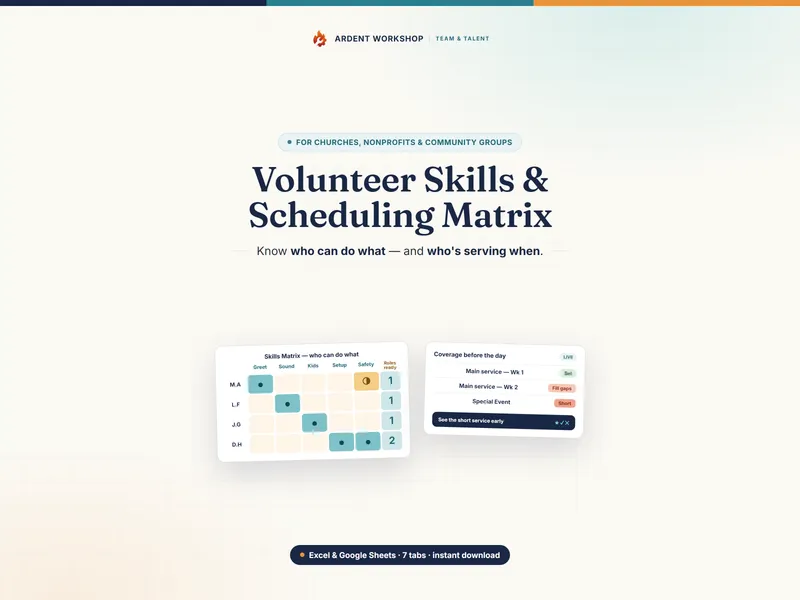
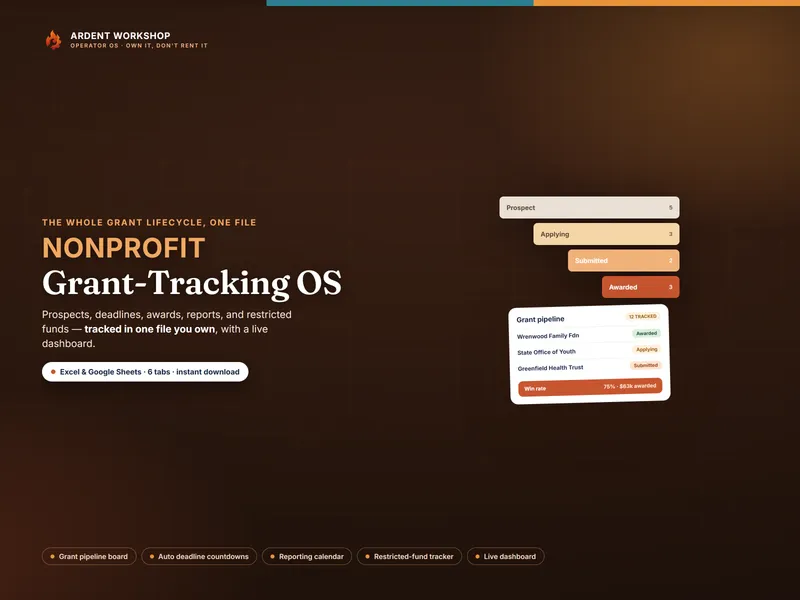
This pack supplies the governance paperwork. Ardent Workshop’s other nonprofit tools supply the numbers and the schedules around it — the Nonprofit Grant-Tracking OS for the funding pipeline, deadlines and reporting; the Volunteer Skills & Scheduling Matrix for who can do what and who is covering Saturday; and the Place-of-Worship & Small-Congregation Operations Workbook for the calendar, the facilities and the giving records.
Want a taste first? Two of the sixteen are free and ungated: the board meeting agenda and minutes templates, with the agenda also shown filled in for an invented organization, and the blank templates identical to the paid pack’s because both are built from the same source. Neither costs anything and neither asks for an email.
Instant digital download. Nothing ships. The files are yours to keep and use within your own organization forever — no subscription, no account, and no renewal when the grant that paid for it ends.
Created with AI assistance under Ardent Workshop’s creative direction, then reviewed and edited before release.
Please note: these are general templates, not legal, tax, or compliance advice, and your purchase does not create a lawyer-client or accountant-client relationship. Nonprofit requirements differ by state and change over time, and where a template and your own articles or bylaws disagree, your bylaws win. Have a lawyer who knows nonprofit law in your state review anything here before your board adopts it as policy. (The guide explains exactly where that line falls.)