Regrettable vs. non-regrettable — the core distinction
Regrettable turnover is a departure you would have prevented if you could: a strong contributor, a high-potential, or someone whose knowledge is hard to replace. Non-regrettable turnover is everything else — a retirement, a planned relocation, a performance-related exit, an end of contract, or simply someone who was not a fit. The call is a judgment, made honestly and consistently: would we have preferred to keep this person? Most involuntary exits are non-regrettable by definition, but not all voluntary ones are regrettable — plenty of people leave for reasons that are genuinely good for everyone.
Why the split matters more than the headline rate
A turnover rate on its own answers “how many left?” but not “does it matter?” Two companies with an identical rate can be in completely different health. The regrettable split answers the question that actually drives action: are we losing people we wanted to keep? A rising regrettable share is often the earliest warning of a retention problem — visible long before the overall rate moves, because a company can backfill routine churn while quietly bleeding its best people.
How to measure it
- Regrettable count — the number of exits you marked regrettable over a period.
- Regrettable share of exits — regrettable departures divided by all departures. Of everyone who left, what fraction did you want to keep? Half your exits being regrettable is a very different story from a tenth.
- Regrettable turnover rate — regrettable departures divided by average headcount, the same way a normal turnover rate is calculated, so it is comparable to the headline number.
The only new input any of these needs is one yes/no call per departure. That is the whole trick: a single field, captured at exit, unlocks the most important cut of your turnover data.
Regrettable turnover and voluntary turnover are not the same
It is easy to blur regrettable with voluntary, but they answer different questions. Voluntary asks who made the decision — the employee or the employer. Regrettable asks whether you wanted the outcome. A layoff is involuntary and usually non-regrettable; a star engineer quitting is voluntary and regrettable; a struggling hire who resigns before a performance process concludes is voluntary but often non-regrettable. Tracking both dimensions — voluntary/involuntary and regrettable/not — is what lets you isolate the preventable, painful losses from the rest.
What to do when regrettable turnover is high
A high regrettable share is a prompt to look, not a verdict. Read it alongside two other cuts of the same exit data: where people leave — by tenure, since an early-tenure spike points at hiring and onboarding — and why — by reason category, since a cluster in compensation, career growth, or management tells you which lever to pull first. A single regrettable exit is noise; a pattern of them, concentrated in one team or one reason, is a signal worth acting on.
A note on fairness
Marking someone’s departure “regrettable” is an internal planning judgment, not a grade on the person, and it should stay confidential to those who need it. The point is never to rank people who left — it is to understand whether your organization is keeping the people it depends on, so you can fix the conditions that made them leave.
Related templates and concepts
The regrettable split lives inside your exit data. To capture one exit for free, the exit-interview form is an ungated taste; the full Exit-Interview & Turnover-Analytics Workbook tracks the regrettable share across every departure and adds the cost of turnover. The flip side — mapping the capability and succession risk of the people who stay — is the 9-Box Talent Grid, and the single-point-of-failure version of the same worry is the bus factor. See how the workbook compares to HR analytics software, or browse the templates for HR & team leads hub.
Templates that implement this
Track the regrettable split
2 templates
Mark each exit regrettable or not and see the share on one dashboard, by team and manager — one owned workbook.
- $24.95 Spreadsheet

Exit-Interview & Turnover-Analytics Workbook for Excel & Google Sheets
An exit-interview and turnover-analytics workbook for Excel & Google Sheets — log departures and see turnover rate, regrettable split, reasons, and cost.
Team & TalentView details - $24.95 Spreadsheet
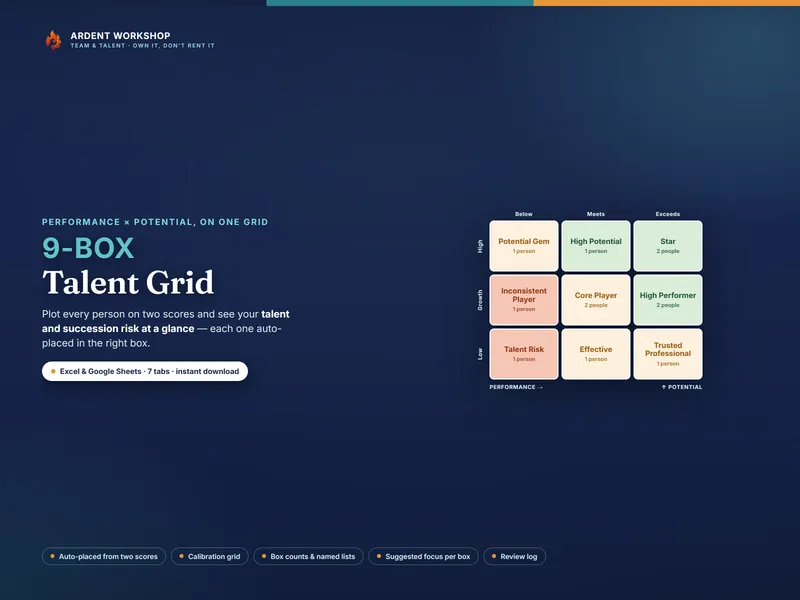
9-Box Talent Grid — Performance & Potential Matrix for Excel & Google Sheets
A 9-box talent grid for Excel & Google Sheets — score performance and potential, auto-place each person, and see succession risk on one grid.
Team & TalentView details