This isn’t really template-versus-platform. The turnover analytics a small team actually acts on — the rate, the regrettable split, the reasons, the cost — is exactly what an owned workbook produces. The mistake is buying a per-employee people-analytics suite when the part that changes a retention decision is something you can own outright.
What each one is for
- An exit-interview & turnover-analytics workbook is a focused analysis tool. Capture each departure with a structured reason, then read your turnover rate, the voluntary and regrettable splits, the reasons people leave, and an estimated cost — for the whole org and by team and manager. It answers “are we losing the right people, why, and what is it costing us?”
- HR analytics software is an enterprise platform. Live HRIS and payroll integration, continuous engagement surveys, headcount and diversity dashboards, and sometimes predictive attrition models — priced per seat or per employee, with an implementation project to match. It answers “model our entire workforce in real time,” at enterprise scale and cost.
A full explanation of regrettable turnover and the cost of turnover are in the glossary.
When the workbook is exactly right
- You run HR (or wear the HR hat) for a small or mid-size team.
- You analyze turnover each quarter, not continuously in real time.
- You want the regrettable split and the cost of turnover, not a survey engine.
- You’d rather own the file than rent a per-employee platform.
- You want your people data in your own hands.
At this stage the workbook beats a platform outright for the part that matters — the analysis. The free exit-interview form is a no-signup taste, and the templates for HR & team leads hub collects the rest.
The signals you may want a full platform
- You’re at enterprise scale. Thousands of employees and turnover to model across many divisions in real time.
- You need live integration. Automatic feeds from your HRIS, payroll, and survey tools, not manual entry.
- You run continuous engagement measurement. Ongoing surveys and sentiment tracking, not just exit data.
- You have a people-analytics team to run it. A platform needs an owner and a budget; a workbook needs one person who fills it in.
Even then, the turnover story is still the rate, the regrettable split, the reasons, and the cost — the platform just computes them across more data. The workbook is the analysis; the platform is the scale.
Side by side
| What matters | Turnover-analytics workbook (owned) | HR analytics software |
|---|---|---|
| What it is | A focused exit-capture and turnover-analysis tool | A broad people-analytics platform |
| Cost | One-time, low; you keep the file | Recurring per-seat or per-employee subscription |
| Best for | Small to mid-size teams analyzing turnover each quarter | Enterprises modeling a large workforce in real time |
| Turnover rate, regrettable split, cost | Built in, computed from what you log | Built in, computed from integrated data |
| Live HRIS / payroll integration | No — you enter departures | Yes |
| Engagement surveys & predictive models | No | Often yes |
| Setup | Open and fill in; works in minutes | An implementation project to connect systems |
| Data ownership | Your own file, in your hands | Held in the vendor’s platform |
Own it, don’t rent it
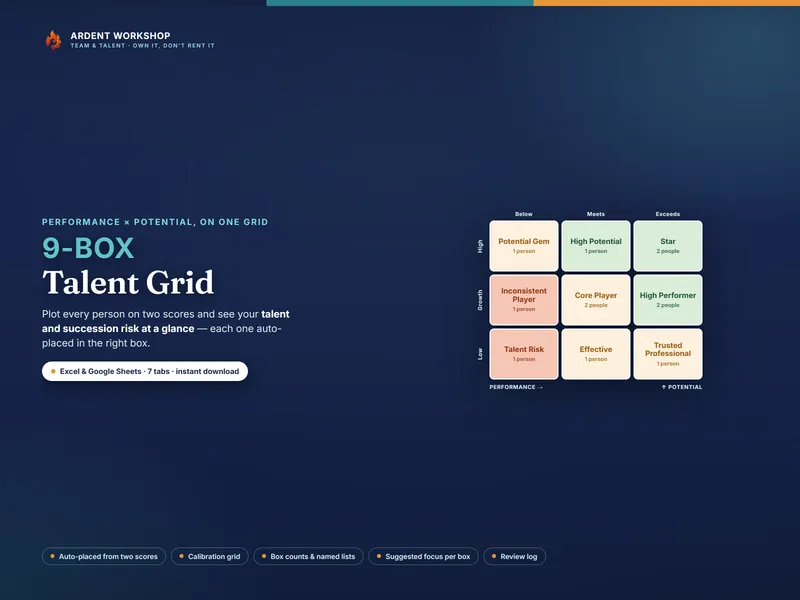
The workbook sits on the middle rung of a familiar ladder. Below it is a blank spreadsheet — free, but you build every formula and dashboard yourself. Above it is HR analytics software — powerful, but overkill and a recurring per-employee bill for most teams. The workbook is the structure you keep: the turnover analysis done for you, in a file you own, with no seats and no monthly fee. Start with the free exit-interview form, step up to the Exit-Interview & Turnover-Analytics Workbook when you want the full picture, and pair it with the 9-Box Talent Grid to map the people who stay.
Frequently asked questions
- What's the difference between an exit-interview template and HR analytics software?
- An exit-interview template is the artifact you use to capture and analyze departures: a structured form for each exit, a reason taxonomy, and dashboards that compute your turnover rate, the regrettable split, and the cost of turnover from what you log. HR (or people) analytics software is a platform that pulls data from your HRIS and survey tools to produce attrition dashboards, engagement scores, and sometimes predictive models — usually per-seat or per-employee, on an annual contract. One is a focused tool you own and fill in; the other is a broad system you rent and integrate. For a small or mid-size team, the template captures the exact analysis that drives retention decisions without the platform.
- Can a spreadsheet replace HR analytics software for turnover?
- For the core job — logging every departure with a structured reason, and seeing your turnover rate by team, manager, and tenure, the regrettable-vs-non-regrettable split, and an estimated cost of turnover — an owned workbook does it well and you keep the file. What a spreadsheet doesn't do is integrate live with your HRIS and payroll, run continuous engagement surveys, or build predictive attrition models across thousands of employees. If you have that scale and a people-analytics team to run it, a platform earns its keep; if you're an HR manager or founder who wants a clear, honest read on why people leave and what it costs, the workbook is the right size of tool.
- How much does an exit-interview template cost vs HR analytics software?
- An owned workbook is a single low one-time cost — you keep it, reuse it every quarter, and pay nothing monthly. People-analytics platforms are typically a recurring subscription priced per seat or per employee, often with an annual minimum and an implementation project to connect your systems. The subscription pays off at enterprise scale with live integrations; paying a monthly per-employee fee just to track and analyze the departures you already have is renting far more system than the job needs.
- Is exit and turnover data sensitive — where should it live?
- Yes. Exit interviews capture candid, personal views, and turnover records are about named people, so the data should stay confidential to those who need it and be anonymized where you can — a role and team is usually enough for the analysis. That's true whether it lives in a workbook you own or a platform you rent. A workbook keeps the data in your own hands rather than a third-party vendor's; a platform adds access controls but also adds another system holding your people data. Either way, handle it the way your own privacy policy and local employment law require.