This isn't really template-versus-platform. Running a review is one thing performance-management software happens to include. The mistake is buying the whole per-seat platform when the part you'll actually use — rating a small team and calibrating the results — is something you can own outright.
What each one is for
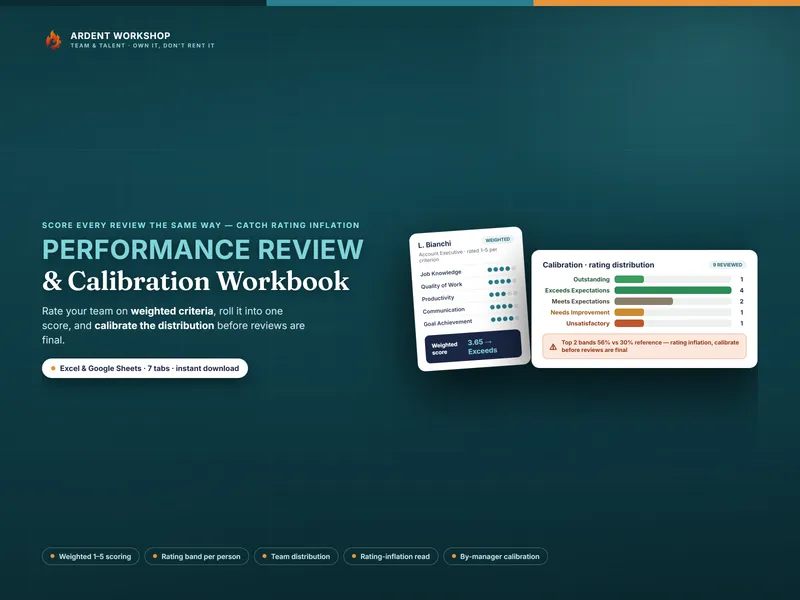
- A performance-review template is a review-and-calibration tool. Rate each person against weighted role criteria on a defined 1–5 scale, roll it into one overall score and rating band, and then calibrate the whole team's rating distribution — with an inflation read and a by-manager view — before ratings are final. It answers “how did each person do, and do our ratings hold together?”
- Performance-management software is a platform. Continuous feedback and check-ins, goal and OKR tracking, 360-degree reviews, an employee database and HRIS integrations, reminders, approval workflows, and analytics — with the review cycle one module inside it. It answers “run our entire performance process,” year-round, at a price to match.
When a performance-review template is exactly right
- You run a review once or twice a year, not a continuous cycle.
- You're a manager, a founder, or a small HR function — not a large People team.
- You want to calibrate a handful of managers' ratings on one view.
- You'd rather own the file than rent a platform per employee.
- You want your rating data in your own hands, offline.
At this stage a workbook beats a platform outright for the review-and-calibrate job. The free performance-review starter is a no-signup, single-person weighted review form to try the scoring, and the templates for HR & team leads hub collects the rest.
The signals you may want a full platform
- You run continuous performance management. Frequent check-ins, ongoing feedback, and goal cascades across the whole org, not one annual event.
- You need 360-degree reviews. Structured feedback gathered from peers, reports, and multiple managers, collected and collated automatically.
- You need live HRIS data and integrations. Org charts, headcount, and role data flowing in, and ratings flowing out to pay and succession systems.
- You have a People team to run it. A platform needs an owner and a rollout; a workbook needs a manager and an afternoon.
Even then, the review and its calibration still come down to rating people on criteria and checking the distribution — the platform just hosts and automates it. The workbook is the thinking; the platform is the plumbing.
What software genuinely does better
To be fair to the platforms: a good performance-management system really does more than a spreadsheet. Continuous feedback and check-ins across the year, 360-degree review collection, live integration with your HRIS and payroll, automated reminders and approval routing, and org-wide reporting are real capabilities a workbook doesn't try to replicate. If those are things you'll actually use every month, the subscription can be worth it. The question is honest use, not feature count.
Side by side
| What matters | Review template (owned workbook) | Performance-management software |
|---|---|---|
| What it is | A focused review-and-calibration tool | A broad performance-process platform |
| Cost | One-time, low — you own the file | Ongoing subscription, often per employee |
| Weighted scoring & rating bands | The whole point — one score and band per person | Included, one feature among many |
| Calibration & distribution | Whole-team distribution, inflation read, by-manager view | Built-in calibration views and analytics |
| Continuous feedback & 360s | Not its job — one review cycle at a time | Full — year-round check-ins and 360s |
| HRIS / integrations | You enter the people you're reviewing | Live employee data and integrations |
| Setup | Open it and rate — an afternoon | Implementation, config, rollout |
| Data ownership | The file is yours, offline | Hosted in the vendor's platform |
| Best for | A manager or small HR function's annual review | A People team running continuous cycles at scale |
The honest middle ground
Plenty of organizations grow into a performance platform eventually, and that's the right move when continuous performance management across a large workforce becomes the job. The mistake is the reverse: buying a per-seat suite to run a once-a-year review, when an owned workbook does that part better and costs once.
Run your review either way
Whichever stack you end up on, the review itself comes down to rating people on weighted criteria and calibrating the result. The Performance Review & Calibration Workbook computes a weighted overall score and rating band for each person, then shows the whole team's rating distribution, an inflation read, and a by-manager view — one owned file for Excel, Google Sheets, and LibreOffice. Own the review; add a platform only when running performance management at scale becomes the job — own it, don't rent it.
Frequently asked questions
- What's the difference between a performance-review template and performance-management software?
- A performance-review template is the artifact: a spreadsheet where a manager rates each person against weighted criteria, rolls it into one overall score and rating band, and calibrates the whole team's rating distribution before ratings are final. Performance-management software is a platform that runs those reviews inside a broader system — continuous feedback, goal and OKR tracking, 360s, integrations with your HRIS, and reporting — usually sold as a per-seat subscription. One is a focused tool you own; the other is a broad system you rent. For a small team running an annual or half-year review, the template does the job the software's review module does, without the platform.
- Can a spreadsheet replace performance-management software?
- For the review-and-calibration job most small teams actually do — rating people on shared criteria, computing a weighted score and band, and checking the rating distribution across the team and across raters — an owned workbook does it completely. What a spreadsheet doesn't do is run continuous feedback and check-ins year-round, collect 360-degree reviews, pull live employee data from an HRIS, or automate reminders and approval workflows across hundreds of people. If you're a People team running frequent cycles at scale, software earns its keep; if you're a manager, a founder, or a small HR function running a review once or twice a year, the workbook is the right size of tool.
- How much does a performance-review template cost vs performance-management software?
- An owned performance-review workbook is a single low one-time cost — you keep the file, edit it offline, and pay nothing monthly. Performance-management software is typically a recurring per-seat or per-employee subscription, often with an annual contract and setup. The subscription pays off when you genuinely use the full platform year-round; paying per seat just to run a once-or-twice-a-year review is renting far more system than the job needs.
- Is a performance review confidential if it's a spreadsheet?
- A spreadsheet you own is as confidential as the file controls you put around it — and unlike a hosted platform, the ratings never leave your control. A review workbook holds candid, named assessments and pay-relevant scores, so keep it to those who genuinely need it and handle it the way your privacy policy and local law require, whether it lives in a spreadsheet or a vendor's cloud. A rating is a structured input to a fair decision and a conversation, not a verdict, and never the sole basis for a pay, promotion, or exit decision.