Net price in one line
Net price is cost of attendance minus gift aid. That's the whole definition. Cost of attendance is the full estimate of what a year costs — tuition, fees, housing, meals, and the indirect costs of books, travel, and everyday expenses. Gift aid is the subset of an award that genuinely lowers that total: grants and scholarships, from the college, the state, or an outside source. Subtract one from the other and what's left is the real price a family has to cover, by whatever combination of savings, work-study earnings, or borrowing it takes.
The definition is simple. What trips families up is that a loan and a work-study award both show up as line items on the same award letter as a grant, styled the same way, and it's tempting to subtract all three together. Only the grants belong in that subtraction.
If you already have a letter in front of you, the free College Net-Price Estimator does that subtraction for one college — a spreadsheet, no signup required. The College Financial-Aid Award-Letter Comparison Calculator does it for up to six at once, which is the point at which the letters start disagreeing with each other.
Why a loan is not a discount
A loan doesn't make the year cost less. It moves the cost forward in time, to whoever signs for the loan, and adds interest along the way. For loans first disbursed between July 1, 2026 and June 30, 2027, federal Direct Loans for undergraduates carry a 6.52% interest rate, and Direct PLUS loans for parents carry 9.07%. An origination fee also comes off the top of what disburses, and it follows the federal fiscal year rather than the award year, so it doesn't turn over on the same date: the current fee is 1.057% on Direct Subsidized and Unsubsidized loans and 4.228% on Direct PLUS, on loans first disbursed before October 1, 2027 — which covers every disbursement of the 2026-27 year. Both sets of figures are published by Federal Student Aid.
Every dollar borrowed against the bill costs more than a dollar by the time it's repaid — which is the opposite of what a subtraction from net price is supposed to mean. A college that leans on loans to close its gap and one that leans on grants can print the same "you pay" number and be offering two very different actual costs.
Why work-study is not a discount either
A work-study award is permission to hold a particular kind of campus job — paid by the hour, in a position the student still has to find, apply for, interview for, and keep. It doesn't arrive as money off the bill due at the start of a term; it arrives as a paycheck spread across the weeks the student actually works. A work-study line on an award letter can go partly or entirely unrealized if the hours or the job itself don't materialize, and even when it's fully earned, it never reduces what's billed — it's income a student uses toward expenses, after the fact, the same as any other part-time job.
Grants and scholarships are the only aid on a letter that changes the price itself. Loans and work-study change how the remaining price gets paid, and by whom.
The "net cost" trap on award letters
Many award letters print a figure labeled "net cost," "remaining cost," or "you pay" — and it's tempting to treat that as net price. Two things usually make it something else. First, it often starts from what the college bills (tuition, fees, housing, meals) rather than the full cost of attendance, quietly leaving out books, travel, and personal expenses. Second, it often subtracts every line on the award — loans and work-study along with grants and scholarships — rather than gift aid alone. Both patterns are what the U.S. Government Accountability Office found when it reviewed colleges' aid offers: many exclude key costs and factor in loans that have to be repaid, making the college look less expensive than it is.
Either change on its own moves the number, and a letter that does both can print a "you pay" figure a long way from a genuine net price. The deeper problem is that colleges don't compute it the same way, so two letters quoting a "net cost" cannot be set beside each other and trusted — which is the whole reason to recompute both yourself, from full cost of attendance minus gift aid alone.
A college's own net price calculator is an estimate, not a quote
Every institution that takes part in the Title IV federal student aid programs is required to post a net price calculator on its website, and the required definition is the honest one: cost of attendance minus grant and scholarship aid. What comes back is an estimate built from the answers a family types in and from what similar students paid in a previous year — worth running early in the search, and not the number a real award letter will land on for one particular student.
That is a different job from the one this page is about. A college's calculator estimates a price before there is a letter; the arithmetic below re-derives the price from a letter you already have, so that two or three of them can be set beside each other.
How to compute your own net price
Recompute it yourself, the same way, for every college on the list:
- Start from the college's full cost of attendance — not the billed subtotal, and not a number an award letter has already netted something against.
- Subtract only the lines that are true gift aid: grants and scholarships, regardless of who's giving them.
- Leave every loan and every work-study award out of the subtraction. Note them separately — they still matter, just not as a discount.
Do that consistently and the totals across colleges become comparable in a way the letters underneath them usually are not. The free College Net-Price Estimator is a spreadsheet that runs exactly that calculation for one college's cost of attendance and award letter — no signup required.
Related templates and concepts
Net price is what's left of cost of attendance once gift aid comes off, and the two terms get used almost interchangeably when they shouldn't be — which line on a letter counts as that gift aid is the subject of gift aid vs loans on an award letter. The College Financial-Aid Award-Letter Comparison Calculator puts up to six colleges' award letters on the same footing against their own cost of attendance, keeps gift aid separate from loans and work-study on every one, and prices out any borrowing plan at the rate and fee that actually apply to it. It's a workbook you own outright rather than a calculator that wants an email address for one result — own it, don't rent it. Browse the rest of the search on the templates for college students hub.
Templates that implement this
Tools that compute net price the right way
4 templates
A workbook that puts up to six award letters on the same footing against their colleges' full cost of attendance and separates gift aid from loans and work-study on every one, plus decision and acceptance calculators for the rest of the college search.
- $14.95 Spreadsheet

College Financial-Aid Award-Letter Comparison Calculator — Six U.S. Offers, True Net Cost, Loan Payments & the 2026-27 Caps (Excel & Google Sheets)
For U.S. parents and students: compare up to six college financial-aid award letters on true net cost, real loan payments and the 2026-27 borrowing caps.
Big DecisionsView details - $2.95 Excel

College Decision Helper - Excel
College choices come down to two camps: the gut-feel and the scored. This excel college decision helper is a college comparison spreadsheet with weighted factors and ranked contenders.
Big DecisionsView details - $3.95 Excel
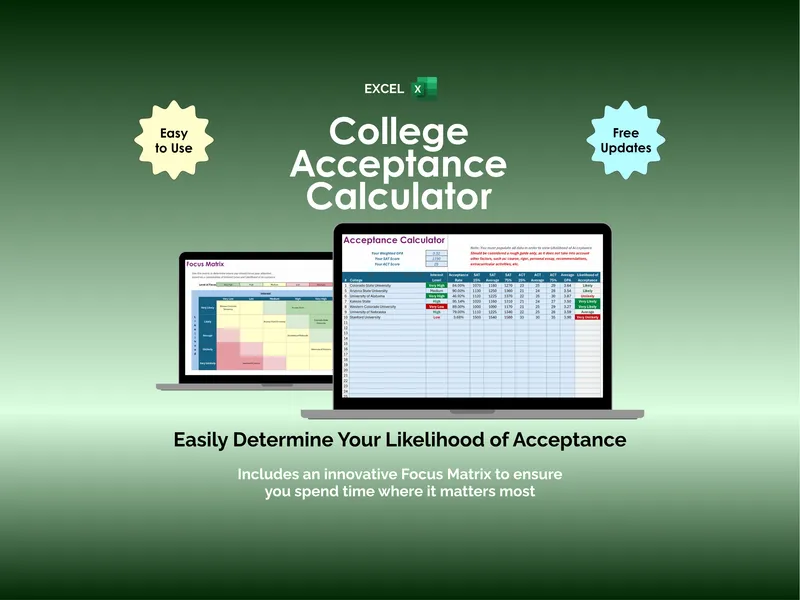
College Acceptance Calculator - Excel
Pricing a college visit without knowing your odds is how December panic starts. This college acceptance calculator excel turns GPA and test scores into a likelihood number.
Big DecisionsView details - $5.95 Excel
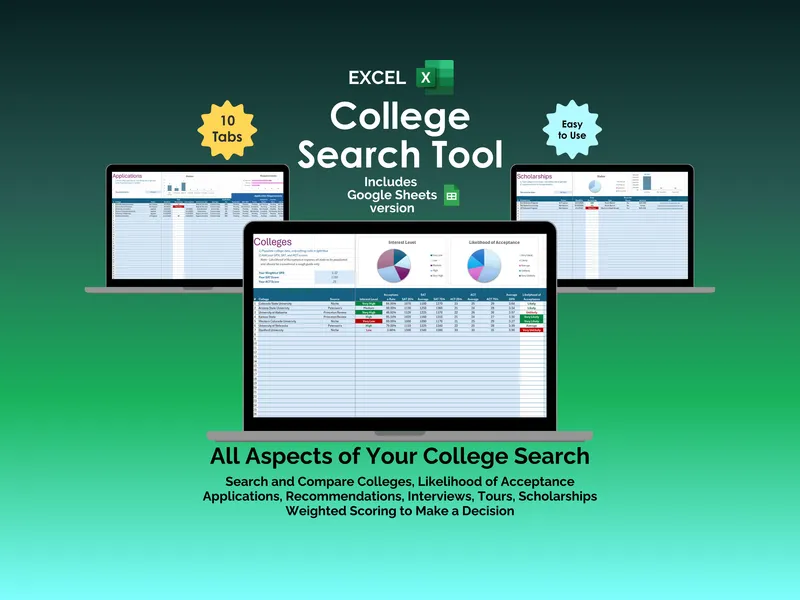
College Search Tool - Excel
Drowning in college deadlines, essays, and rec letters? This Excel college search tool tracks every application, scholarship, tour, and ranks your final pick on data.
Big DecisionsView details
Frequently asked questions
- What is net price?
- Net price is what a year at a college actually costs a family after subtracting the aid that genuinely lowers the price: grants and scholarships. In one line, net price = cost of attendance minus gift aid. Nothing else comes off — not a loan, not work-study — because neither of those makes the year cost less, they only change how the remaining cost gets paid.
- Is net price the same as cost of attendance?
- No, and the two get swapped constantly. Cost of attendance is the full price of one year at a college — the tuition, fees, housing and meals it bills, plus the books, travel and everyday costs it doesn't. Net price is what's left of that figure after grants and scholarships come off. Cost of attendance is where the arithmetic starts; net price is where it ends, and it's the one to compare across colleges.
- Is net price the same as what an award letter says I'll pay?
- Often not. Many award letters print a “net cost,” “remaining cost,” or “you pay” figure that starts from what the college bills — not the full cost of attendance — and subtracts loans and work-study along with any grants and scholarships. That number can look close to a true net price without being one; recompute it yourself from the full cost of attendance and the gift-aid lines only, and compare that figure across colleges instead.
- Why isn't a loan counted against net price?
- Because a loan doesn't reduce what the year costs — it defers the cost, with interest, to whoever has to repay it. For loans first disbursed between July 1, 2026 and June 30, 2027, federal Direct Loans for undergraduates carry a 6.52% interest rate, and Direct PLUS loans for parents carry 9.07%. An origination fee comes off the top of the disbursement as well, and it's set by federal fiscal year rather than award year, so it doesn't turn over on the same date: the current fee is 1.057% on Direct Subsidized and Unsubsidized loans and 4.228% on Direct PLUS, on loans first disbursed before October 1, 2027 — which covers every disbursement of the 2026-27 year. So a dollar borrowed against the bill is a dollar that costs more than a dollar by the time it's repaid. Subtracting it from cost of attendance makes a college look cheaper on paper without making it cheaper in fact.
- Why isn't work-study counted against net price either?
- Work-study is an eligibility to hold a particular kind of campus job, paid by the hour, in a position the student still has to find, apply for, and keep. It shows up as pay spread across the school year — not as money off the bill due at the start of a term. A student who can't land a work-study job, or whose hours fall short, doesn't get a shortfall refunded; the aid was never a price reduction to begin with.
- Where does the published net price on a college's website come from?
- Every institution that takes part in the Title IV federal student aid programs is required to post a net price calculator on its website, and the required definition is the correct one: cost of attendance minus grant and scholarship aid. What it gives back is an estimate, built from the answers you type in and from what similar students paid in a previous year — not an offer. It's a useful starting point before you apply; it is not the number your own award letter will land on, and it isn't a substitute for recomputing net price from the letter once you have one.
- How do I calculate my own net price?
- Start from the college's full cost of attendance, not the billed amount on the award letter. Then subtract only the lines that are true gift aid: grants and scholarships, whether from the college, the state, or an outside source. Do not subtract loans of any kind or work-study. Do that for every college on the list, the same way each time, and the totals can be set beside each other and trusted — which an award letter's own “you pay” line usually cannot be.