What counts as cost of attendance
Cost of attendance splits into two groups, and the split is exactly what trips people up when they compare it to an award letter.
- Direct costs are what the college actually bills you: tuition and fees, housing, a meal plan, and — at many colleges — a mandatory student health insurance charge. These show up on an invoice, and they're the part every award letter is built around.
- Indirect costs are real spending the college never invoices: books and course supplies, travel to and from campus, and personal and everyday expenses. Nobody sends you a bill for a plane ticket home at Thanksgiving or a semester of textbooks, but the money still leaves your account.
A college's published cost of attendance is supposed to add both groups together for one student, for one year. When it does, it's the most complete single number a college puts in writing about what attending actually costs.
Once you have that number, the free College Net-Price Estimator subtracts one college's gift aid from it and returns the net price underneath — a spreadsheet, no signup required. The College Financial-Aid Award-Letter Comparison Calculator does the same for up to six colleges at once.
Why your award letter usually shows a smaller number
Award letters exist to tell you what aid the college is offering against a cost — and the cost most letters show is the billed cost: tuition, fees, housing, and meals. The indirect half of cost of attendance rarely appears, because the college isn't the one collecting that money, so it has little reason to put it on the same page as the number it's discounting. This is not a fringe complaint: reviewing colleges' aid offers, the U.S. Government Accountability Office found that many exclude key costs and net loans against the price, which makes a college look less expensive than it is.
The effect shows up fastest with distance. A college a plane ride away has a real travel cost every time a student comes home, on top of everything else — but if the letter only quotes billed cost, that college can land on paper looking about as affordable as one a short drive away that a student could visit for the price of a tank of gas. Cost of attendance is where that gap becomes visible; an award letter alone usually won't show it to you.
It's an estimate, and it resets every year
Cost of attendance is a college's own estimate, built around a first-year or standard-student budget — not a guarantee, and not a figure that holds still. Colleges republish it for each new academic year as tuition, housing rates, and their cost-of-living allowances change. The cost of attendance a college quoted the year a student applied is not the number that governs the year they actually enroll, and it will move again before graduation.
Two cost-of-attendance figures compare; two award letters mostly don't
Because every college that publishes a cost of attendance is describing the same categories — one student, one year, direct costs plus indirect costs — two colleges' cost-of-attendance totals sit next to each other far more honestly than their letters do. Each college still sets its own allowance amounts for housing, travel and personal spending, so the totals are comparable in shape rather than identical in method. Their award letters usually don't: one college calls a loan an "award," another lists work-study beside a grant in the same line style, and a third starts from a cost of attendance that quietly left out travel and personal expenses in the first place. Cost of attendance is the base a comparison should start from, before any letter's own wording or its own choice of what to net against it enters the picture.
Check whether the health insurance line is waivable
Some colleges fold a mandatory student health insurance charge into the direct-cost side of cost of attendance. Where a college does, ask whether it will waive that charge for a student who can show comparable coverage elsewhere — staying on a parent's plan is the usual route — because the one line can move the total by a meaningful amount without anything else about the offer changing. A waiver has to be filed with the college by its own deadline; it isn't automatic just because other coverage exists.
Once you know cost of attendance, the next question is how to cover it
Gift aid — grants and scholarships — is the only thing that should ever be treated as lowering cost of attendance. What's left after gift aid is what has to be funded some other way: savings, work-study, or borrowing. If borrowing is part of that plan, the federal terms are set in three separate windows that don't line up with each other:
- Interest rates apply to loans first disbursed between July 1, 2026 and June 30, 2027: 6.52% on Direct Subsidized and Unsubsidized loans for undergraduates, 9.07% on Direct PLUS, per Federal Student Aid's published rates.
- Origination fees follow the federal fiscal year, not the award year, so their window doesn't line up with the rates'. The current fee — 1.057% on Direct Subsidized and Unsubsidized loans and 4.228% on Direct PLUS, per the same Federal Student Aid table — runs on loans first disbursed before October 1, 2027, which covers every disbursement of the 2026-27 year. It comes off before the money reaches the college, so the borrower owes more than the college is ever paid.
- Borrowing limits are set by award year. A dependent undergraduate's annual Direct Loan limit is $5,500 in year one, $6,500 in year two, and $7,500 in years three and beyond, up to a $31,000 aggregate — of which no more than $23,000 can be subsidized. For each academic year beginning on or after July 1, 2026, Parent PLUS is capped at $20,000 per dependent student per year and $65,000 in total per dependent student, per Federal Student Aid's Parent PLUS limits.
Those caps apply to what's borrowed against the gap cost of attendance leaves behind — which is one more reason the size of that gap, not just the sticker price, is the number worth getting right first. There's more on which line does what in gift aid vs loans on an award letter.
What to ask a college for
Ask each college directly for its full published cost of attendance for a first-year student — not just what it will bill you. Most colleges post it on their financial-aid website, broken into the same direct and indirect categories described above; if a college only sends billed costs, ask specifically whether the figure includes books, travel, and personal expenses, and whether the health insurance charge is mandatory or waivable. That's the number to compare across colleges before any award letter's own aid is netted against it — the free College Net-Price Estimator is a spreadsheet that takes one college's cost of attendance and its award letter and returns the net price underneath them, with loans and work-study kept separate from the discount — no signup required.
Related templates and concepts
Cost of attendance is the base; net price is what's left of it once gift aid comes off — the two terms get used almost interchangeably and shouldn't be. The College Financial-Aid Award-Letter Comparison Calculator puts up to six colleges' award letters on the same footing against their own cost of attendance, prices out every loan at the rate and fee that actually apply to it, and tests a borrowing plan against the federal caps before a loan application does. It's a workbook you own outright rather than a calculator that wants an email address for one result — own it, don't rent it. Browse the rest of the search on the templates for college students hub.
Templates that implement this
Tools that turn cost of attendance into a real comparison
4 templates
A workbook that puts up to six award letters on the same footing against their colleges' full cost of attendance, plus the decision, acceptance and college-search calculators for the rest of the search.
- $14.95 Spreadsheet

College Financial-Aid Award-Letter Comparison Calculator — Six U.S. Offers, True Net Cost, Loan Payments & the 2026-27 Caps (Excel & Google Sheets)
For U.S. parents and students: compare up to six college financial-aid award letters on true net cost, real loan payments and the 2026-27 borrowing caps.
Big DecisionsView details - $2.95 Excel
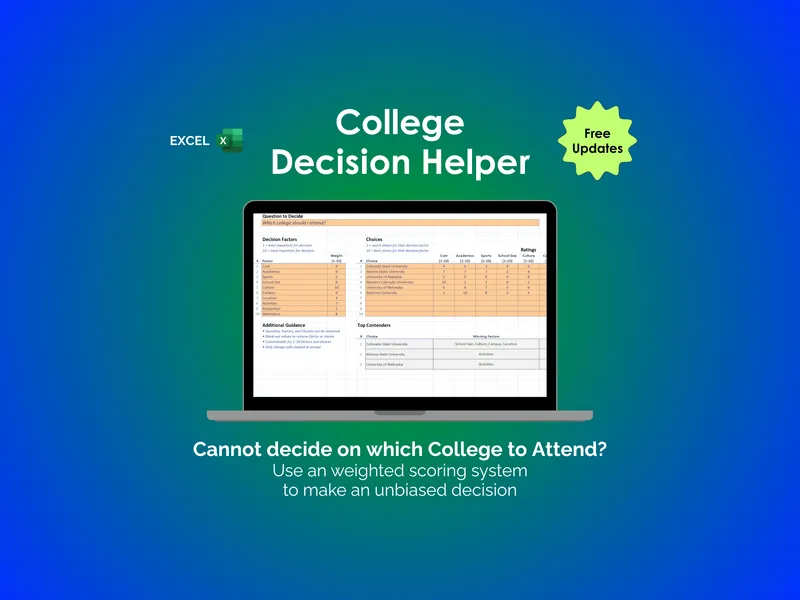
College Decision Helper - Excel
College choices come down to two camps: the gut-feel and the scored. This excel college decision helper is a college comparison spreadsheet with weighted factors and ranked contenders.
Big DecisionsView details - $3.95 Excel
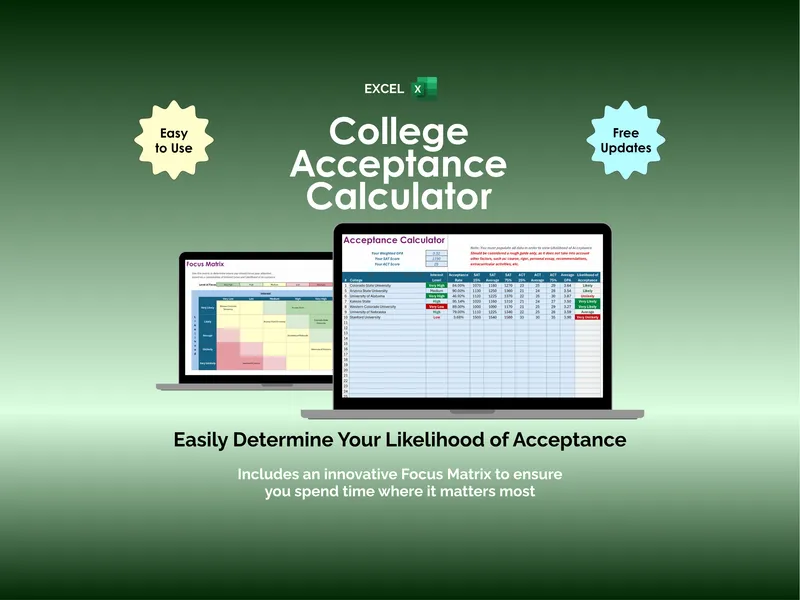
College Acceptance Calculator - Excel
Pricing a college visit without knowing your odds is how December panic starts. This college acceptance calculator excel turns GPA and test scores into a likelihood number.
Big DecisionsView details - $5.95 Excel
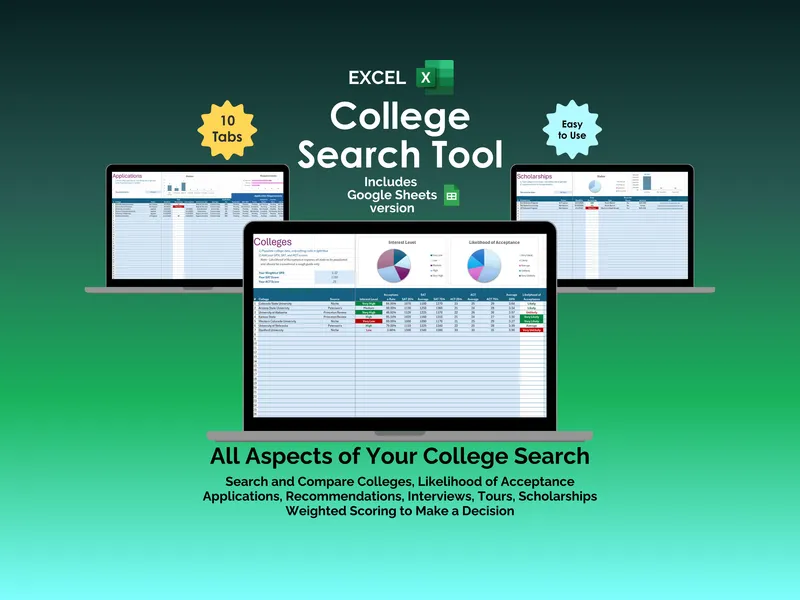
College Search Tool - Excel
Drowning in college deadlines, essays, and rec letters? This Excel college search tool tracks every application, scholarship, tour, and ranks your final pick on data.
Big DecisionsView details
Frequently asked questions
- What is cost of attendance (COA)?
- Cost of attendance is a college's own published estimate of what one year there costs a student, in full. It combines the direct costs the college actually bills you — tuition and fees, housing, meals, and any mandatory fees such as student health insurance — with the indirect costs it doesn't bill but you pay anyway: books and supplies, travel to and from campus, and everyday personal expenses. It's the figure federal financial-aid eligibility is calculated against, and it's meant to describe the whole year, not just the part that shows up on an invoice.
- What's included in cost of attendance?
- Two groups of costs. Direct costs are what the college bills you for: tuition and fees, housing, a meal plan, and often a mandatory student health insurance charge. Indirect costs are real money you spend but the college never invoices: books and course supplies, getting to and from campus, and personal and day-to-day expenses. A college's published cost of attendance is supposed to add both groups together — leaving out the indirect half is what makes a total look smaller than the year will actually cost.
- Why does my award letter show a lower number than the college's cost of attendance?
- Many award letters quote what the college will bill you — tuition, fees, housing, and meals — not the full cost of attendance. Books, travel, and personal expenses are real costs of that year, but because the college doesn't collect that money itself, many letters simply leave them off. The effect is that a college a plane ride away, with a real travel cost every semester, can look about as affordable as one down the road, because the number on the letter never accounted for the flights.
- Does cost of attendance include health insurance?
- Often, yes — many colleges add a mandatory student health insurance charge to the direct-cost side of the published cost of attendance. Where a college does, ask whether it will waive the charge for a student who can show comparable coverage elsewhere, such as staying on a parent's plan. It's worth checking before you accept the charge: a waiver filed before the college's own deadline can move the total by a real amount without changing anything else about the offer.
- Is cost of attendance the same every year?
- No. Cost of attendance is an estimate the college publishes for one year at a time, built around a first-year or standard-student budget, and it's re-published for each new academic year as tuition, housing rates, and cost-of-living allowances change. A cost of attendance you saw as a high-school junior is not the number that applies the year you actually enroll, and it won't stay fixed for all four years, either.
- What's the difference between cost of attendance and net price?
- Cost of attendance is the full price of one year at a college; net price is what's left of that price once gift aid comes off. Net price = cost of attendance minus grants and scholarships, and nothing else — a loan isn't subtracted, because it defers the cost rather than reducing it, and neither is work-study, which is pay for a campus job the student still has to find and work. Cost of attendance is the number to start from; net price is the number to compare across colleges.
- How do I compare cost of attendance across colleges?
- Ask each college directly for its full published cost of attendance for a first-year student — not just what it will bill you — and use that figure, not the award letter's headline number, as your starting point. Because cost of attendance covers the same categories at every college that publishes one — direct costs plus indirect costs, for one year — two or three colleges' totals can be set beside each other and compared far more honestly than the award letters underneath them. Each college still sets its own allowance amounts for housing, travel and personal spending, so ask how the figure was built if two colleges look surprisingly close.