Picture it: 8:40 on a Friday, four people standing in front of a shelf holding sixty-one board games. Someone says “we could do the one with the trains.” Someone else says “that’s forty minutes of setup.” Someone reads the back of a box they have read the back of eleven times.
Nine minutes later you are playing the same game you played last time. And the time before that.
The shelf watched all of it and said nothing, because a shelf can’t. Your shelf is a record of what you bought. It is not a record of what you play. Those are two different hobbies, and only one of them is the fun one. To track the board games you’ve actually played, keep a play log: one dated row per session — date, game, who played, minutes, winner, rating, note — and never one row per game.
Your collection is a purchase history, not a hobby
Here is the reframe: a game you own is a claim, and a game you’ve played is a receipt.
Collectors track claims. They know exactly how many games are on the shelf, which edition each one is, and which sleeves fit. That knowledge is real, but it describes a library. It tells you nothing about your actual Friday nights — which is where the hobby lives.
A play log is a dated record of every session you actually play: what you played, who was there, how long it took, and who won. It’s the receipts. And once you have a few months of receipts, three things happen that a catalog can never do for you:
- You often find that a handful of games account for most of your table time — and they are rarely the ones you’d have guessed.
- You find out which games your group quietly refuses to pick, no matter how good the reviews were.
- You find out what each game has actually cost you per hour of fun — which is the number that changes what you buy next.
If you don’t have the collection written down yet, that comes first. We’ve covered how to catalog a collection in its own post; this one assumes you have a list of titles and picks up at the part almost nobody does.
What to log after each game night
Log seven things after every board game session. Not six, not fifteen. Seven fields is about where a play log stays rich enough to answer real questions and fast enough that you’ll actually fill it in with a drink in your other hand.
| Field | Why it earns its column | Example |
|---|---|---|
| Date | Turns a pile of rows into a trend — plays per month, seasonal dips, the eight-week gap after a house move | 2026-08-14 |
| Game | The join key to everything else. Use one exact spelling and never vary it | Big-box campaign game |
| Who played | Reveals how much of your collection only really works at four players, when you’re usually three | Sam, Ana, Dev |
| Minutes | The box says 60. Your table says 105. Only your log knows which is true | 105 |
| Winner | Fuels the rivalry, and win rate is the cheapest fun a spreadsheet can give you | Ana |
| Rating (1–10) | How the night felt, not how the game reviews. This is the column that identifies your real favorites | 8 |
| Note | One line: “taught 2 new players”, “wrong rule on trades”, “too long after dinner” | Taught 2 new players |
One row per session, never one row per game. This is the fastest way to kill a play log. The moment you start editing a “plays: 12” cell instead of adding a row, you lose the dates, the players, and every trend hiding in them.
Cost-per-play: the number that changes what you buy
Cost-per-play is the price you paid for a board game divided by the number of times you’ve played it. It is the honest measure of what a game is worth to you, and it is brutal in a useful way.
Let’s work through a sample shelf with illustrative numbers — these aren’t survey data, just the shape the math usually takes:
| Game | Price paid | Plays logged | Cost per play |
|---|---|---|---|
| Big-box campaign game | $89.99 | 2 | $45.00 |
| Mid-weight strategy game | $54.00 | 17 | $3.18 |
| Ten-minute card filler | $14.99 | 31 | $0.48 |
| Co-op with the fiddly setup | $64.99 | 4 | $16.25 |
| Party game bought for one specific evening | $29.99 | 1 | $29.99 |
The $15 filler is doing more work than everything above it combined — and that is the pattern cost-per-play tends to surface. Which is why it usually nudges people toward buying smaller, not toward buying less.
The fairer version: break-even plays
Cost-per-play punishes new games. A game you bought last week is always the worst thing on the shelf by that measure, which isn’t a fair trial.
So flip it into a target you set before you buy:
Break-even plays = price ÷ your target cost-per-play.
Pick a target — $5 a play is a clean round number to start from; set yours wherever the comparison makes sense to you. Then a $90 game needs 18 plays to be worth it, and a $15 game needs 3.
That single sentence is a better purchase filter than any review score. Standing in a shop holding a $90 box, the question stops being “does this look good?” and becomes “will the four of us really get this to the table eighteen times?” Usually the honest answer is no, and you put it down.
This is the point where a play log stops being a hobby toy and starts being a spending decision. If that’s the thread you want to pull, our post on how to track hobby spending covers the same idea across the other hobbies you fund.
The four quadrants every game falls into
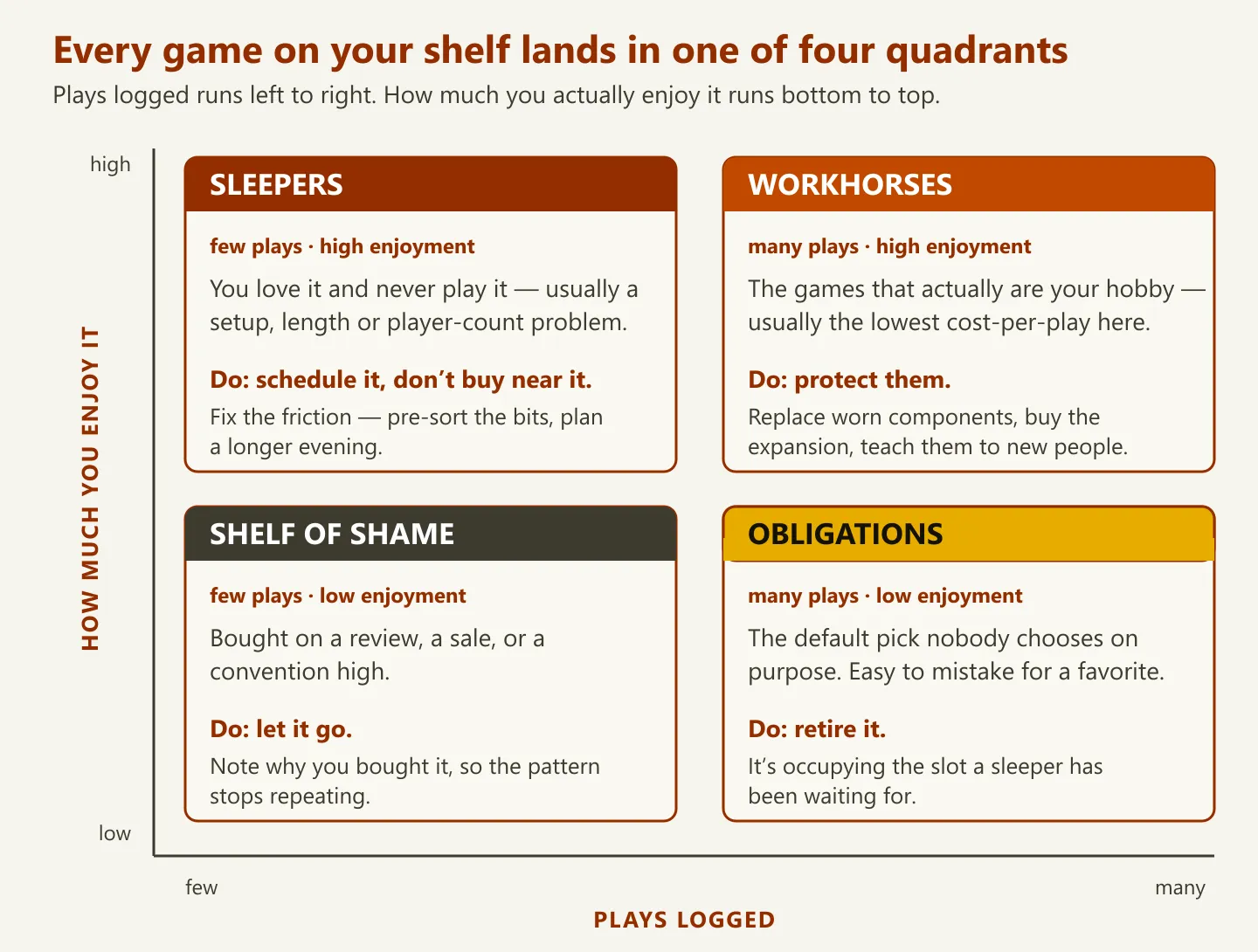
Once you have plays and ratings, every board game on your shelf lands in one of four boxes — plays logged running left to right, enjoyment running bottom to top. The game-level rating is what buys you that second axis: a game can be played constantly and still not be liked, and the plays count alone will never tell you which is which.
| Quadrant | Profile | What it means | What to do |
|---|---|---|---|
| Sleepers | Few plays · high enjoyment | You love it and never play it — usually a setup, length, or player-count problem | Schedule it, don’t buy near it. Fix the friction: pre-sort the bits, plan a longer evening |
| Workhorses | Many plays · high enjoyment | The games that actually are your hobby — usually the lowest cost-per-play on the shelf | Protect them. Replace worn components, buy the expansion, teach them to new people |
| Shelf of shame | Few plays · low enjoyment | Bought on a review, a sale, or a convention high | Let it go, and note why you bought it so the pattern stops |
| Obligations | Many plays · low enjoyment | The default pick nobody chooses on purpose | Retire it. It’s occupying the slot a sleeper should have |
Obligations are the easiest quadrant to overlook. A game with high plays looks like a success in any tracker that only counts plays — but paired with a mediocre rating, it’s just the thing you reach for when it’s late and nobody wants to explain rules. Retiring one obligation is often what frees up an evening a sleeper has been waiting for.
How to start a board game play log in ten minutes
- List what you own. One row per board game: title, player count, rough play time. Titles only — don’t stop to look up publishers or designers.
- Add price paid, the month you got it, and a 1–10 rating for the game itself. That game-level rating is a separate thing from the per-night one, and it is what gives you the enjoyment axis later. Estimate the price where you have to — an approximate figure is enough to make cost-per-play useful, and a game you were given costs nothing per play forever.
- Make a second tab called Play Log. Seven columns: date, game, who played, minutes, winner, a 1–10 rating, and a note. One row per session.
- Backfill your last three sessions. Your camera roll and your group chat will reconstruct them faster than your memory will. Three rows is enough to prove the thing works and to stop it looking accusingly empty.
- Log the next session before the box goes back on the shelf. Forty seconds, while everyone is still arguing about the last turn. Logging tomorrow takes ten minutes and never happens.
- After twenty sessions, sort by cost-per-play and act. The top of that list is either a game to schedule deliberately or a game to let go of.
Twenty sessions is four or five months of weekly play, or a year or two of monthly game nights. That’s when the log stops being a chore and starts telling you things.
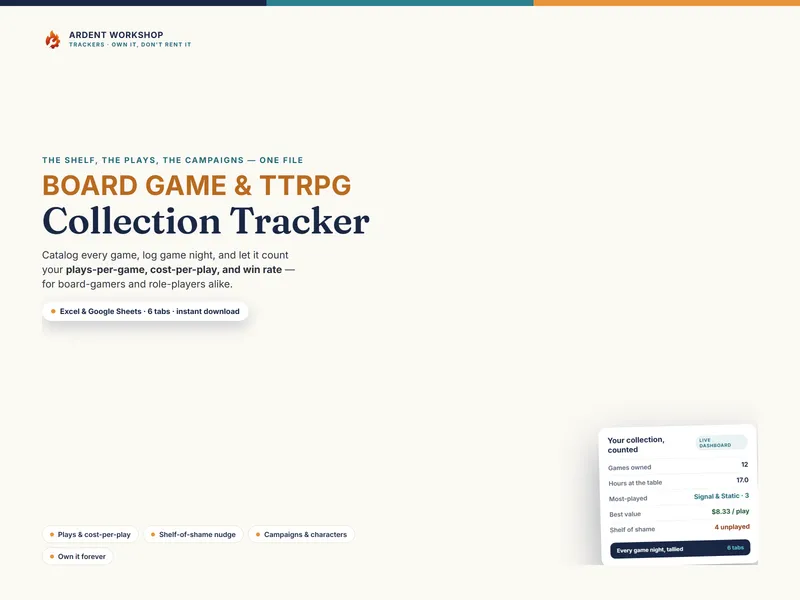
Or start from a file that already has both tabs, all seven fields, and the cost-per-play column wired in — that’s what the Board Game & TTRPG Collection Tracker is.
What not to track
A board game play log dies of ambition, not neglect. Leave all of this out:
- Final scores. You’ll swear you’ll analyze them. You won’t. Winner is enough. (Your tracker probably has a score column — leave it blank unless your group actually replays the numbers.)
- Setup time, separately. Fold it into the minutes column and move on.
- Half-point ratings. Whole numbers, one to ten. A 7.5 is an 8 in a good mood.
- Expansions as separate rows. Log the base game and put the expansion in the note, or your cost-per-play math splits in half.
- Solo sessions, if you’re only doing this for the group. Track them if you play solo often — but don’t let a rule you never use be the reason you stop logging.
What to do with your shelf of shame
Sort your board games by cost-per-play, descending — then ignore anything you rated 8 or above. Those are sleepers, and they need a calendar slot, not the door. What’s left is the shelf of shame, and its worst offenders often turn out to share a trait — the length, the player count, the teach. Look for what the top of that list has in common before you look at the individual games.
Games you have never played at all won’t show up in that sort — with no plays, they have no cost-per-play to rank. Pull those out separately. A game you have owned for a year and never once opened has already told you what it is.
A pair of rules worth borrowing:
- Twelve months with no plays and a rating below 5 — or no rating at all, which is its own answer — is a reasonable line to draw. Chances are it isn’t going to happen. Sell it, trade it, or give it to someone who’ll table it.
- One in, one out. Every new box on the shelf displaces one. This tends to work better than resolve does.
Working out which games survive that cut is its own exercise — we go through the sorting method in detail in how to downsize a collection.
Your minimum viable play log
That’s the ten-minute setup above, plus the two numbers that make it pay off. If you do nothing else this weekend, do these six things:
- One row per board game you own, with the price you paid and a 1–10 rating
- A second tab for sessions, with date, game, players, minutes, winner, rating, note
- Your last three game nights backfilled from photos
- A cost-per-play column that divides price by plays
- A break-even target written down somewhere you’ll see it before you buy
- The next game night logged before the box goes back on the shelf
Then, in about twenty sessions: sort by cost-per-play to find your shelf of shame, and sort by plays descending to find your obligation — the game you play most and rate lowest.
That’s it. Six lines and a season of Fridays, and you’ll know more about your own hobby than the sixty-one boxes ever told you.
Own the log, don’t rent it
Plenty of apps will do this, and some do it well. But when an app does hold your log, its terms, its pricing, and its continued existence are all decisions someone else gets to make — not you, and not fifteen years of your Friday nights.
A play log is precisely the sort of thing you should own outright. It’s a small amount of structure, it’s yours, and it still opens in ten years.
The Board Game & TTRPG Collection Tracker is built exactly around this: a Games tab for the shelf, a Play Log tab for the sessions, and a dashboard that computes plays-per-game, cost-per-play, win rate, hours at the table, and a shelf-of-shame tally of everything you own but have never once played, with the top few named — without you writing a formula. It’s one file for Excel and Google Sheets, with no account and no monthly rent.
Want to start smaller? The free game-shelf starter is one tab, one row per game — title, type, player count, a played flag and a 1–10 rating — with no signup. That gets you the catalog and the enjoyment axis; it is deliberately not a play log. The paid version is what adds the Play Log tab, the price column, and the cost-per-play math the rest of this post runs on.
Sixty-one games is a lovely shelf. Knowing which handful of them are your hobby is better.