What an executor actually does
California Courts' formal-probate overview illustrates appointment, inventory, creditor notice and distribution as one state's process. Other jurisdictions and simplified procedures differ.
- Preserve records and arrange immediate care, while checking authority and others' property or access rights.
- Determine whether court appointment, a simplified procedure or another role applies to each asset.
- Once authorized, maintain separate estate financial records and obtain the accounts and tax identification the estate needs.
- Track notice, tax and creditor requirements using their actual triggering events.
- Confirm payment priorities and necessary approvals before distribution.
- Complete the required accounting and closing process; ask which receipts or releases are appropriate.
The estate-records tutorial organizes these questions without setting a universal timetable.
Executor, administrator, personal representative
An executor is nominated under a will; an administrator generally serves through appointment when no executor can serve. Personal representative is a broader term used in many jurisdictions. Confirm the appointment and powers under the applicable procedure rather than inferring them from a title.
What an executor is not liable for — and what they are
The FTC explains that a deceased person's debts are generally paid from the estate, with exceptions for some other people's obligations. Personal responsibility for one's own administration of assets is a separate question.
Premature distributions and improper payments can create exposure. Seek advice about disputed claims and insufficient funds. Before hiring counsel, confirm who is the client, who initially pays, and whether reimbursement or court approval is required; estate payment of the fee is not guaranteed.
The will does not decide everything
Ownership, beneficiary designations, trusts and applicable law affect how assets transfer. A non-probate transfer does not automatically protect property from creditors. As a state-specific example, California Probate Code 19001 makes certain revocable-trust property available for debts and administration expenses when the probate estate is insufficient.
Record ownership and supporting documents, then flag uncertain classifications for review.
You are allowed to decline
If you cannot serve, ask the court or estate adviser about declining the nomination. If already appointed, follow the applicable resignation, accounting and replacement process rather than simply stopping work.
Where to start
If it has just happened, start with the free First Two Weeks After a Death checklist — an organizing starting point to check against the circumstances. When you are ready for the whole job, the Executor's Estate Settlement Records & Task Binder dates fifty-eight of its sixty tasks from the date of death — the other two recur — and routes every asset by how it is titled: probate, non-probate, or one to put to the attorney. Verify suggested routing and calculated reminders against the governing documents and applicable rules. See also what probate is, executor binder vs estate settlement app, and the caregiver and family templates hub for the rest. This is a record-organizing approach — not legal, tax or financial advice, and no substitute for a probate attorney.
Templates that implement this
Tools for the person doing the job
3 templates
Owned workbooks for settling an estate, and for getting one's own affairs in order before anyone has to.
- $24.95 Spreadsheet

Executor's Estate Settlement Records & Task Binder — 60 Dated Tasks, Probate vs Non-Probate Asset Inventory, Creditor Claims & Estate Accounting (Excel + Google Sheets)
An executor checklist spreadsheet for Excel & Sheets — 60 tasks dated from the date of death, assets sorted probate or not, the accounting kept as you go.
Life AdminView details - $29.95 Spreadsheet
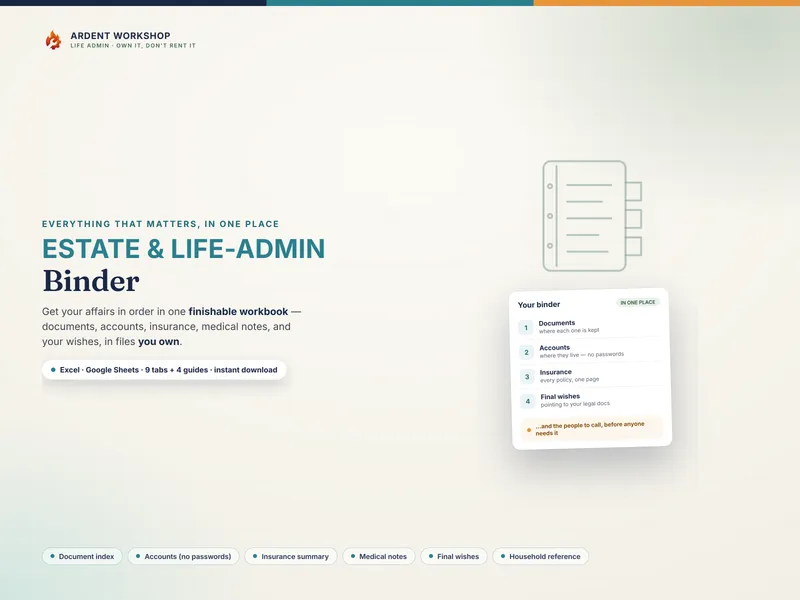
Estate & Life-Admin Binder — Important Documents, Accounts, Insurance & Final Wishes Organizer (Excel + Google Sheets)
An estate & life-admin binder for Excel & Google Sheets — organize important documents, accounts, insurance, and final wishes in one file you own.
Life AdminView details - $21.95 Spreadsheet

Funeral & Final-Arrangements Planning Binder — Final Wishes, Costs & Funding Planner (Excel + Google Sheets)
A funeral planning binder for Excel & Google Sheets — record your final wishes, price them, and see the funding gap and the cash reachable in days.
Life AdminView details