Everyone tells you to “get your affairs in order.” Nobody tells you what that costs.
Somebody will be asked, within about a day of your death, a run of questions they have never thought about. Burial or cremation. Embalming or not. Open casket or closed. Which cemetery. What should the obituary say. Who is paying, and how. They will be asked while they are the least equipped they have ever been to answer, and they will answer anyway, because the questions do not wait.
Free “final wishes” worksheets help with the first half of that — they give you somewhere to write down what you want. This binder does that too, in more detail than most. Then it does the half nobody else does: it prices those wishes, and works out whether the money is actually reachable when the bill lands.
The number families are caught by
Money set aside for a funeral is not all the same kind of money, because it does not all arrive at the same speed:
- A prepaid contract is already paid — its portion is available immediately.
- A payable-on-death account pays the named person within days of a certificate being produced.
- A life or final-expense insurance claim commonly takes weeks.
- The Social Security lump-sum death payment arrives only after somebody applies for it.
The funeral home usually expects to be paid before the service. So the Cost Estimate & Funding tab gives you two answers, not one: the gap overall, and the shortfall in the days when the money is actually needed.
In the worked example that ships inside the workbook, the plan is fully funded — and still $2,410 short in the first few days. That is not a mistake in the example. That is the situation this binder exists to find, while there is still time to fix it with something small and boring, like a payable-on-death designation at your own bank.
What’s in it
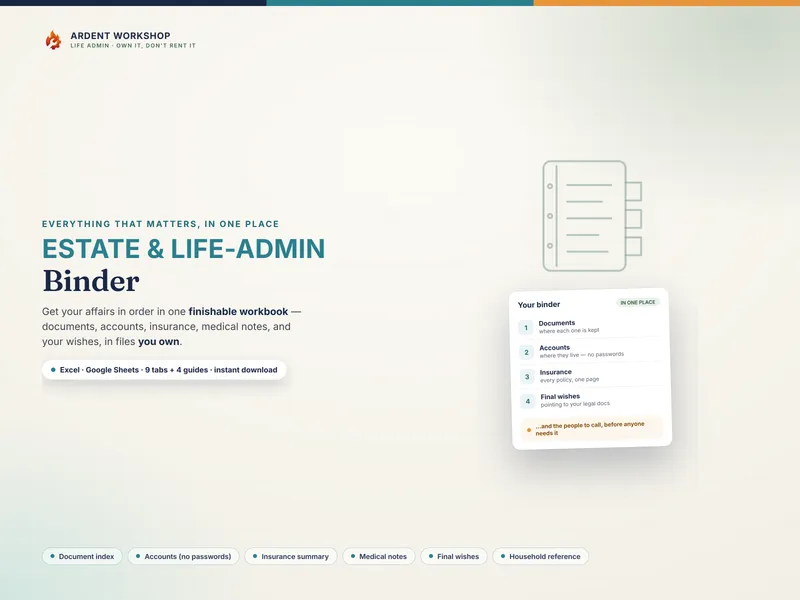
An 11-tab workbook that works natively in Excel and Google Sheets, plus four PDF guides:
- My Final Wishes — the one page that answers the first twenty-four hours: your legal name as it will appear on the certificate, what you want done with your body, the send-off you want, who is in charge, and where the paperwork lives.
- Arrangement Decisions — twenty-six choices someone will otherwise make blind, each with a plain note on what happens when nobody knows the answer. Casket, viewing, ashes, headstone wording, pallbearers, military honors, the photograph, what to do with the pets. “No preference — do whatever is simplest” counts as a settled decision, because it is one.
- Cost Estimate & Funding — thirty itemized line items drawn from the categories a provider’s own price list uses, plus the cemetery, the notice, and the reception. Mark each Yes or No and the estimate totals only what you chose. Then list every funding source, flag which ones pay quickly, and read off the two numbers.
- Plans, Policies & Documents — where the prepaid contract, the policy, the cemetery deed, the will, and the discharge papers physically are.
- Obituary & Vital Facts — the questions only you can reliably answer. Your mother’s full maiden name. Your father’s name. The county you were born in. Your usual occupation. A funeral director needs these before a permit, an obituary, or a single claim can move, and they are the ones families most often wish had been written down.
- People to Notify, Accounts to Close (with a running total of what is still being charged each month), Key Contacts, a Start Here Checklist, and a Readiness Dashboard that reads every other tab and shows how far along you are without you typing a thing.
The guides cover the thinking: what the options actually mean, what you are entitled to ask any funeral provider for (an itemized price list is a right under the FTC’s Funeral Rule, not a favor), the five decisions that drive the cost, the benefits worth checking, and where to keep the binder so your family can actually reach it.
One rule, and it’s the reason this binder is useful
It records where things are and who to call — never account numbers, Social Security numbers, PINs, or passwords.
That is not squeamishness. A binder with no identifying numbers in it is a document your family can simply use — you can hand a copy to the person who will need it. A binder with numbers in it is one they have to guard, which is how binders end up somewhere so safe that nobody can reach them on the day. Keeping the numbers out is what makes the rest of it shareable.
Honest about what this is
This is a record of your wishes and of where things are kept. It is not a will, a trust, or an advance directive, it does not appoint anyone or transfer anything, and it is not legal, financial, or tax advice. In most places the legal right to direct a funeral is set by law or by a signed authorization form, not by a wish list — so make your wishes findable here, and talk to an attorney about the documents that carry legal weight. No figure in it is a price quote; the example (Ruth Hollis) is clearly fictional and you overwrite it.
Already have the Estate / Life-Admin Binder? Its Final Wishes tab is a summary. This is that summary done properly — with the decisions, the real prices, and the funding math behind it.
Own it, don’t rent it
This document may not be opened for twenty years. In that time a subscription end-of-life planning app can raise its price, change its terms, be acquired, or shut down — and the one moment your family needs it is the one moment nobody can ask you for the password. A file you own will still be there.
Not ready for the full binder? Start with the free Final Wishes One-Pager — one printable page, no email required.