This overview concerns U.S. probate. For an official state example, see California Courts' overview of formal probate; use the court guidance for the state handling your estate for actual procedures and deadlines.
What the court is actually doing
Probate exists to answer a short list of questions in public, with a record:
- Is this the valid will? The original is filed with the court, which admits it (or finds there is none, and applies the state's intestacy rules instead).
- Who has authority? The court appoints an executor or administrator and issues letters testamentary or letters of administration — the document every bank and registry will ask to see.
- Who is owed money? Creditors are given notice and a set window to bring claims. Deadlines, notice duties and exceptions depend on the type of claim and state law.
- What was there, and where did it go? An inventory of the estate, and eventually an accounting of what came in, what went out, and what is left.
- Can it be distributed? In a supervised administration the court approves the accounting before anything reaches the beneficiaries. Many states also allow an independent or unsupervised administration, where the executor distributes without going back for approval each time — ask your court which one your estate is in.
Only the probate estate goes through probate
This is the distinction that decides how much probate an estate actually needs. The probate estate is what the deceased owned in their sole name with nobody named to receive it, plus their share of anything held as tenants in common. Everything else — a jointly-held home with right of survivorship, a payable-on-death bank account, a transfer-on-death brokerage registration, a life policy or retirement account naming a living person, anything already in a living trust — passes directly and generally does not go through probate at all.
Beneficiary designations generally control the assets they cover rather than the will, subject to applicable law. Passing outside probate does not by itself establish that an asset is protected from creditors. Liability depends on the asset, transfer and jurisdiction; have the estate attorney determine what is available before making distributions. See what an estate binder records for the other side of the same problem — making all of it findable in the first place.
How long it takes, and why
There is no single national timetable. Required notices, creditor claims, asset sales, tax matters and disputes can affect the schedule. Ask the court or estate attorney which deadlines apply and what must be completed before distribution.
The parts that vary by state — which is most of them
Probate is state law, and the differences are not cosmetic. The length of the creditor claim period and the event that starts it, the deadline for filing an inventory, whether and when an accounting is required, the executor's commission, the availability of a simplified small-estate procedure and the threshold for it, and whether transfer-on-death deeds work on real estate at all — every one of those differs by state, and some differ by county. Anything you read online that quotes a specific number of days is quoting somewhere, and possibly not where the person lived. The reliable sources are your probate court's clerk and a probate attorney in that state.
Ways an estate avoids or shortens probate
Some transfers depend on planning before death; a qualifying small-estate procedure may instead be available to the person administering the estate afterward:
- A living trust holds assets outside the probate estate, administered by a trustee under the trust rather than by the court.
- Beneficiary designations on retirement accounts, life insurance and annuities pass directly to the person named.
- Survivorship titling — joint tenancy, and, where the state offers them, tenancy by the entirety (spouses only) or community property with right of survivorship — passes to the surviving owner by operation of law. Which forms are available depends on the state.
- Payable-on-death and transfer-on-death registrations do the same for bank and brokerage accounts, and in some states for vehicles and real estate.
- Small-estate procedures — an affidavit or summary administration — can skip most of full probate when an estate falls under a state threshold.
Four things people believe that are not true
- "Probate always takes years." Some do; the timetable depends on the estate and local procedure.
- "The executor pays the debts." Debts are generally paid from the estate, but separate personal liability can exist, for example for a cosigner. The FTC explains debts after a death. An executor must also follow their own duties when handling estate assets.
- "Having a will avoids probate." A will directs probate; it does not avoid it. What avoids probate is how assets are titled.
- "You can start distributing right away." Beneficiaries come last, after the debts, taxes and expenses — and in a supervised administration, after the court says so. Whether your state requires that approval, or lets you administer independently, is one of the first questions to ask.
Where to start
If a death has just happened, the free First Two Weeks After a Death checklist covers what needs doing before probate starts at all. For the whole administration, the Executor's Estate Settlement Records & Task Binder dates fifty-eight of its sixty tasks from the date of death — the other two recur — and routes every asset by how it is titled: probate, non-probate, or one to put to the attorney. It prints no state deadline as fact, asking you to enter your own court's periods instead. See also what an executor is, the step-by-step walkthrough of settling an estate, executor binder vs estate settlement app, and the caregiver and family templates hub. This is a record-organizing approach — not legal, tax or financial advice.
Templates that implement this
Tools for the estate side of it
3 templates
Owned workbooks for administering an estate, and for organizing records before anyone has to.
- $24.95 Spreadsheet

Executor's Estate Settlement Records & Task Binder — 60 Dated Tasks, Probate vs Non-Probate Asset Inventory, Creditor Claims & Estate Accounting (Excel + Google Sheets)
An executor checklist spreadsheet for Excel & Sheets — 60 tasks dated from the date of death, assets sorted probate or not, the accounting kept as you go.
Life AdminView details - $29.95 Spreadsheet
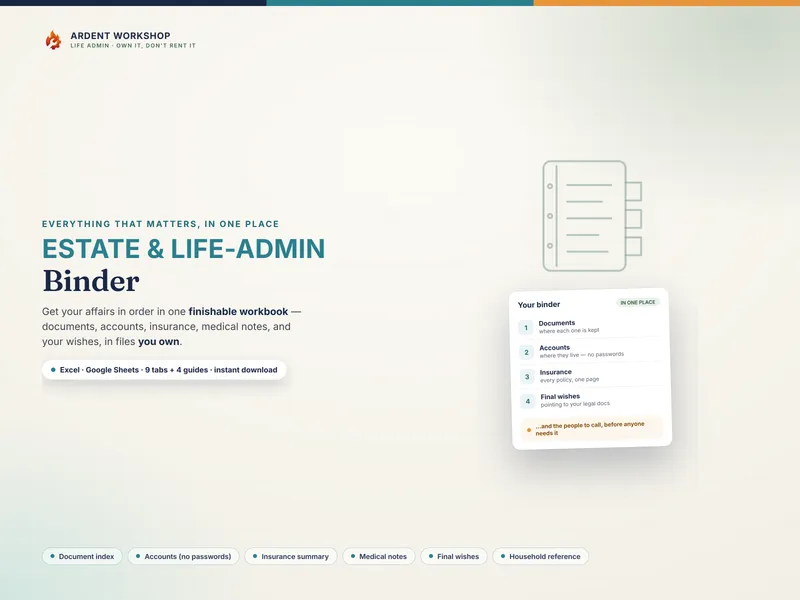
Estate & Life-Admin Binder — Important Documents, Accounts, Insurance & Final Wishes Organizer (Excel + Google Sheets)
An estate & life-admin binder for Excel & Google Sheets — organize important documents, accounts, insurance, and final wishes in one file you own.
Life AdminView details - $24.95 Spreadsheet
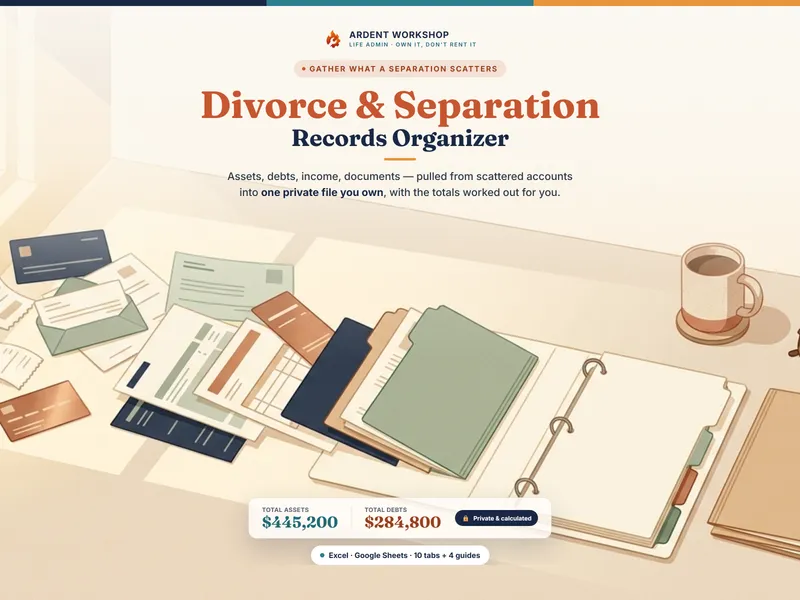
Divorce & Separation Records Organizer — Assets, Debts, Income & Documents in One File (Excel + Google Sheets)
A divorce & separation records organizer for Excel & Google Sheets — your assets, debts, income & documents in one private file, totals done for you.
Life AdminView details