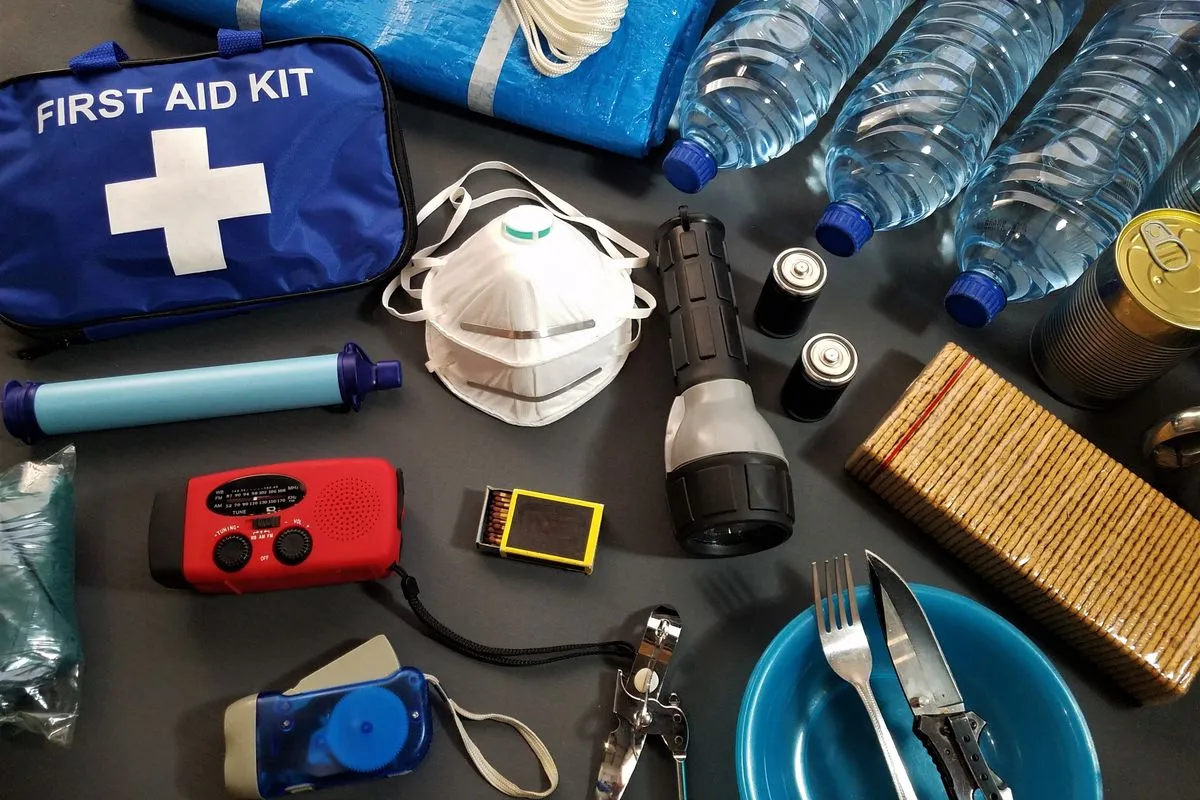
The shutoffs most homes have
"The shutoff" is usually several shutoffs. A typical single-family home has all or most of these, and they are worth finding in this order:
- The main water shutoff — on the incoming water line, normally where the pipe enters the house: the front basement wall, a utility closet, the garage, or near the water heater. It is either a lever (a ball valve, a quarter turn — open runs along the pipe, closed sits across it) or a round wheel (a gate valve, turned clockwise through many full turns).
- The curb stop — a small lid set into the sidewalk, the grass strip, or the end of the driveway, with the valve down a narrow shaft. It needs a long T-handled curb key. In many places it belongs to the water utility rather than to you, so the useful thing is knowing where it is so you can point at it.
- The gas meter valve — a flat rectangular tab on the pipe before the meter, turned a quarter turn with an adjustable wrench so the tab sits across the pipe.
- The main breaker — the largest breaker in the electrical panel, usually alone at the top and twice the width of the others, marked with the service size (100, 150, or 200 amps).
- Fixture and appliance stops — the small oval handles or quarter-turn levers under every sink, behind each toilet, and on the lines to the washing machine, dishwasher, and icemaker. These are the ones that actually matter day to day: a burst supply hose is stopped here in five seconds without shutting the whole house off.
- Equipment shutoffs — the cold inlet valve and gas dial on the water heater, the service switch on the furnace (which looks exactly like an unlabeled light switch), and the outlet the sump pump is plugged into.
The gas rule everybody gets wrong
If you shut the gas off at the meter, do not turn it back on yourself. Restoring gas service means purging the lines and relighting and checking every pilot, and that is work for the gas utility or a licensed technician. And if you ever smell gas, hear hissing, or feel unwell near an appliance: get everyone outside first, then call from outside. Don't switch anything on or off on your way out — including a light.
Why a location alone isn't enough
"Basement" is not where your water shutoff is. A shutoff you can find in daylight, with time, is not the same as one a house-sitter can find at eleven at night. A record worth keeping answers four things for each one:
- Where it is — specifically enough that a stranger could walk to it. "Basement, front wall under the porch, behind the metal shelving."
- How it operates — quarter turn or many turns, and which way. In an emergency people turn things the wrong way, then keep turning.
- What tool it needs — and where that tool lives. A shutoff you can't operate isn't really a shutoff, which is why the wrench belongs zip-tied to the gas meter.
- Any caution — the gas rule, a seized gate valve, a cleanout that shouldn't be opened while the line is backing up.
Find them before you need them
The job is one calm walk around the house with a pen. Start where the water line enters, then the curb, then the gas meter, then the panel, then the water heater and furnace. Number each one on a rough sketch of the floor plan, tag the valve itself with a weatherproof label, and photograph each tag from far enough back that the photo shows the surrounding wall — a close-up of a valve is useless for finding it again.
Then walk one other person in the household to each one, in person. The written record is the backup; the walk is the part that sticks.
Get the map free
Ardent Workshop publishes a free printable Home Shutoff & Breaker Location Map — one page to sketch the plan, number each valve, and record which way it turns and what tool it takes. It comes shown filled in for a worked example, and there's no signup. It's one page of the Home Emergency & "If I'm Away" Printables Pack, which adds the full 14-system guide, a walking order for the whole house, and seven more print-and-fill pages.
This is general orientation for finding and labeling the shutoffs in your own home — not plumbing, gas, or electrical advice, and no substitute for your utility company or a licensed trade. If a valve is seized, corroded, or unfamiliar, leave it alone and ask someone qualified.
Templates that implement this
Write your shutoffs down once
4 templates
A print-and-fill map for where every shutoff is, which way it turns, and the tool it needs — plus a 14-system guide to finding them.
- $10.95 PDF
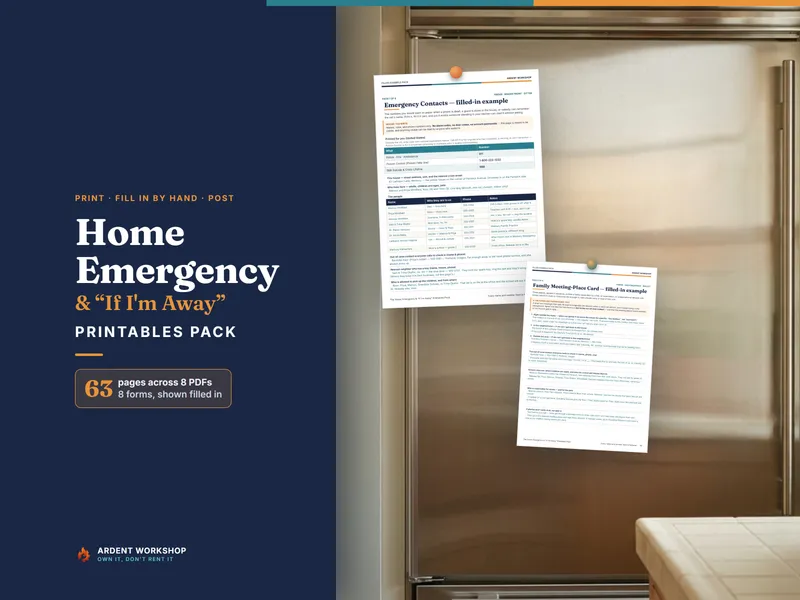
Home Emergency & “If I'm Away” Printables Pack — 63-Page Printable Set: Emergency Contacts, Utility Shutoff Map, House-Sitter Sheet, Pet & Medical Cards
63 pages across 8 PDFs — eight print-and-fill forms, 12 cut-out cards and two guides, with every form shown already filled in. US Letter and A4.
Life AdminView details - $12.95 PDF

The First-Year Homeowner's Playbook — 119-Page Guide: What a House Costs to Own Per Month, the Month-by-Month First Year, and How to Read a Contractor's Quote
119 pages across 4 PDFs — a month-by-month first year, 32 systems with the annual reserve each implies, and a contractor's quote read line by line.
Life AdminView details - $24.95 Spreadsheet
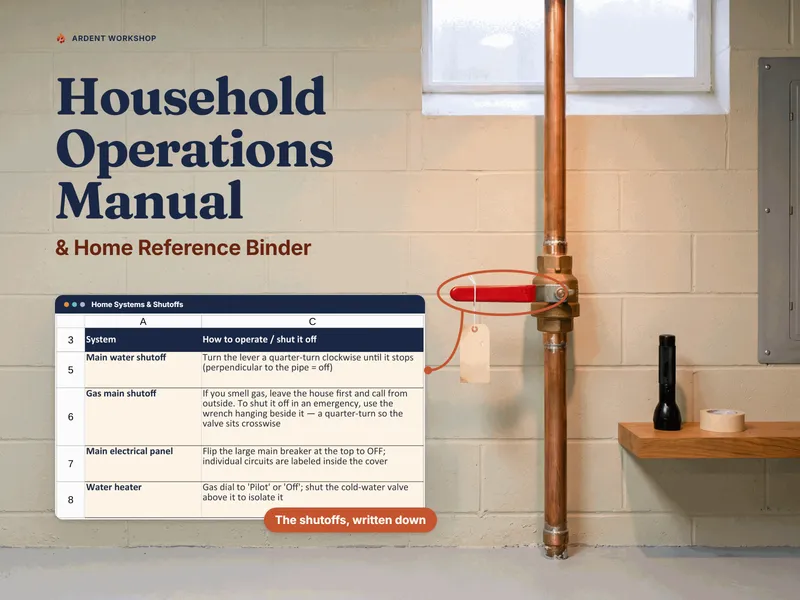
Household Operations Manual & Home Reference Binder — Utilities, Shutoffs, Maintenance, Emergency Contacts & House-Sitter Info (Excel, Google Sheets & Word)
Household operations manual for Excel, Google Sheets & Word: shutoffs, a maintenance schedule that computes what's due, and a house-sitter packet.
Life AdminView details - $21.95 Spreadsheet

Emergency & Evacuation Readiness Binder — Family Plan, Document Grab-List, Home Inventory & Go-Bag (Excel + Google Sheets)
An emergency & evacuation readiness binder for Excel & Google Sheets — your plan, documents to grab, home inventory & go-bag in one file you own.
Life AdminView details