Nobody hands you a manual for a house. You get a folder of documents about the transaction — the loan, the title, the disclosures — and then the door closes behind you and you own a building whose systems, ages, quirks and deadlines are, as of that afternoon, entirely your problem. Most people spend their first year finding out what they didn’t know by being surprised by it.
This is the other way round: a year’s worth of the knowledge a first-year owner usually assembles by accident, in the order the work actually wants doing, with the reasoning attached. It is a guide you read, not a form you fill in — 119 pages across four PDFs, and the two reference files are built to still be useful in year six.
The one idea it is all built on
A house is not one asset. It is a portfolio of dated parts, each with its own clock. The roof, the water heater, the furnace, the deck, the alarms on your ceiling — every one has a service life, an age, and therefore a date. Almost everything that feels like bad luck in home ownership is one of those dates arriving unannounced.
Once you can see the clocks, three things follow. You know what to do first. You know what it costs to own this house, in dollars per month, rather than guessing with a rule of thumb. And you stop being surprised, which is the expensive part.
Putting a number on it
Search for how much to set aside for maintenance and you will land on the one percent rule: one percent of the purchase price a year. It is genuinely useful, and it is indifferent to your house — the same answer for a five-year-old home and a thirty-year-old one, for a slate roof and an asphalt one, for a house on a well and one on city water. It is anchored to what you paid, which is a fact about a market rather than about a building.
The alternative is old and it is not ours: a sinking fund. If a thing costs a known amount and lasts a known number of years, then owning it costs the first divided by the second, every year. The Home Systems Reference does that for 32 systems, so you can cross out the rows you don’t have and total what remains.
On the worked example — an ordinary 1,920 sq ft two-story, eighteen years old, clean inspection, nothing obviously wrong — the arithmetic returns $502 a month. One percent of what it cost says $332. That gap is not a rounding error, and the book shows exactly where it is.
Then it splits the number in two, by a test that has nothing to do with cost. Must-fund is the envelope, the mechanical systems, water management and life safety — the things whose failure causes further damage or hurts somebody, and which arrive on their own schedule. Plan-for is appliances and finishes: they announce themselves, they degrade rather than rupture, and they can wait for a good weekend to shop. The first figure is the transfer you automate this week. The second is a target to grow into. A single undifferentiated maintenance number is exactly why people raid the roof money for a dishwasher.
How to read a contractor’s quote
A quote is the only document in home ownership where the price is the least informative thing on the page. The companion reference takes one roofing quote apart line by line — what each of its ten lines is for and, more usefully, what its absence from a cheaper quote would have cost you. Named underlayment rather than felt. Ice-and-water membrane at the valleys, not just the code minimum at the eave. New flashing rather than eighteen-year-old flashing reused. An allowance with a unit price attached, which is the difference between an estimate and a blank check.
Then it does the arithmetic on three bids for the same roof. Read as headlines they were $5,500 apart and the choice looked obvious. Priced for the same scope, the cheapest becomes the most expensive, the ranking inverts, and the three sit within about fifteen hundred dollars of each other. Nothing was hidden by anybody — the difference was entirely in what each company had written down. Which is why the useful question is never “can you do better on the price?” but “can you tell me what is not in this?”
DIY or call a pro — screening the job, not yourself
Most advice about what a homeowner should tackle is really an opinion about the person. This screens the job instead: does it need a permit; does it involve gas, the inside of a breaker panel, or refrigerant; is there stored energy, height or a confined space; if it fails while you are asleep does it flood, burn or fall; and — the most underrated one — would the failure be silent?
Forty common first-year jobs come pre-sorted, and seven are hard stops that are not confidence questions at all. Garage-door torsion springs are stored energy that has put people in hospital. The area behind a panel’s dead front is live with the main breaker off. Refrigerant needs federal certification, and a second top-up in two seasons means a leak you have paid to lose again.
What’s in the four files
| File | Pages | What it is for |
|---|---|---|
| 00 — Start Here | 7 | Which file is which, five reading paths, the thirty-minute first pass |
| 01 — The Playbook | 76 | Ten chapters, contents, 62-term glossary, one-page annual calendar |
| 02 — Home Systems Reference | 22 | 32 systems: life, cost band, annual reserve, warning signs, yours or theirs |
| 03 — Hiring and Quotes Reference | 14 | The annotated quote, eleven red flags, nine questions, three-bid arithmetic |
Honest about its own limits
Every service life and cost range in it is a typical band offered for orientation and arithmetic — not a quote, not a promise. They move a long way with climate, water chemistry, install quality, usage and local labor rates, and the book says so, states where the figures come from, and tells you to overwrite each one the first time you get a real price for your own market. Where a job is genuinely dangerous it says so plainly and tells you not to do it.
It is American in its assumptions — dollars, US Letter, US insurance and utility conventions. The physics of water and the logic of the reserve arithmetic travel anywhere; the paperwork chapter does not. The example house and all three example contractors are invented; the arithmetic is real.
General guidance for homeowners — not professional, legal, insurance, tax, or contracting advice. It does not replace your own manuals, your declarations page, your local building department, your servicer, your county assessor, or a licensed trade looking at the actual thing.
Where it sits next to the other home tools
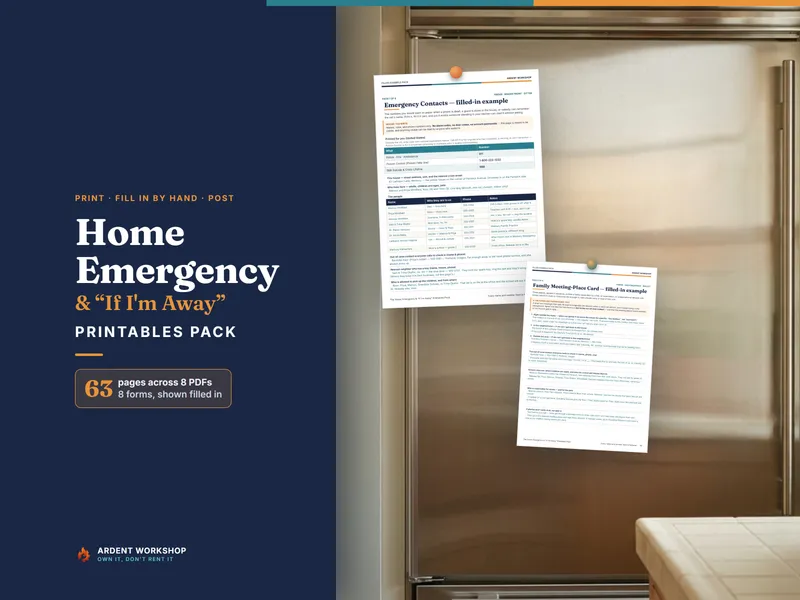
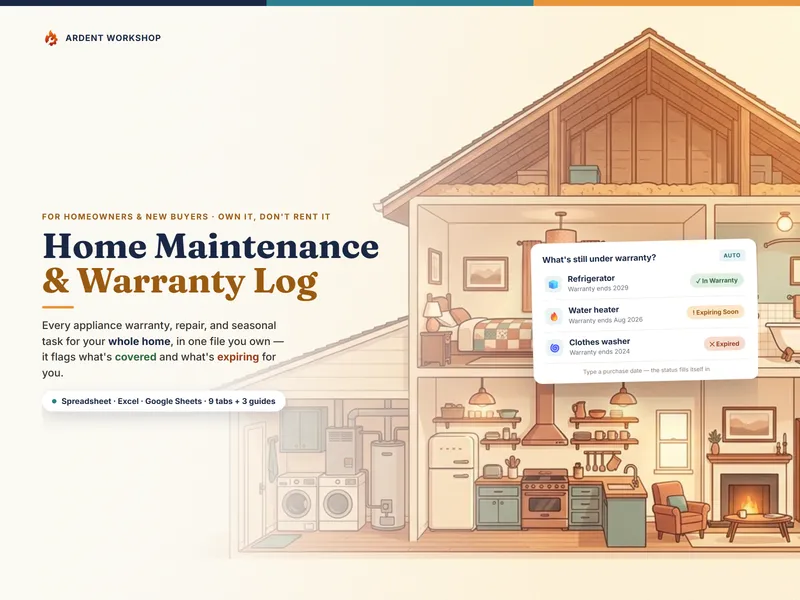
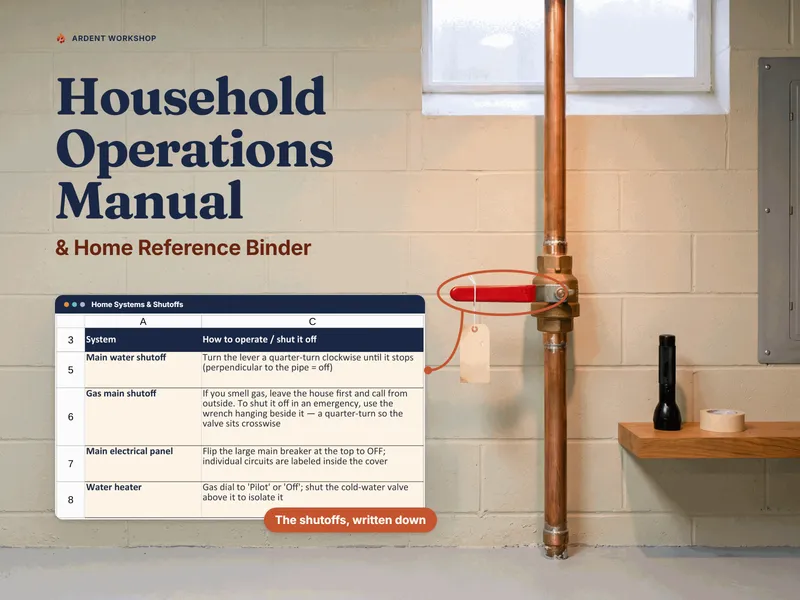
This one is the read-it half of the shelf. If you would rather type your own numbers into a live spreadsheet than work through a reference with a pen, the True Cost of Homeownership Calculator automates the reserve arithmetic — and this book is what tells you which rows matter and why. The Home Maintenance & Warranty Log is where the schedule and the ages you collect actually live. The Household Operations Manual holds every utility, account and system detail. And the Home Emergency & “If I’m Away” Printables Pack carries the per-system shutoff-location guide this book deliberately doesn’t reproduce — where each valve hides, which way it turns, and the tool it needs.
None of them contains this book, and this book doesn’t replace any of them.
Try it free first
The First 30 Days in a New Home mini-guide is free and ungated — no email, no signup. It is the first-month slice of this book: the week-one safety pass and the transfers and registrations that have a clock on them.
Own it, don’t rent it
Four PDFs you keep. No login, no signal, no subscription, nothing to be discontinued when a company changes direction — and it will still open in ten years, when the water heater you wrote a date on in month one is finally due. Print the parts you use, write in the margins, and hand the marked-up copy to whoever owns the house after you. That hand-off is genuinely the kindest thing one owner can do for the next.