What a final-arrangements plan covers
A funeral director, a cemetery, and a newspaper each ask a different set of questions, and they ask them fast. A complete plan answers all three:
- Disposition — burial, cremation, green burial, or whole-body donation, and what should happen to the remains afterward.
- The service — a funeral with the body present, a memorial weeks later, a graveside gathering, or nothing at all; where it is held and who leads it.
- The details people agonize over — viewing or no viewing, open or closed casket, music and readings, pallbearers, flowers or donations, military honors, what to be dressed in.
- Who decides — the person you would like to make the arrangements, and a second in case the first cannot be reached.
- What it costs, and what pays for it — an itemized estimate set against any prepaid contract, policy, or account earmarked for it.
- Where everything is — the prepaid contract, the policy, the cemetery deed, the discharge papers, and the will.
- The facts only you know — your mother's full maiden name, your birth county, your usual occupation: the details a death certificate asks for before anything else can happen. Some of these double as bank security answers, so keep the page with your household records rather than emailing or photographing it.
What it is not
A final-arrangements plan is not a will, not a trust, and not an advance directive. It does not appoint anyone, transfer anything, or override a document that does — and it is not a life-admin binder, which records what a household has rather than what you want. In most places the legal right to direct a funeral is set by statute or by a signed authorization form — not by a wish list — so if it matters to you who decides, ask an attorney what form your state uses and sign it. The plan makes your wishes findable; the legal documents make them binding.
It is also not the place for account numbers, Social Security numbers, or passwords. A plan without those is a document your family can simply use, and one you can safely hand to the person who will need it. A plan with them has to be guarded, which is how these documents end up somewhere nobody can reach on the day.
The part most plans skip: the money
Recording preferences is the easy half. The half that catches families is money — and specifically how fast the money moves. Funds set aside for a funeral do not all arrive at the same speed:
- A prepaid funeral contract is already paid, so its portion is available immediately.
- A payable-on-death account pays the named person on production of a death certificate, usually within days, and does not wait for probate.
- A life or final-expense insurance claim is slower — someone has to obtain a certified certificate, file the claim, and wait, commonly for weeks.
- The Social Security lump-sum death payment is a one-time $255 payment to an eligible surviving spouse or, in some cases, a child. Somebody has to apply — generally within two years of the death — and it arrives well after the funeral. Check ssa.gov for the current rules.
The provider usually expects to be paid before the service. So a plan that only tots up the total can be fully funded on paper and still leave nobody able to pay in the week it is needed. A plan worth having answers two questions rather than one: the shortfall overall, and the shortfall in the first few days.
What you are entitled to ask for
Pricing the plan is easier than people expect, because the Federal Trade Commission's Funeral Rule puts specific rights on your side. A funeral provider must give you a written, itemized General Price List to keep at the start of any in-person discussion of arrangements, and must give you price information over the telephone if you ask. You may buy only the goods and services you want rather than a package — the one exception is the provider's basic services fee, covering planning, permits and filings, which the Rule lets them make non-declinable (it must still be itemized). A provider may not refuse a casket or urn you bought elsewhere, and may not charge a handling fee for it. And embalming is rarely required by law: a provider may not tell you it is required when it isn't, though one may be needed for a public viewing or certain transport. Two or three price lists from providers in your area is an afternoon's work that can move the total substantially — prices for the same line item vary widely between providers in the same town.
How to write one without dreading it
- Start with one page — your legal name as it will appear on the certificate, burial or cremation, the service you want, and who is in charge. That alone gets your family through the first day.
- Work through the smaller decisions a few at a time. "No preference — do whatever is simplest" is a real, kind answer, and worth writing down explicitly.
- Get itemized price lists from two or three providers and put their actual numbers in, rather than a national average.
- List what is set aside, and be honest about which sources pay quickly.
- Tell two people where the plan is. Two, because the first may be traveling or too close to it to function. A plan nobody can find is a blank page.
- Look at it once a year, and sooner if you move, change providers, or change your mind.
Not sure where to begin? The free Final Wishes One-Pager is eleven lines and no signup — it opens on a completed example so you are never staring at a blank form.
Final-arrangements plan vs estate binder
They sit next to each other and answer different questions. An estate binder — or the broader life-admin binder — records what a household has: the documents, accounts, insurance, and key contacts someone would need to step in. A final-arrangements plan records what you want, and what it would cost. Most estate binders carry a short "final wishes" section; a dedicated plan is that section done properly, with the decisions, the prices, and the funding worked out.
Related templates and guides
A final-arrangements plan pairs naturally with an estate binder and the rest of the caregiver templates hub. See also final-wishes binder vs a funeral-planning app and the step-by-step guide to recording your final wishes. This is a record-organizing approach — not legal, financial, or tax advice, and not a substitute for a will or a professional.
Templates that implement this
Write your final-arrangements plan
3 templates
A workbook that records the wishes, prices them against the money actually set aside, and keeps the whole thing in a file you own.
- $21.95 Spreadsheet

Funeral & Final-Arrangements Planning Binder — Final Wishes, Costs & Funding Planner (Excel + Google Sheets)
A funeral planning binder for Excel & Google Sheets — record your final wishes, price them, and see the funding gap and the cash reachable in days.
Life AdminView details - $29.95 Spreadsheet
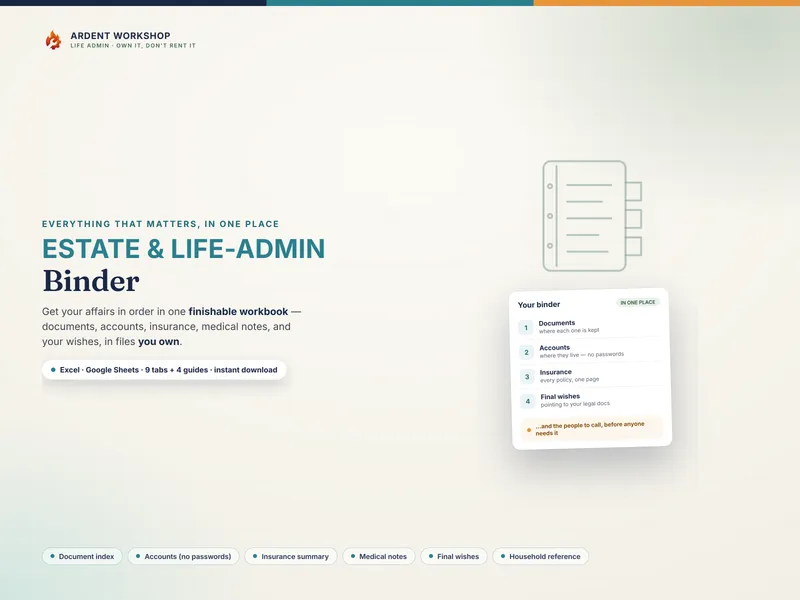
Estate & Life-Admin Binder — Important Documents, Accounts, Insurance & Final Wishes Organizer (Excel + Google Sheets)
An estate & life-admin binder for Excel & Google Sheets — organize important documents, accounts, insurance, and final wishes in one file you own.
Life AdminView details - $24.95 Spreadsheet

Caregiver / Aging-Parent Care Binder — Medications, Refill Alerts, Appointments & an Emergency Handoff Sheet That Writes Itself (Excel + Google Sheets)
Caregiver binder for an aging parent: medications with refill alerts, appointments, care team and documents — plus a self-writing emergency handoff sheet.
Life AdminView details