The confusion is understandable. Both hold names, places, factions and notes, and both promise to make you a more organized game master. But one of them is used at nine o'clock on a Wednesday with forty-five minutes and a pen, and the other is used at eleven o'clock on a Sunday with a keyboard and an hour to reorganize. They fail in different places, too.
| Consideration | Printable kit (owned) | Campaign management app (hosted) |
|---|---|---|
| Full-text search across years of notes | No — you flip, or you tab the page | Yes — this is what the app is for |
| Linked entities (a person lists their scenes) | No | Yes — a real advantage at scale |
| Sharing a live view with players | No — you photograph it or read it out | Yes |
| Backup if the laptop dies | No — it is a piece of paper | Yes — hosted, and often versioned |
| Speed of a weekly prep pass | Faster — fixed boxes, and it finishes when the page is full | Usually slower — a text field has no edge |
| Usable at the table without a screen between you | Yes — and it never shows a notification mid-scene | Partly — a laptop is a wall, a tablet is a distraction |
| Works in a basement with no signal | Yes | Depends on the app's offline mode |
| Roll-when-stuck tables at hand | Yes — a page you flip to, open beside you | Sometimes — usually a generator, not a table |
| Session-zero and safety-tool sheets | Yes — filled in alone, collected face down | Uncommon — and a shared doc is the wrong medium for it |
| Effort to keep current | Ten seconds in pencil, mid-session | Lower per entry, but it invites more entries |
| Where your campaign sits | In your folder | The company's servers, under their policy |
| Cost model | One-time purchase, print it forever | Free tier, or a monthly or annual subscription |
What a campaign management app is genuinely good at
The first four rows of that table belong to the app outright, and the search one is the advantage paper will never take back. If you are running a shared world across three campaigns, with two hundred named people and four years of history, search and linking are not conveniences — they are the only way the material stays usable. A folder cannot tell you every session a particular baron appeared in.
Sharing is real too. A player who wants to re-read what happened in session eleven can do that from an app and cannot do it from your folder. So is backup: a printed page is one spilled drink from gone, and no version of this comparison should pretend otherwise.
Where paper wins, and why it is not nostalgia
Prep on paper finishes. That is the whole argument, and it is a constraint rather than a feature of the medium: a page has an edge, and a box that is full is done. A text field does not have an edge, so a prep session in an app tends to expand until the evening is gone — usually into detail the party will never ask about, because the detail that survives contact is the one attached to a person who wants something, not the one attached to a place.
At the table, a screen sits between you and four people. It sleeps, it notifies, it needs a hand to scroll and a login the venue's Wi-Fi wants first. A sheet under the screen needs none of that, and a table of things to say when the plan evaporates needs to be a page you flip to in two seconds, not a menu you navigate while everyone watches.
The thing neither one does on its own
Both media will store a faction. Neither will make you move it — and that habit, not the storage, is what makes a campaign feel alive. The same is true of the two disciplines that actually save a long campaign: writing down what you improvised the moment you improvise it, and writing a recap the same night in the words you will say out loud next week. Those are routines. A tool can prompt them or ignore them; most apps ignore them, because a blank page is not a workflow.
That is what a kit adds over both a blank notebook and an empty app: an opinionated set of boxes in a fixed order, with the reason each one is there, and a between-sessions checklist that says what to do first when the week got away from you.
The honest split
- One campaign, weekly, a page of prep. Paper. You are paying a subscription for search over material that fits on a table.
- A shared world, several campaigns, years of history. An app, for the archive — and print the weekly prep sheet anyway.
- A group that reads between sessions. An app or a shared doc for the player-facing recap; the prep and the safety sheets stay yours.
- You already have an app and still prep badly. That is not a tooling problem. It is that nothing told you which five things to decide, in which order.
Where to start
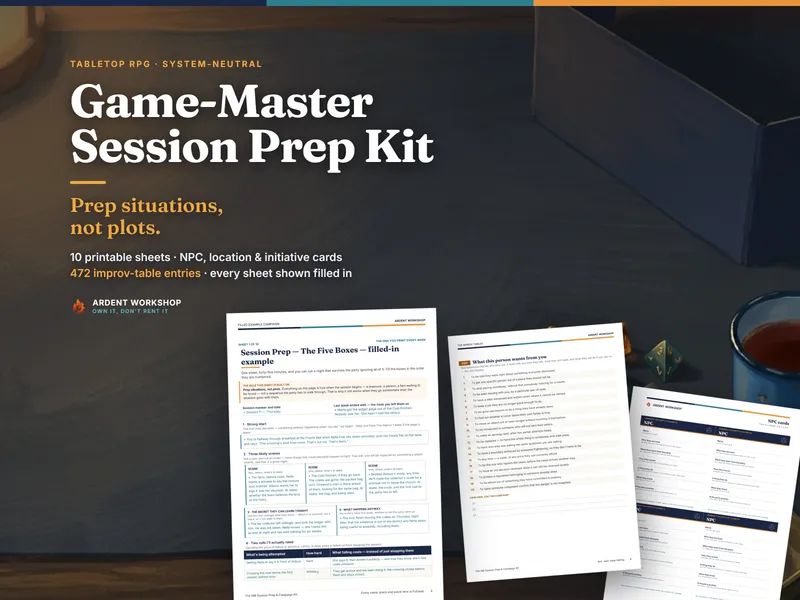
The free one-page session prep sheet is the weekly half on its own — five boxes, the dangling-threads page on the back, one improv table, and a worked example so the method is legible before you write anything. It asks for no email.
The Game-Master Session Prep & Campaign Kit adds the other nine sheets — the party reference, the session-zero questionnaire, the lines-and-veils sheet, the campaign arc and its clock, the faction board, the loot and downtime log, the read-aloud recap page and the between-sessions checklist — plus twenty improv tables with 472 entries, NPC, location and initiative cards imposed with cut marks, and every sheet shown filled in for an invented campaign. It is system-neutral: no rules, no statistics, nothing drawn from any published game.
For the method itself, step by step, read how to prep a session in thirty minutes, or browse the hub for game masters.
Frequently asked questions
- Is a printable GM kit better than a campaign management app?
- For the forty-five minutes before a session and the three hours at the table, usually yes — not because writing is quicker than typing, but because a fixed set of boxes finishes when the page is full and a text field never tells you to stop. For a searchable archive of hundreds of notes across years, an app is better: it indexes, it links, and it never loses a page. Many game masters run both, prepping on paper and archiving digitally.
- What does a campaign management app do that paper cannot?
- Four things paper genuinely cannot: full-text search across every note you have ever written, links between entities so a person's page lists every session they appeared in, sharing a live view with players between sessions, and backup — a laptop failure loses nothing, a spilled drink loses the page. Those are real advantages and no printable replaces them.
- Do I need an internet connection to run a session from paper?
- No, and that is the practical case for it. A printed sheet works in a basement with no signal, in a garage, on a train, and at a table where the venue's Wi-Fi asks everyone to log in through a captive portal. It also does not sleep, does not need charging, and cannot show a notification in the middle of a scene.
- Is a subscription worth it for running one campaign?
- That depends on how long the campaign runs and how much you write. A game master running one weekly campaign and prepping a page a week is paying a recurring fee for search over material they could fan out on a table. Someone running three campaigns in a shared world with two hundred named people is getting something a folder cannot give them. The honest split is volume, not preference.
- What happens to my campaign notes if an app shuts down?
- It depends entirely on the export the company offers, and how much of the structure survives it. A page you printed is unaffected by a company's strategy — it does not need permission to open, and it will still be readable in five years. That is not an argument against apps; it is an argument for keeping the things you would miss in a form nobody else controls.