The definitions, precisely
- A line is content that never appears at this table, at all. Not described, not implied, not off-screen. It is simply not in this campaign.
- A veil is content that exists in the fiction but is never played out. The group fades to black, and picks up on the other side. The thing happened; nobody sat through it.
- Everything else is fine to play out. That is the third column, and it matters — a safety sheet that only collects objections reads as a list of things going wrong.
Both are about content, not about how frightening or sad a scene is. A horror campaign with lines is still a horror campaign. The point is that the group knows in advance which specific material is off the table, so nobody has to find out mid-scene.
How to collect them — the part most tables get wrong
- Hand out one sheet per person and have everyone fill it in alone. Going round the table asking each person for their lines is the version that does not work: a line drawn in front of five people is a line most people will not draw.
- Collect them face down. The game master combines them onto one sheet afterwards, without recording who wrote what. The point is that the content never comes up — not that the table learns who is uncomfortable with it.
- Take the strictest answer given, not the average. Three "fine" and one "line" is a line. That is exactly what makes filling the sheet in honestly worth doing.
- Include your own. A game master grimly running material they find unpleasant because a player asked for it is not doing anyone a favor. You are at the table too.
- Re-ask every few months, and let anyone add a line quietly at any time. Answers change — because of what happened last month, or because of something with nothing to do with the game.
The signal, and what happens when it is used
Lines and veils are agreed before play. The tools people reach for during a scene are a separate family, and worth knowing by name: the X-Card (a card anyone can tap to have the current content edited out, no explanation required), Script Change (rewind, fast-forward and pause, borrowed from a remote control), and the Open Door (anyone may leave the room or the campaign at any point, without it being a thing). A group can run any of them alongside the sheet; what follows is the minimum version.
A sheet covers what you knew to name in advance. A signal covers the rest. Agree a word or a gesture — two fingers laid flat on the table works — that anyone can use mid-scene with no explanation required. It has to be usable by somebody who cannot currently form a sentence about why they need it.
Then agree what happens next, because the pause is the easy part and the five seconds after it are the awkward one. The three usual answers are stop (the scene ends), rewind (back up and take a different path), and fade (cut away, resume afterwards). Pick one as the default and say it out loud during session zero, so nobody has to invent it in the moment.
Common objections, answered
- "It will make the game bland." The opposite, in practice. A group that knows exactly where the edges are plays closer to them. Uncertainty is what makes people pull their punches.
- "Nobody at my table needs it." You do not know that, which is the entire reason the sheet is filled in privately. And the cost of running it when it turns out to be unnecessary is ten minutes.
- "We're five months in, it's too late." It is slightly awkward to introduce in month five, and it is worth it anyway. Say you have picked up a tool you want to use, hand the sheets out, collect them face down.
What lines and veils are not
They are a table-management tool, not a psychological or therapeutic one. They help a group agree what it does and does not want to play, and nothing more. If a session raises something that needs more than a conversation between friends, that is a matter for someone qualified, not for a form. They are also not a substitute for paying attention: a sheet filled in six months ago does not tell you how the person opposite you is doing tonight.
A printable sheet to use
The Game-Master Session Prep & Campaign Kit includes a one-page Lines, Veils and Table Agreements sheet with eight subjects already printed on and blanks for your own, a line/veil/fine tick grid, and space for the signal, the response, the check-in and the review date — plus the guide on collecting them without turning it into a discussion. If you want the weekly half of the kit first, the free one-page session prep sheet is ungated and asks for no email.
Related terms and templates
See also what a session zero is, the printable GM kit vs a campaign management app comparison, and the hub for game masters.
Templates that implement this
A printable safety sheet, and the kit around it
2 templates
The sheet is designed to be handed out, filled in alone, and collected face down — with the method for combining the answers without saying whose was whose.
- $9.95 PDF
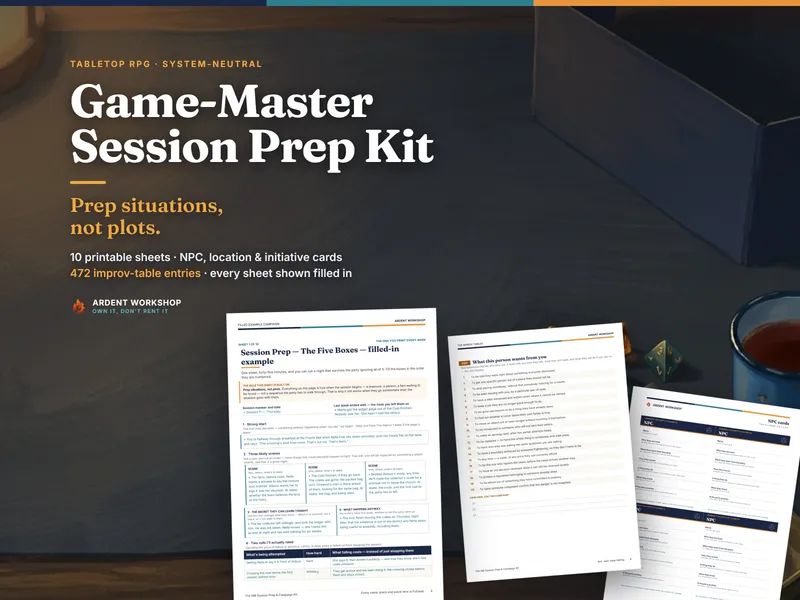
Tabletop RPG Game-Master Session Prep & Campaign Kit — 10 Printable Sheets, NPC and Location Cards, Session Zero, and 472 Improv-Table Entries
A system-neutral print-and-run kit for game masters: 10 fill-in sheets, cut-out NPC and location cards, and 472 improv-table entries. Print at 100%.
TrackersView details - $6.95 Spreadsheet
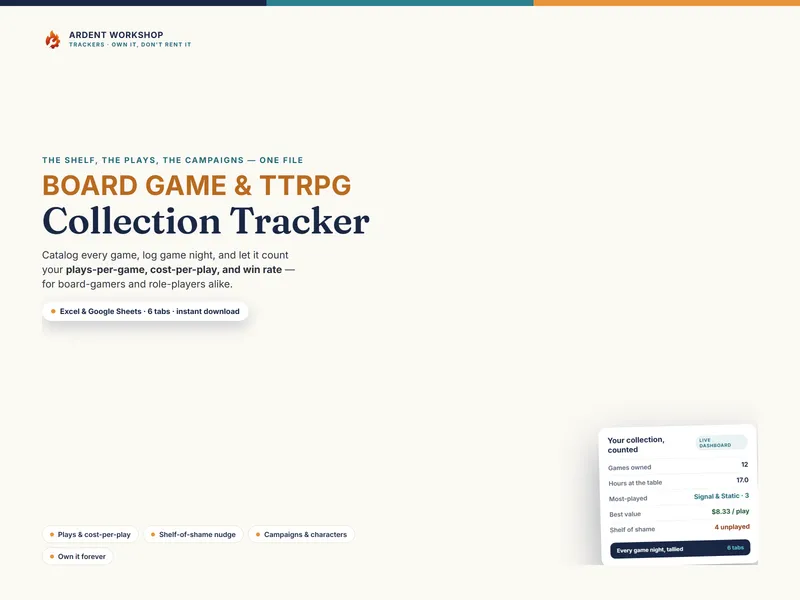
Board Game & TTRPG Collection Tracker — Excel & Google Sheets
A board game & TTRPG collection tracker for Excel & Google Sheets — catalog your shelf, log plays, and track cost-per-play, win rate, and campaigns.
TrackersView details