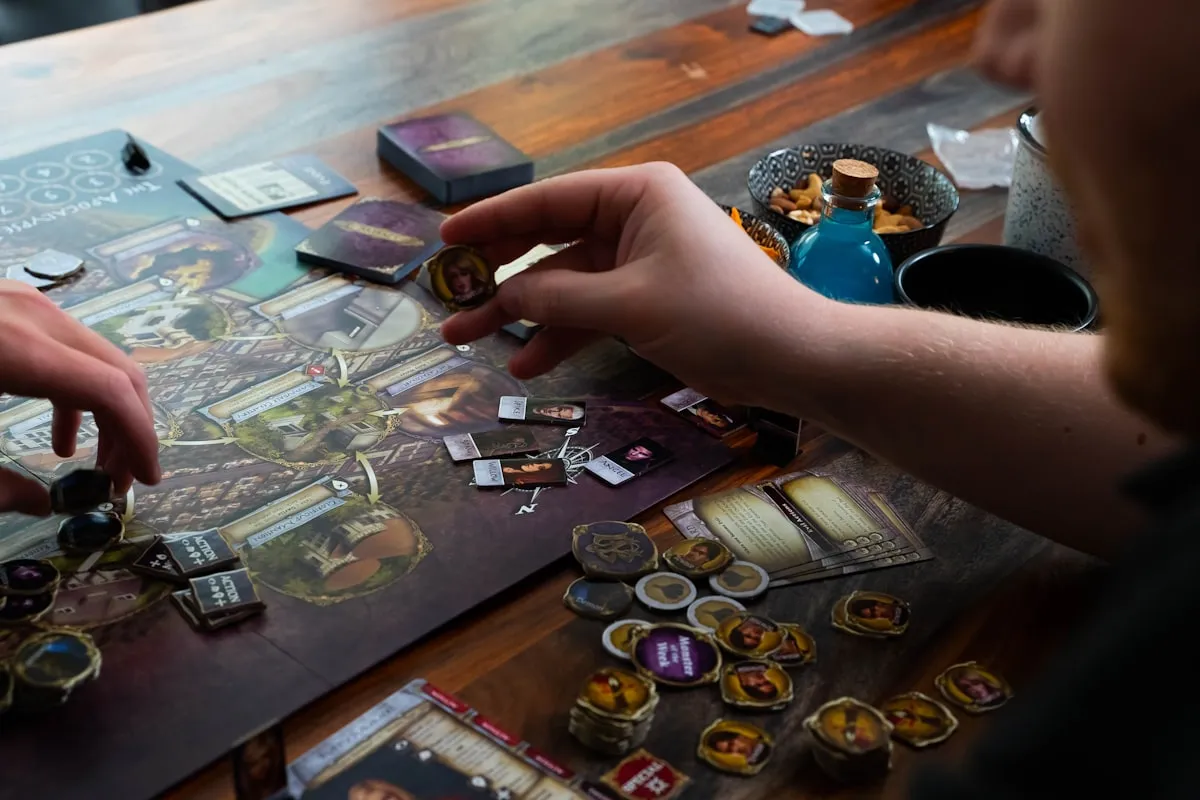
Everybody at the table shows up. One person does homework.
This is the homework, on paper. Ten sheets you print and fill in with a pen, cards you cut out once and use all campaign, and 472 curated entries to roll on when four people are looking at you and the plan has just evaporated. No app, no spreadsheet, nothing to log into — and no rules, statistics, or setting material from any published game, so it works with whatever your group already plays.
The one idea the whole kit is built on
Prep situations, not plots.
A plot is a sequence of events the party is supposed to move through. It breaks the first time they do something you did not think of, which is usually inside the first twenty minutes. A situation is a set of people who want things, in a place, with a clock running — and it cannot break, because there is nothing for the party to get wrong. Whatever they do, it responds.
Every sheet here exists to help you write situations quickly and remember them accurately. That is also why the prep sheet is short: it has five boxes, because five is what fits in the time a working adult actually has.
What makes this different from a blank prep sheet
Most game-master printables hand you a nicely ruled form and wish you luck. That is the easy half. The hard half is knowing what to put in the boxes at nine o’clock on a weeknight, and remembering in month six what you invented in month two.
A method with a clock on it. The prep sheet’s five boxes have a forty-five-minute order — read the recap and the threads, decide what the world did anyway, write three likely scenes, pick a strong start, decide the secret and the two rolls. And if the week got away from you, three of those steps are marked essential and produce a runnable session in about twenty.
472 entries you would not have written yourself at speed. Twenty tables, grouped by the question you are actually being asked when you reach for one: who is this, where are we, what happens now, what did that cost, how does tonight start and finish. What a person wants. A mannerism you can play in one breath. A voice you can hold all night rather than an accent that collapses in four minutes. What a failure costs when damage is the boring answer. What the enemy does instead of fighting to the death. Twenty rewards that are not treasure. None of them hands you a plot — every entry is deliberately unfinished, because a table that gives you a complete story takes the game away from the people playing it.
A campaign memory. The players remember every name you improvised and every door you explained away. You remember none of it, and that asymmetry is the single most common reason a good campaign starts to feel thin. The Dangling Threads page is ten seconds in pencil, mid-session; the faction board gets one move a week; the recap page is written in the sentences you will actually say out loud next week.
Every sheet comes shown filled in. A complete worked example — all ten sheets, answered in full for a campaign that does not exist. Ten minutes with it and you will never stare at a blank box wondering how much detail is enough. “The villain continues his plan” against “the levy finish moving the crates on Thursday night, and after that the evidence is gone” is fifteen seconds of extra writing and the entire value of the sheet.
The ten print-and-fill sheets
- Session Prep — The Five Boxes — the one you print every week
- The Table — the party reference, including the column nobody else puts on this sheet: what each player came for
- Session Zero — the hour that saves the campaign that quietly dies in week nine
- Lines, Veils and Table Agreements — filled in alone, collected face down
- Campaign Arc and Timeline — the long view, and the clock that runs whether or not they are ready
- Factions and Relationships — one move each, every week
- Loot, Rewards and Downtime — including the rewards that are not treasure
- Session Recap — written to be read aloud next week
- Dangling Threads — the page that saves you in month six
- Between Sessions — the forty-five minutes, in order, with a twenty-minute fallback
Session zero and safety tools, done properly
The session zero questionnaire is sixteen questions with the answers written down where they can be pointed at later — how often you play, what counts as enough people to run, the tone in three words, what happens when a character dies, and how the group settles a decision it cannot agree on.
The lines-and-veils sheet is designed around the part most tables get wrong: you hand it out to be filled in alone and collect it face down. A line drawn in front of five people is a line most people will not draw. The guide covers combining the sheets without saying whose was whose, taking the strictest answer rather than the average, agreeing a signal anyone can use mid-scene, and re-asking every few months — because answers change.
Cards you cut out once
Four NPC cards to a sheet at 3.8 × 4.4 in, two half-page location and set-piece cards, and twenty initiative strips, all imposed with cut marks. The NPC card has one line that makes the rest work — what they want from the party — and every blank on both cards has a table behind it in the improv tables. A final sheet shows an NPC card and a location card answered in full, so you know how much fits before you start writing.
Why paper, and not an app
A sheet behind the screen works in somebody’s basement with no signal, and it is still yours in five years. It needs no battery, no account, and no active subscription. It does not want your campaign uploaded in order to be useful, it cannot lock four years of notes behind a password nobody else knows, and it will not vanish when a company decides the product is no longer strategic.
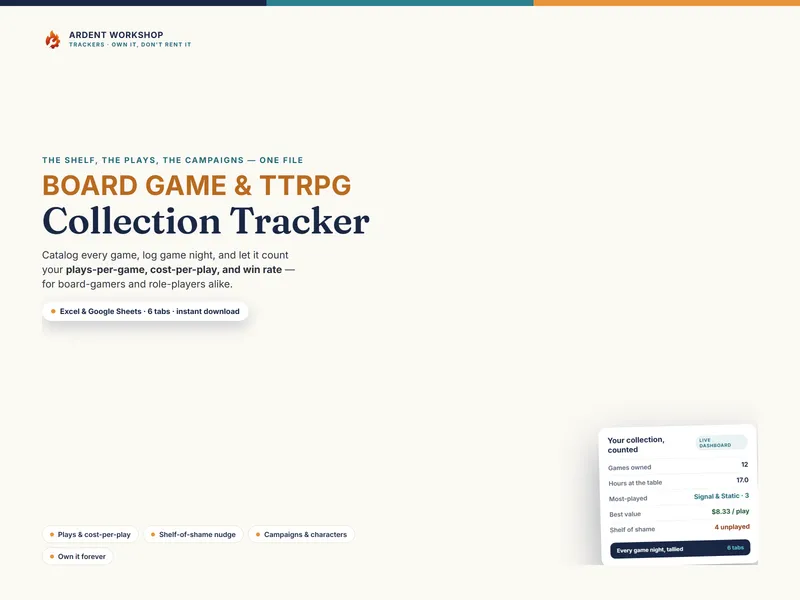
That is the whole idea behind Ardent Workshop: things you own outright, sitting between a blank notebook and a rented app. This kit is the running half of the hobby. If you also want the collecting half — what you own, what you have played, what it cost per play, and what is still in the shrink wrap — the Board Game & TTRPG Collection Tracker is that, in a workbook. Neither contains the other; they sit side by side.
Printing it
US Letter or A4 — the two files you actually print each come in both editions, laid out for the sheet rather than scaled to it. Single-sided, at 100% (Actual size) — not “fit to page”, which moves the cut marks on the card sheets. Grayscale is fine everywhere: nothing in this kit uses color to carry meaning, so the tick-boxes are labeled, the standing scale is a row of named columns, and every emphasis is also a word. Card stock is worth it for the cards. Print sheet 1 in tens; it is the one you use every week.
System-neutral, and not affiliated with anyone
There are no rules, no statistics, no spell or monster content, and nothing drawn from any published game or setting anywhere in this kit. It is about the job of running a table, not about any particular ruleset. It is not affiliated with, licensed by, or endorsed by any game publisher, and every person, place and event in the worked example is invented.
The lines-and-veils sheet is a table-management tool, not a psychological or therapeutic one — it helps a group agree what it does and does not want to play, and nothing more. If a session raises something that needs more than a conversation between friends, that is a matter for someone qualified, not for a form.
Want a taste first? The One-Page Session Prep Sheet — the sheet you use every week, with the dangling-threads page on the back — is free and ungated. It does not ask for an email.