Prep is the only part of this hobby you do alone, and it is the part most people quietly do badly — not from laziness, but because nothing tells you when to stop. A blank page has no edge. Fill in a fixed set of boxes instead and the job finishes when the page does.
What follows is the sequence, with timings that make it a routine rather than an evening. Give it forty-five minutes the first time — the printed sheet in the kit is timed that way — and it settles to about thirty once you have done it three or four times. It works with any ruleset, because none of it is about rules.
The one idea underneath the whole thing
Prep situations, not plots.
A plot is a sequence of events the party is supposed to move through. It breaks the first time they do something you did not think of, which is usually inside the first twenty minutes — and then you either railroad them back onto it or improvise from nothing.
A situation is a set of people who want things, in a place, with a clock running. It cannot break, because there is nothing for the party to get wrong. Whatever they do, it responds. Every step below is a way of writing a situation quickly.
The difference is easiest to see side by side:
| Written as a plot — breaks | Written as a situation — bends |
|---|---|
| The party hears a rumor, travels to the mill, finds the body, and follows the tracks to the camp. | There is a body at the mill. Three people know, and each wants something different. The tracks will be rained out on Friday. |
| The baron refuses to see them, so they break in through the kitchens. | The baron will not see anyone this week. His steward can be persuaded, his cook can be bribed, and there is a window nobody has fixed since spring. |
| In scene three, the informant betrays them. | The informant is being paid by both sides and has already taken the second payment. He will act on it the first time it is safe. |
Both columns contain the same material. Only one of them survives the party going somewhere else.
The thirty minutes, in order
0–5 · Read last week and the open threads
Do not start from a blank page. Start from your recap of last session and your list of dangling threads — the names you invented, the doors you explained away, the promises you made at the table.
You are looking for one thread the players clearly wanted followed. It is almost always obvious: somebody has asked about it twice. That is tonight’s spine, and it is free, because they chose it.
5–12 · Decide what happens anyway
Go down your list of factions and give each one action since last session. Not a plan — one thing they did. Most of them the party will never hear about; two or three surface as rumor; one is waiting for them.
Then pick the move that would most inconvenience the party and make it this week’s world event. Write it down first. It is the line that makes a campaign feel alive rather than staged, and it is the reason a session where the party does nothing still has consequences.
Weak: “The villain continues his plan.” Strong: “The levy finish moving the crates on Thursday night. After that the evidence is out of the district, and the one person who could testify stops being useful to anybody.”
The strong version took fifteen seconds longer and gave you a deadline the players can see.
12–21 · Three likely scenes
One sentence each: who wants what, where, and what is at stake if the party does nothing. Not an order of play. Three things that could plausibly happen tonight.
Two will happen. One will be replaced by something a player invents. That is the expected outcome, not a failure — and because each scene is a situation rather than an event, the one they skipped is not wasted. It is postponed, and it has had a week to get worse.
21–25 · A strong start
The worst thirty seconds in the hobby is the silence after “so, what do you want to do?”. Kill it by having something already happening when you say we begin.
A few that work with almost any campaign:
- Someone is already at the door, and has been knocking a while.
- A stranger has paid for their meal and is sitting at the next table, waiting.
- The thing they were escorting is gone, and the ropes were cut from the inside.
- The bells are ringing at the wrong hour and everyone local is running one way.
- Everything is fine. It is a beautiful morning. (Let the table get nervous.)
Put your own party’s names and last week’s facts into it, and read it off the page rather than improvising it.
25–27 · The secret
One fact that changes what the party knows, attached to a person rather than a place.
This is the single most useful habit in the whole sequence. A secret in a room only works if they go to the room. A secret in somebody’s head can walk across town, turn up at the ferry, or be sold to them by a third party — so the session works wherever they go.
27–29 · Two rolls, and what failing costs
Write the two checks you can already see coming, and decide the price of failure now, while you are calm.
The rule: failure moves the story sideways, never into a wall.
- It works, and takes three times as long as they have.
- It works, and somebody sees them do it.
- They get the information, and it is a week out of date.
- The way forward opens and the way back closes.
- It works for one of them. Just one. They have to choose who.
None of those stops the session. All of them cost something.
29–30 · Finish with five names and one place
Pick five names and say them out loud once, so you do not freeze mid-scene and name a shopkeeper “Bob” for the third time this month. Write one place down in three senses — a sight, a sound, and a smell — because description that only reports what a room looks like is a floor plan, and the ear and the nose are what make a party lower their voices.
Then stop. The page is full.
When the week got away from you
Do three steps: read the recap and the threads, decide what happens anyway, and pick a strong start. That is about fifteen minutes and a runnable session. Everything else on the list makes it a better one — but a night that happens beats a night that was going to be brilliant next month.
The two habits that matter more than the prep
Prep gets you through Thursday. These two are what keep a campaign from thinning out over months:
- Write down what you improvise, the moment you improvise it. The name you gave the ferryman, the reason you invented for the closed road, the cousin somebody mentioned. Ten seconds in pencil, mid-session. An improvised detail that gets written down becomes plot; one that does not becomes a plot hole.
- Write the recap the same night, in sentences you will say out loud. Not notes — sentences, naming characters doing things, ending on what they were about to do. Ninety seconds of recap next week is worth twenty minutes of “wait, where are we?”.
Where to start
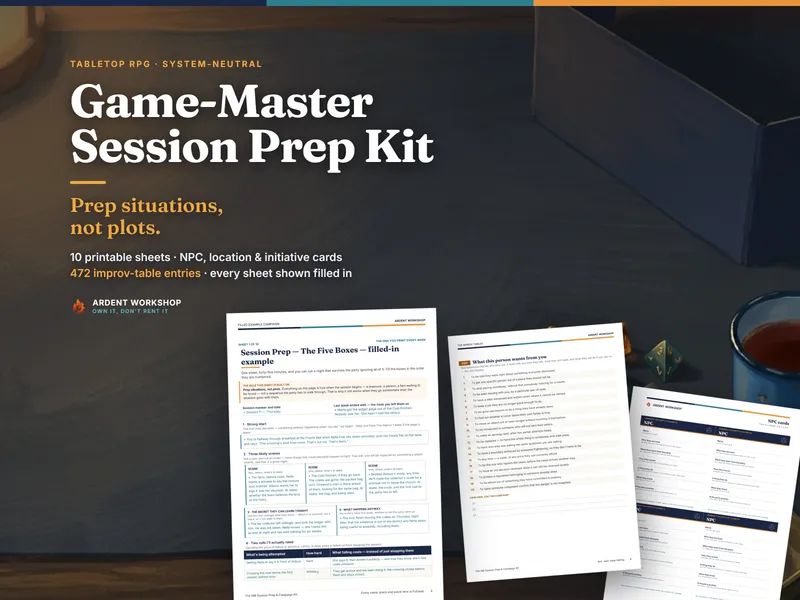
The free one-page session prep sheet is this whole sequence as five boxes on one printable page, with the dangling-threads page on the back and one improv table — and it comes shown filled in for an invented campaign, so you can see the level of detail before you write anything. It is ungated and asks for no email.
The Game-Master Session Prep & Campaign Kit adds the other nine sheets — a party reference, a session-zero questionnaire, a lines-and-veils sheet, the campaign arc and its clock, a faction board, a loot and downtime log, the read-aloud recap page and a between-sessions checklist — plus twenty improv tables with 472 entries for exactly the moments this sequence cannot pre-empt, and NPC, location and initiative cards imposed with cut marks. It is system-neutral: no rules, no statistics, and nothing drawn from any published game.
If you are weighing paper against software, the printable GM kit vs a campaign management app comparison is an honest one, including the four things an app does better. Everything else for the person behind the screen is collected on the hub for game masters.