You can walk into Thursday’s game with a session zero that runs to the clock, ends with a written record, and does not feel like a staff meeting. In short: logistics, the pitch and tone, lines and veils, the hard calls, a review point, then characters, in that order and in about 90 minutes. Here is the agenda, block by block, with the minutes attached.
A session zero is the conversation a tabletop roleplaying group has before anyone rolls a die, to agree how the campaign will actually run. The full definition and the long list of questions worth asking are on the glossary page, what is a session zero. This post is the part that page does not cover: the running order.
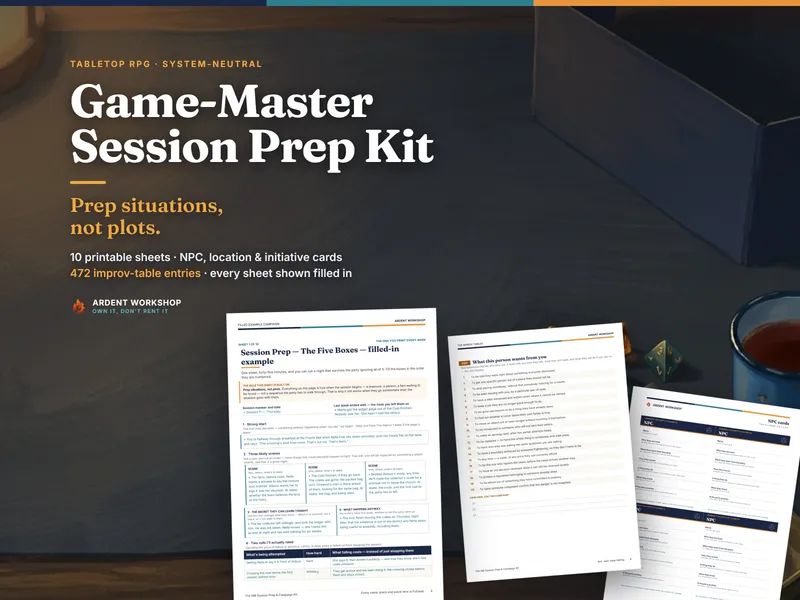
A common way a session zero goes wrong is drift. It starts as a friendly chat, slides straight into character creation, and ends with nothing written down. Three months later nobody can point at what was agreed. The fix is structure plus a sheet to write on. The Game-Master Session Prep & Campaign Kit ships both as printables (a sixteen-question session zero questionnaire and a lines-and-veils sheet built to be filled in privately), but the agenda below works with an index card and a pen.
The 90-minute session zero agenda
Run the agreements first and the characters last. A player who knows the campaign is meant to be bleak builds a different character from one who expects a romp.
| Minutes | Block | You walk out with |
|---|---|---|
| 0–10 | Logistics | A schedule, a session length, a quorum, a cancellation rule |
| 10–25 | The pitch and the tone | A two-sentence pitch and three agreed tone words |
| 25–40 | Lines and veils | A merged, anonymous list and a mid-scene signal |
| 40–55 | The hard calls | Rules for character death, player-versus-player, and deadlock |
| 55–60 | Commitment and review point | A number of sessions, then a dated, honest check-in |
| 60–90 | Characters, together | A party whose characters already know each other |
Ninety minutes is a target, not a law. A group of three can often finish the agreements in about forty minutes; a group of six will usually need the full hour.
How to run each block
Pick one person, usually the game master, to keep the group’s page. Keep every block short and write its answer on that page before you move on. The record is the point.
- Logistics (10 minutes). Agree how often you play, for how long, what counts as enough people to run, and what happens when someone cancels. Do this first, while everyone is fresh. A schedule nobody can keep is a problem no amount of good fiction fixes.
- The pitch and the tone (15 minutes). Pitch the campaign in two sentences, then have the group agree the tone in three words. The game master proposes; the table edits. Write the three words at the top of the page.
- Lines and veils (15 minutes). Hand out a lines-and-veils sheet, have everyone fill it in alone, collect the sheets face down, merge them into one anonymous list, and agree a signal anyone can use mid-scene. The next section splits these fifteen minutes up, because this is the block that is easiest to get wrong.
- The hard calls (15 minutes). Decide what happens when a character dies, whether characters can act against each other, and how the group breaks a deadlock. These are easy to answer while everyone is calm and very hard to answer while someone’s character is bleeding out.
- Commitment and review point (5 minutes). Agree a number of sessions, then put a date on the check-in where everyone says honestly whether to go on. “Ten sessions, then we all decide” gives everyone a clean exit that costs nobody a friendship.
- Characters, together (30 minutes). Make characters at the same table, and give every character a reason to know at least one other. A party that shares a history on page one is easier to keep in the same room in the fiction.
How to run the lines-and-veils block in 15 minutes
The natural move, going round the table and asking, rarely works well: people hesitate to name a line in front of the whole group. The definitions and the reasoning behind private collection are on what are lines and veils. Here is how the fifteen minutes divide:
- Minutes 0–2: hand out one sheet per person. Three columns: lines, veils, and fine to play. As you hand them out, mention a few common categories to consider, such as harm to children, graphic torture, or a phobia like spiders.
- Minutes 2–7: everyone fills theirs in alone, in silence.
- Minutes 7–10: collect the sheets face down and shuffle them. Whoever keeps the group’s page merges them into one list and take the strictest answer. If one person marks something a line and four mark it fine, it is a line. This is not a vote.
- Minutes 10–12: read the merged list aloud without saying whose was whose. Then write it on the group’s page.
- Minutes 12–15: agree the mid-scene signal. One widely used signal is the X-Card, created by John Stavropoulos in 2013 (opens in new tab): anyone taps it, and the group changes, rewinds, or skips the content, no explanation needed. The TTRPG Safety Toolkit (opens in new tab), co-curated by Kienna Shaw and Lauren Bryant-Monk, collects more options if your group wants a different tool.
How to run a session zero for a group already playing
A mid-campaign session zero takes about 30 minutes and uses the same private method. Run one when the tone has drifted, a new player joins, or attendance has quietly started to slip.
- Skip the pitch. Everyone knows the game.
- Ask what is working and what is not, on paper (10 minutes). The same face-down collection as lines and veils. The polite answer comes out loud; the useful one comes on paper.
- Re-check logistics (5 minutes). The schedule that worked in spring may not work in autumn.
- Refresh lines and veils (10 minutes). People’s answers change, and new players have never given theirs.
- Set a new review point, with a date (5 minutes). Then go back to playing.
How to run a session zero online
Online, run the group conversation on the call and collect lines and veils through a private form set not to collect names or email addresses, never a shared document. A shared document can show who typed what, which defeats the point. For the mid-scene signal, agree a typed X in the chat that means the same as tapping the card.
Split it across two shorter calls if you can. Send the private form before the first call, so the answers are in when you reach that block. Run logistics, the pitch and tone, lines and veils, the hard calls and the review point on the first call, and make characters on the second. A long video call tends to tire a group faster than the same time around a table.
Common questions about running a session zero
How long should a session zero take?
About 90 minutes for a new group: an hour of agreements and half an hour of making characters together.
Should you make characters during session zero?
Yes, but after the agreements, not before.
What you should walk out with
When the session zero ends, the group should have one page it can point at in month three:
- Schedule, session length, quorum and cancellation rule
- The pitch and three tone words
- The merged lines-and-veils list and the mid-scene signal
- Answers on character death, player-versus-player and deadlock
- The review point, with a date
- A party that already knows each other
The Game-Master Session Prep & Campaign Kit includes the printable session zero questionnaire and lines-and-veils sheet, then carries the campaign past it: a five-box weekly prep sheet, NPC and location cards, a recap page, and 472 improv-table entries, all printed and kept rather than rented from an app. If you want to start smaller, the free one-page session prep sheet is the sheet you use every week after session zero.
And if your group plays board games between campaigns, here is how to track the board games you actually play.