What a session zero is for
A session zero settles the questions that are easy to answer while everyone is calm and almost impossible to answer well in the moment. It is agreement, written down — not a contract, and not a rules seminar. Plenty of groups make characters together in the same sitting, and that works well; the agreements are the part that makes it a session zero. Three kinds of things belong in it:
- Logistics. How often you play, for how long, and what counts as enough people to run. In practice more campaigns end over scheduling than over anything that happens in the fiction.
- Tone and content. What kind of game this is, what the group specifically does not want, and roughly how the night splits between fighting, talking, and exploring.
- The hard calls. What happens when a character dies, whether characters can act against each other, and how the group settles a decision it cannot agree on.
Questions worth asking out loud
Ask the question, then be quiet. The first answer is usually the polite one; the useful one arrives about four seconds later. These are the ones that repay the silence:
- How often, how long, and what counts as a quorum? Deciding in advance turns a cancellation into a rule rather than a negotiation.
- What tone are we going for, in three words? Three is short enough that people commit and specific enough to be useful later. "Grim, funny, and fair" and "heroic, warm, and high-stakes" are different games.
- What does this group specifically not want? The polite answer is "anything's fine". Anything named here belongs on the lines and veils sheet, whether or not it sounded serious.
- What happens when a character dies? Deciding this calmly is a completely different conversation from deciding it while someone's character is bleeding out and the table is looking at the game master.
- Can characters act against each other, and when? Player-versus-player conflict is fine at tables that agreed to it and poisonous at tables that did not. There is no default.
- How does the group settle a decision it cannot agree on? In-character deadlock is one of the most common ways an evening stalls. A group with an agreed tiebreak loses a few minutes to it; a group without one can lose most of the session.
- How long is anyone committing to? "Until it stops being fun" ends badly for whoever quits first. "Ten sessions, then we all decide" gives everyone a clean exit that costs nobody a friendship.
- What should a player do if they are not enjoying it? Ask this one out loud. The answer you want — tell the game master between sessions, and it will not be a big deal — only becomes true because somebody said it first.
How to run one
- Take the agreements before character creation. Tone shapes characters, so a group that has agreed on "grubby, funny, and fair" builds different people than one that has not. Making the characters together afterwards, in the same sitting, is a good use of the rest of the evening.
- Write the answers down where they can be pointed at. The value is not the conversation, it is the record. In month three you want to point at a page, not at a person.
- Record disagreements, not just agreements. Where the group split, write down both answers and the compromise. A disagreement that gets written down stops being an argument you re-have later.
- Hand out the safety sheet separately, and privately. Lines and veils get collected face down, not discussed round the table — see below.
- Set a review point. "Ten sessions, then we all say honestly whether to go on" is the single kindest line in a session zero.
Session zero and safety tools
A session zero is where safety tools get agreed, but the two are not the same thing. The questionnaire is a group conversation. The lines and veils sheet is not — it is filled in alone and collected face down, because a line drawn in front of five people is a line most people will not draw. The group also agrees a signal anyone can use mid-scene, and what happens when it is used: stop, rewind, or fade.
Is a session zero worth an hour?
It is one evening against several months. The failure it prevents is not dramatic — it is the campaign everybody enjoyed for six weeks that quietly stops being scheduled, because the tone drifted, or the fights outnumbered the talking three to one, or somebody has been waiting since session two for a scene that never comes. None of those are anyone's fault. They are all conversations that never happened.
Running one this week
The free one-page session prep sheet is the sheet you use every week after session zero — five boxes, forty-five minutes, shown filled in. The full Game-Master Session Prep & Campaign Kit adds the printable session-zero questionnaire itself — sixteen questions with room for the answers and a sign-off block — plus the lines-and-veils sheet, a party reference that records what each player came for, and a guide on running the conversation without it feeling like a meeting.
Related terms and templates
See also what lines and veils are, the printable GM kit vs a campaign management app comparison, and the hub for game masters. To catalog the games themselves rather than run them, see the Board Game & TTRPG Collection Tracker or browse the full Trackers catalog.
Templates that implement this
Run a session zero, then run the campaign
3 templates
A printable questionnaire, a safety sheet built to be filled in privately, and the weekly prep sheet that comes after — plus the collection side of the same hobby.
- $9.95 PDF
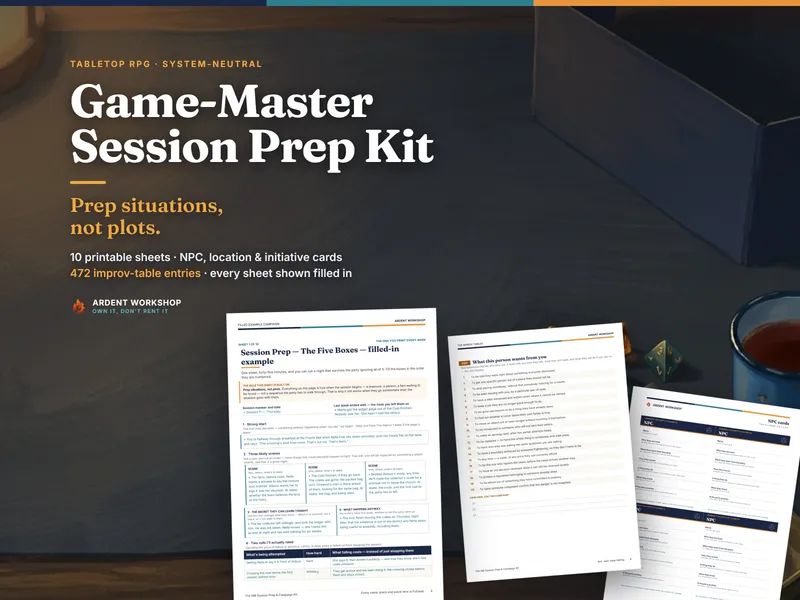
Tabletop RPG Game-Master Session Prep & Campaign Kit — 10 Printable Sheets, NPC and Location Cards, Session Zero, and 472 Improv-Table Entries
A system-neutral print-and-run kit for game masters: 10 fill-in sheets, cut-out NPC and location cards, and 472 improv-table entries. Print at 100%.
TrackersView details - $6.95 Spreadsheet
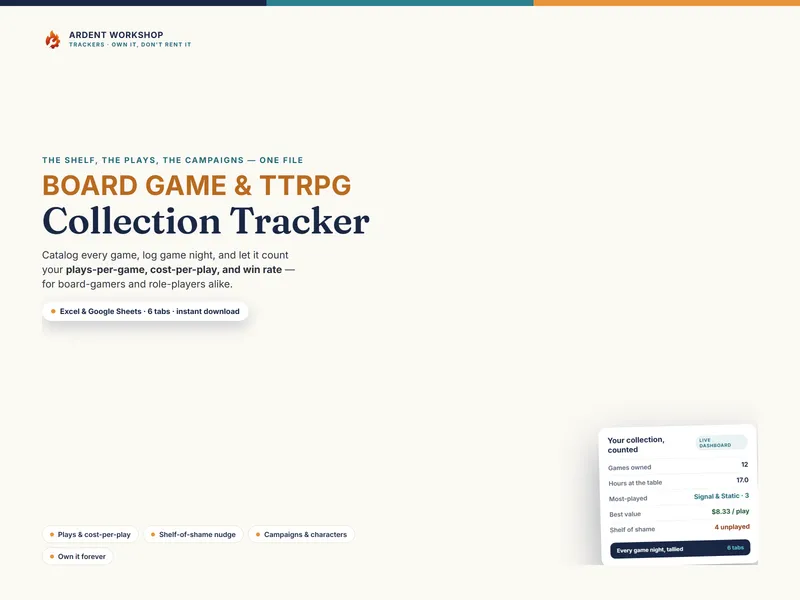
Board Game & TTRPG Collection Tracker — Excel & Google Sheets
A board game & TTRPG collection tracker for Excel & Google Sheets — catalog your shelf, log plays, and track cost-per-play, win rate, and campaigns.
TrackersView details - $6.95 Spreadsheet

Set Collection & Build Tracker for LEGO® Sets — Excel & Google Sheets
A LEGO set collection tracker for Excel & Google Sheets — catalog every set, compute cost per piece and gain/loss, and count what's still sealed.
TrackersView details