This page is general management guidance, not legal or HR advice. Progressive discipline is usually a policy framework rather than a statutory requirement in US workplaces — though union contracts, public-sector just-cause rules and a few states change that — and what any given process must contain — notice, the right to be accompanied where it applies, appeal rights, record retention — is set by law and by your own employer's policy and varies sharply by jurisdiction. Check the policy that governs you, and take advice before any step that could lead to dismissal.
The four rungs, and the one people skip
- Notice. You have observed something more than once and you can say what it is — three instances with dates, and an honest check that the cause is not something on your own side.
- Say it. One informal conversation. No file, no policy, a short note to yourself and a copy to them. They leave knowing what is expected, in observable terms, and there is a review date.
- Say it again, on the record. A second informal conversation that refers explicitly to the first, with support offered and written down.
- Formal. The policy's own process, run with HR, with notice, evidence, support and a stated consequence.
The rung that gets skipped is the third. A manager raises something once, nothing changes, patience runs out over the following months, and the next thing the employee hears is a letter. That gap is a common procedural weakness in an otherwise reasonable case.
Conduct or capability?
Many employers run two separate tracks, and they are not interchangeable. Conduct is about choices — lateness, a policy breach, how somebody spoke to a colleague. Capability is about ability — the work is not landing despite effort, which is usually a performance improvement plan rather than a warning. Using the conduct route for a capability problem reads as punishing somebody for struggling, and it is a defect in the process before it is anything else.
What each documented step should record
- The observable behavior, with dates, and its effect on the work or on other people.
- What was said at each earlier step, and when.
- The support offered, by whom, and whether it was taken up.
- What the employee said, in their own words rather than the manager's summary.
- What the employer committed to, not only what the employee must change.
- The review date, and the consequence stated in the policy's own language.
Write it within the hour and send the employee a copy the same day, with their comments going on the record alongside yours rather than instead of them. A file that only contains one side reads exactly like what it is.
When to stop and route it instead
Some situations are not a discipline matter at all, and treating them as one is the expensive mistake. Stop and take it to HR before you act if:
- The behavior may relate to a health condition, a disability, treatment, pregnancy, caring responsibilities, religious observance, or an accommodation already in place.
- Anyone has used the words bullying, harassment or discrimination — including the person you were about to speak to, about somebody else.
- The employee has recently raised a grievance, made a protected disclosure, or returned from leave. Expect the timing to be scrutinized alongside the substance.
- The conduct touches a protected characteristic in any direction.
- You cannot explain the decision in terms that would survive being written down. If it only makes sense out loud, the problem is the decision.
Progressive discipline in a small company
Small employers get the worst of this: no HR business partner to call, the manager and the owner are often the same person, and everybody involved eats lunch together. Two habits do most of the work. Keep the informal steps genuinely informal — a short note to yourself and a copy to them is enough, and it is not a file. And when the situation crosses into any of the route-it conditions above, buy an hour of an employment lawyer's time rather than improvising a process. It costs far less than unwinding a process that was wrong.
Related templates and concepts
Every rung on the ladder is a conversation somebody has to actually hold. The Manager's Difficult-Conversations Script Bank scripts fifteen of them word for word — branched for the four replies you actually get, each with a stop-check naming when to bring HR in before you open — and, for the formal ones, when not to hold the meeting alone at all — plus a documentation note to write afterward. The first performance concern is the free first-performance-concern script (PDF, no signup). See also how to start a performance conversation, performance improvement plans and the templates for managers hub.
Templates that implement this
Templates for the steps before a formal one
3 templates
Most of progressive discipline is conversations. The paperwork only holds up if the conversations happened first, in terms the person could act on.
- $24.95 Mix

Manager's Difficult-Conversations Script Bank — 15 Word-for-Word Scripts, Each Branched for the Four Replies You Actually Get, With the Note to Write Afterward
15 word-for-word manager scripts for difficult conversations — each branched for the four replies you actually get, with the exact next line for every one.
Team & TalentView details - $19.95 Mix

Performance-Review Phrasing & Feedback Wording Bank — 189 Review Phrases by Competency and Rating Level, Plus 54 for Goals, Self-Review and Calibration, Each With the Evidence It Requires
189 performance review phrases by competency and rating level, plus 54 more for goals and calibration — each naming the evidence it requires.
Team & TalentView details - $16.95 PDF
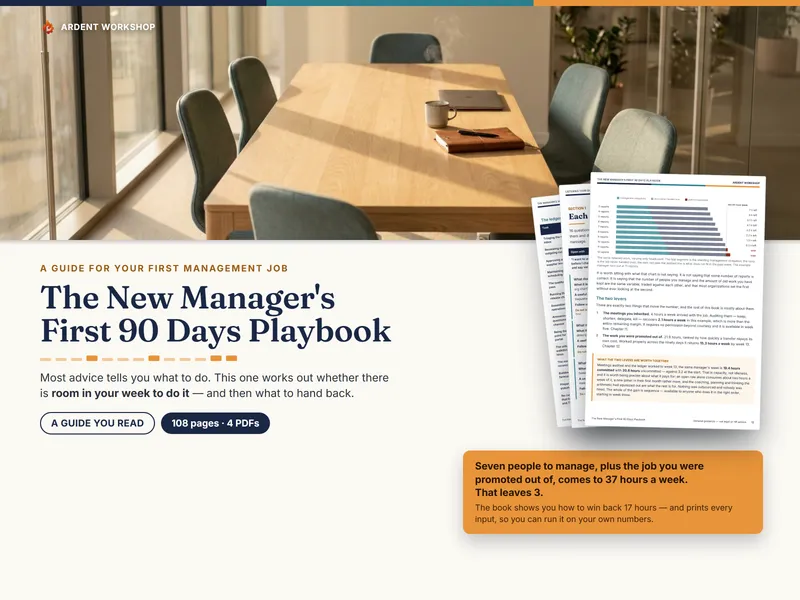
The New Manager's First 90 Days Playbook — What to Do Each Week, What to Ask, and How to Make the Job Fit the Week You Actually Have
108 pages across 4 PDFs for your first 90 days as a new manager: your week costed, 62 listening-tour questions, and a delegation ledger ranked by payback.
Team & TalentView details