There’s a pill bottle somewhere in your house right now — on a nightstand, in a kitchen cabinet, in the door of the fridge — that you look at almost every day and have never really looked behind. You know roughly what it is. You know roughly when it’s taken. And you’re pretty sure there’s enough left to get through the week.
That “pretty sure” is the whole problem.
Tracking your family’s medications means keeping one current record of every medicine each person takes — the dose, the timing, the reason, the prescriber, and the refill date — in a single place anyone in the household can find. Most families don’t have that.
What they have instead is a distributed system running entirely inside one person’s head: which kid finished the antibiotic, when Grandpa’s blood-pressure refill is due, whether the new prescription the urgent-care doctor wrote actually interacts with the one the regular doctor manages. It works right up until the day it doesn’t — and the day it doesn’t is usually a weekend, a trip, or an emergency, when the person holding all the information isn’t the person who needs it.
Here’s what’s actually happening underneath that pill bottle — and how to replace the mental version with something that doesn’t fall apart under pressure.
The stakes are higher than a missed pill
Here’s what most people don’t realize: medication mistakes at home are common, and they land people in the hospital. Each year in the United States, adverse drug events cause more than 1.5 million emergency department visits (opens in new tab), according to the CDC — a category that includes overmedication, allergic reactions, and the plain mix-ups that come from nobody having an accurate list.
The risk climbs with the number of medications in the house, and modern families carry a lot. CDC survey data shows that 34.5% of adults aged 60–79 take five or more prescription drugs (opens in new tab) in a given month (2015–2016 national survey figures, the most recent available). Add a couple of working adults on a maintenance medication each (one taken on an ongoing basis, like a blood-pressure or thyroid pill), a kid on a rotating course of something, and the over-the-counter drawer everyone treats as furniture, and a single household can easily be managing a dozen active medicines at once — with zero written record tying them together.
This isn’t a fear pitch. It’s just the reason the mental system stops scaling. One person on one medication is easy to track in your head. A family is not one person on one medication.
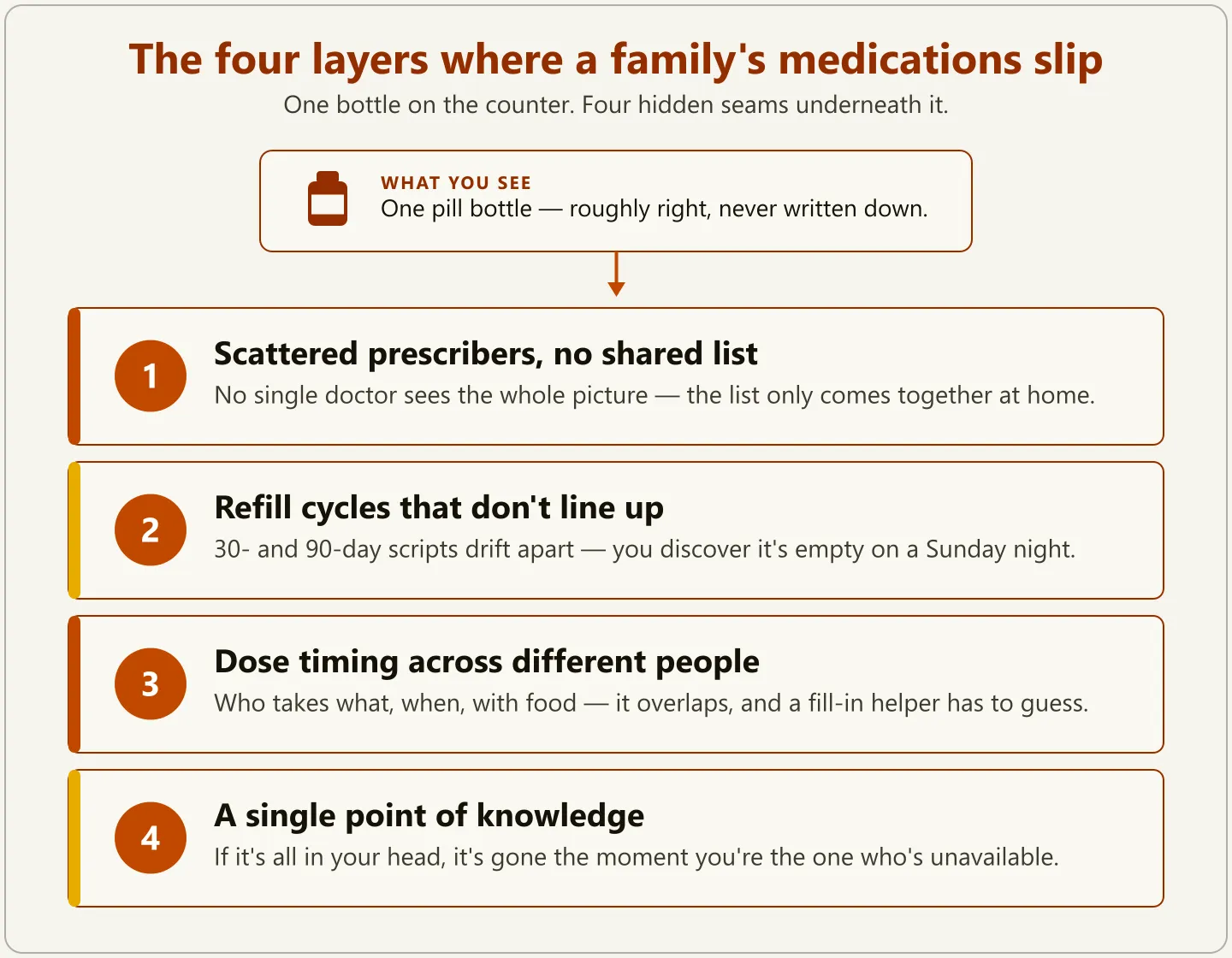
The four hidden layers where a family’s medications slip
A family’s medications don’t fail all at once. They slip at four specific seams — and once you can see the seams, the fix becomes obvious.
Layer 1: Scattered prescribers, no shared list
No single doctor sees your family’s whole medication picture. The pediatrician writes for one kid. A regular doctor manages an adult’s maintenance meds. An urgent-care visit or a specialist adds something new, often without knowing what’s already in the cabinet. The only place all of those prescriptions could ever come together is a list you keep at home — because no one in the system is keeping it for you. When a new medicine gets added, nobody’s checking it against the full set unless you hand someone the full set.
Layer 2: Refill cycles that don’t line up
A 30-day prescription and a 90-day prescription drift out of sync within a month or two. One runs out on the 3rd, another on the 19th, a third on some date you’d have to count out on a calendar. Because the dates never align, “I’ll refill when I notice it’s low” turns into a discovery you make at 8 p.m. on a Sunday, with the pharmacy closed and one dose left. Refills don’t fail because you forgot — they fail because there’s no single view of which one is due next.
Layer 3: Dose timing across different people
Morning, midday, evening, bedtime, with food, on an empty stomach, not within two hours of another medicine — every drug carries its own timing rules, and in a family those rules overlap. Who takes what at breakfast? Which one can’t be given at the same time as another? When a second person steps in to help — a partner covering while you travel, a grandparent watching the kids — the timing lives in your head, not on paper, so it either gets guessed or skipped.
Layer 4: A single point of knowledge
This is the one that turns an inconvenience into an emergency. If you are the only person who knows your family’s medications, then the moment you’re unavailable — sick, traveling, in the ambulance yourself — the information is gone exactly when someone needs it most. A paramedic’s first question is “what does he take?” A covering caregiver needs to know before the next dose. “It’s all in my head” is not a system anyone else can use.
What a family medication record actually needs
A good family medication record answers, for every person and every medicine, the handful of questions a doctor, a pharmacist, or a fill-in helper will actually ask. You don’t need software or a medical background — you need these five parts kept current.
| Part | What it captures | Why it matters |
|---|---|---|
| The medication list | Each person’s medicines: name, dose, what it’s for, and the prescriber | The single source of truth no individual doctor has |
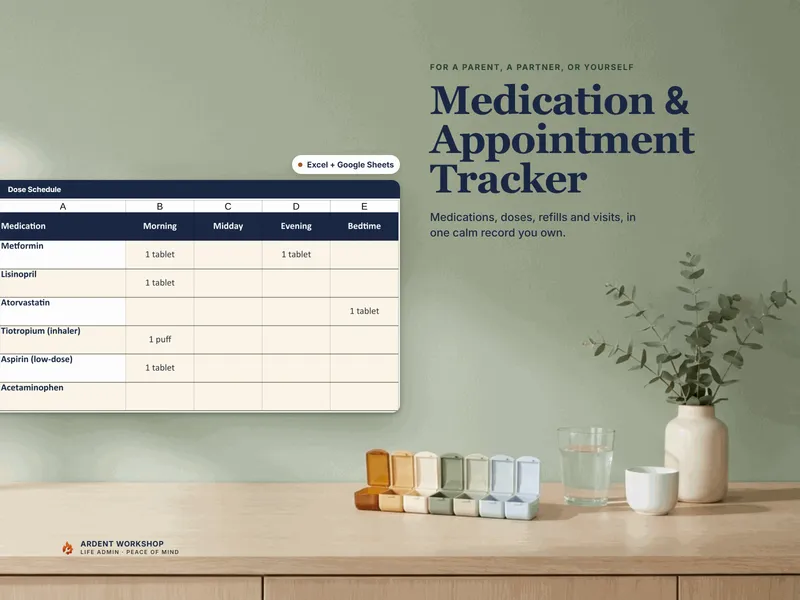
| The dose schedule | When each medicine is taken across the day, and any “with food / not with” rules | So a helper can keep the routine straight without guessing |
| Refill tracking | Last filled, days’ supply, and the next refill-by date | So nothing runs out on a weekend |
| The at-a-glance sheet | Conditions, allergies, primary doctor, pharmacy, and who to call | What a paramedic or babysitter needs in the first 30 seconds |
| Providers & pharmacies | Every doctor and pharmacy with direct phone numbers | So a refill or a question doesn’t start with a search |
Notice what this is and isn’t. It’s a record of care you keep — not a diagnosis, not a substitute for your pharmacist. It doesn’t tell you whether two drugs interact; it makes sure the person who can tell you is looking at the complete, accurate list. That distinction is the whole point, and it’s why the record stays useful no matter how many medicines the household adds.
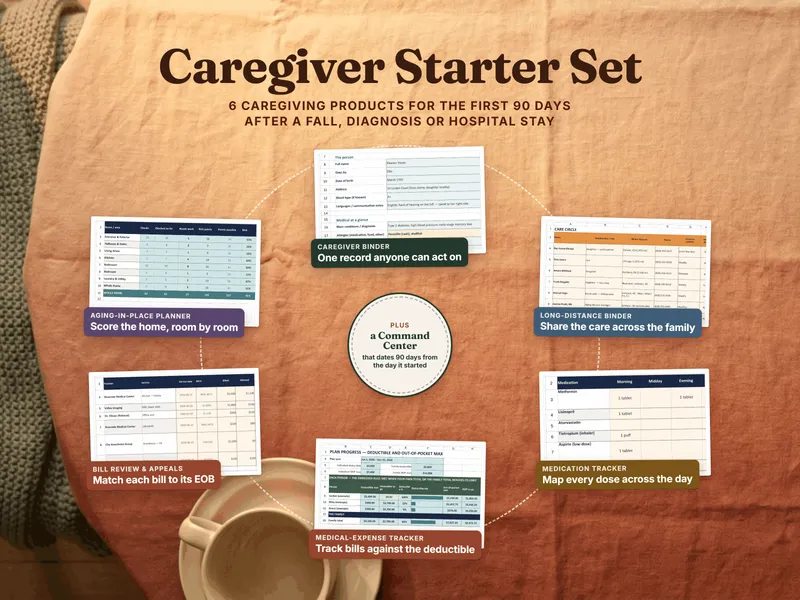
If you’d rather not build the grid from scratch, the Medication & Appointment Tracker is exactly these five parts as an 8-tab workbook (Excel and Google Sheets) — pre-built, with a color-coded refill status and an at-a-glance page you can hand to anyone. It’s a file you own and fill in once, not an app you rent by the month.
How to build your family’s medication list in one sitting
The fastest way to get an accurate list is the method pharmacists use, called a brown-bag review. The AHRQ health-literacy toolkit (opens in new tab) describes it plainly: gather every medicine into one place and go through them one at a time. Do it for your household and you’ll have a complete first draft in under an hour.
- Collect everything into one bag or box — per person. Prescriptions, over-the-counter pills, vitamins, supplements, creams, patches, inhalers, eye drops. Include the empties and the expired ones; what someone stopped taking is information too.
- Write down what each label says. Medicine name, dose (the milligrams, not just “one pill”), how often, and what it’s for. Copy it straight off the bottle — don’t work from memory.
- Note the prescriber and pharmacy for each. This is what stitches Layer 1 back together. Add the direct phone numbers while you have the bottle in hand.
- Map the day. For each person, mark when each medicine is taken — morning, midday, evening, bedtime, as-needed — plus any food or spacing rules. This becomes the schedule a helper can follow.
- Record the refill math. Last filled date, days’ supply (the day count printed on the label — a “30-day supply” and so on), and the resulting refill-by date. Now you can see which prescription comes due next instead of finding out when it’s empty.
Do this once and the hard part is over. From there it’s maintenance: update a line when a dose changes, check the refill column once a week, and re-run the full brown-bag pass a couple of times a year — a natural thing to do right before an annual checkup, which is also when your doctor most wants to see the complete list. (If you’re weighing how much home tracking is worth versus just showing up to appointments, we made that home tracking vs. the annual checkup case separately.)
The one rule that keeps a medication record safe to share
Here’s the rule that makes all of this usable: write down the care and where the documents live — never the logins or the full account numbers. A medication record is only useful if you can hand it to a babysitter, a paramedic, or a relative in a crisis. That means it has to be safe to leave on the counter or text to a family member.
So it records:
- Medicines, doses, schedules, conditions, and allergies
- Doctor and pharmacy names and phone numbers
- Where the insurance card and the patient-portal access can be found
And it deliberately leaves out:
- Pharmacy or patient-portal passwords
- Full insurance member ID numbers
- Anything that would let a stranger impersonate the patient
You get all the benefit of a shareable emergency reference without turning a countertop sheet into an identity-theft kit. This is the same principle behind a good family emergency binder — the medication list is one of the most important pages in it, and the safe-to-share rule is what lets it actually leave the house.
When the tracking is really for someone else
The stakes change when you’re tracking medications for a person who can’t fully track their own — an aging parent, or a family member with complex needs. The mechanics are identical, but two things get more important: the at-a-glance sheet (because more people rotate through the caregiving) and the schedule (because a missed or doubled dose has less margin).
If that’s your situation, the medication list is one piece of a larger picture that also includes appointments, insurance, and key contacts. A dedicated Caregiver Binder organizes all of it in one place a rotating set of helpers can actually use — with the medication list as one of its most important pages. We walk through the full approach in organizing an aging parent’s records.
The takeaway
The pill bottle on your counter is the visible tip of a system your family is already running — scattered across prescribers, drifting refill dates, overlapping schedules, and one person’s memory. You’re not adding a system by tracking your medications. You’re just writing down the one you already have, so it survives the day you’re not there to run it.
Start with the brown-bag pass this weekend. One bag per person, one hour, one list. Everything after that is upkeep — and the first time someone else can answer “what does she take?” from a sheet instead of a phone call, you’ll understand exactly what the mental version was costing you.